

A glimmer of hope amid Bolivia turmoil
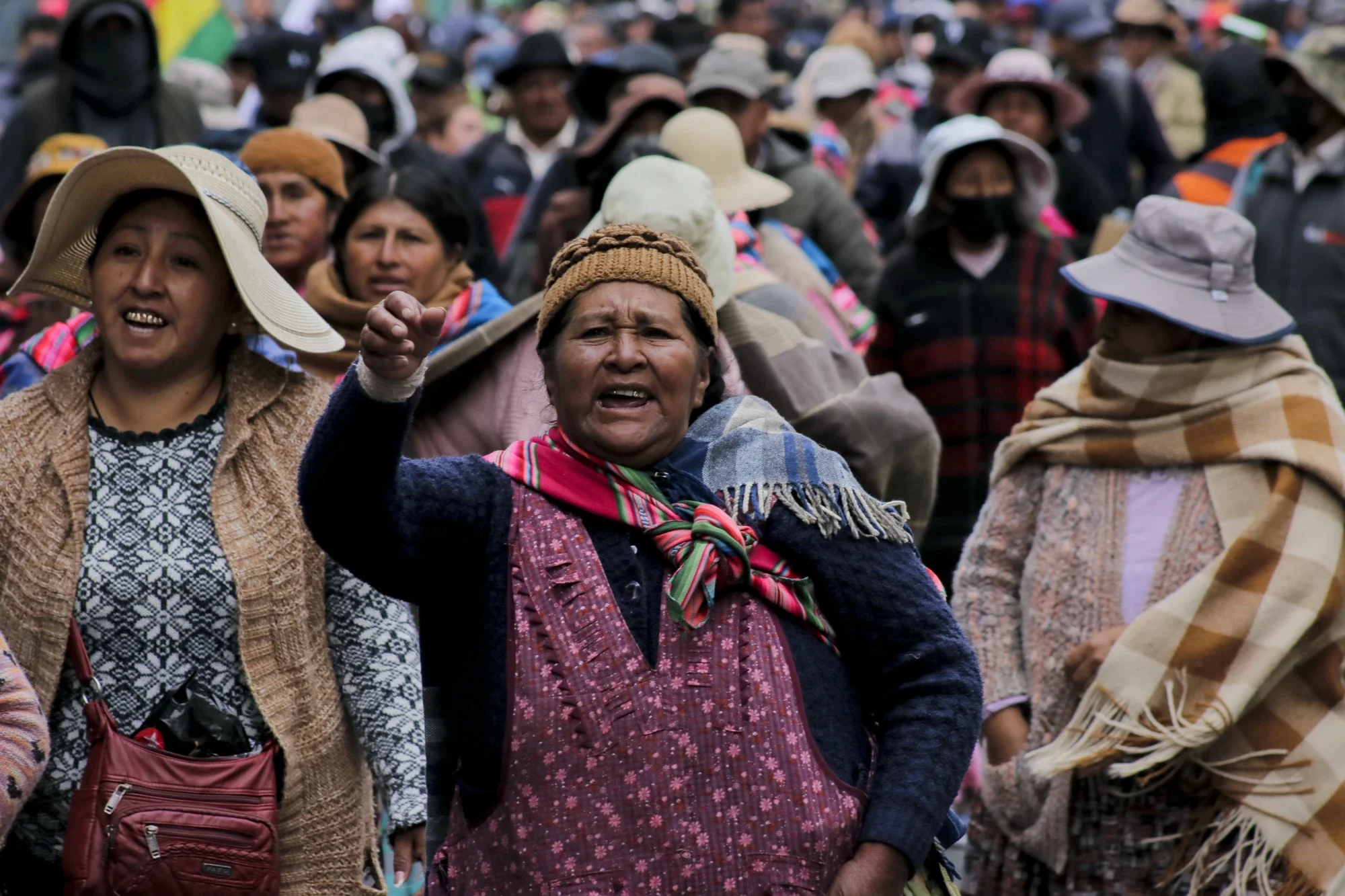
A member of the Federation of Neighborhood Councils of El Alto Sur shouts “Because of the government, we are in the streets!” during a protest in downtown La Paz, Bolivia, on May 25, 2026. Photo © Josué Córtez.
Opinion • Raquel Gutiérrez Aguilar • June 4, 2026 • Leer en castellano
After a month of protests and roadblocks in Bolivia, the situation is contradictory and difficult, but there is also an opening that creates the possibility for hope. Throughout much of the month of May, social organizations have shown their ability to exercise territorial control. And, in a vague and and often unclear manner, certain strands of political autonomy are emerging, reorganizing from the grassroots up.
The Aymara-led siege of the city of La Paz is a show of strength. But food shortages are suffocating a significant portion of the population, and conflicts and fractures are beginning to emerge between those who are blocking roads and those who reject the continuation of these direct protest measures.
As Aymara thinker Quya Reyna points out, this mobilization has not managed to produce a strategic political coordination among different social sectors, as occurred during the most powerful uprisings in Bolivia at the beginning of the 20th century.
Instead, the general mood—especially in La Paz and Cochabamba—is one of intense frustration and deprivation, given the scarcity of food and soaring costs, as well as the limited availability of fuel.
Resignation, or political change?
On Monday, June 1, much to the despair of President Rodrigo Paz and his inner circle, more than 100 roadblocks continued to be reported across western and central Bolivia, including in the departments of La Paz, Oruro, and Potosí, as well as Cochabamba and Chuquisaca.
Protesters have continuously demanded Paz’s resignation as a condition for ending the protests. They’ve ignored the government’s calls for dialogue and, instead, organized large-scale assemblies at roadblocks and at the headquarters of different organizations over the last week.
Conflicts have flared at certain roadblocks in places like Tipuani and Caranavi— where gold-mining cooperatives are active in the Yungas region of La Paz. While small family farmers decided to continue to hold the blockade, municipal authorities, local residents, and members of mining cooperatives are pushing to reopen the roads.
Despite growing hardship, an encouraging process of political revitalization from below is being painstakingly advanced after the long years of subjugation, clientelism, and co-optation that characterized the relationship between the Movement Toward Socialism (MAS) government and social organizations.
The revival of grassroots deliberation allows for independent political decisions and can lead to agreements among groups by evening out differences. Younger people are once again training in the art of political organizing and strategic thinking, learning to balance individual interests with broader collective needs and desires.
This core political capacity is regaining strength in Bolivia, though it is also facing the growing threat of militarization and a deepening economic crisis.
On Sunday, May 31, after many difficulties, an expanded meeting of the Bolivian Workers’ Confederation—which brings together a significant segment of the protesters—was convened. Their decision ratified that Paz must “step aside” so that the siege of La Paz and road blockades could end.
Should he resign, what comes next remains shrouded in uncertainty. There is a complex web of interests competing for sector-specific deals and vague partisan agreements. This is particularly true of the mining cooperatives, which since mid-May have secured even more permissive concessions for their predatory activities.
Nor is it clear to anyone what will happen if Vice President Edmand Lara ends up taking over as president. Who will he ally himself with, and on what terms? Could the result be an even more inexperienced and incompetent government?
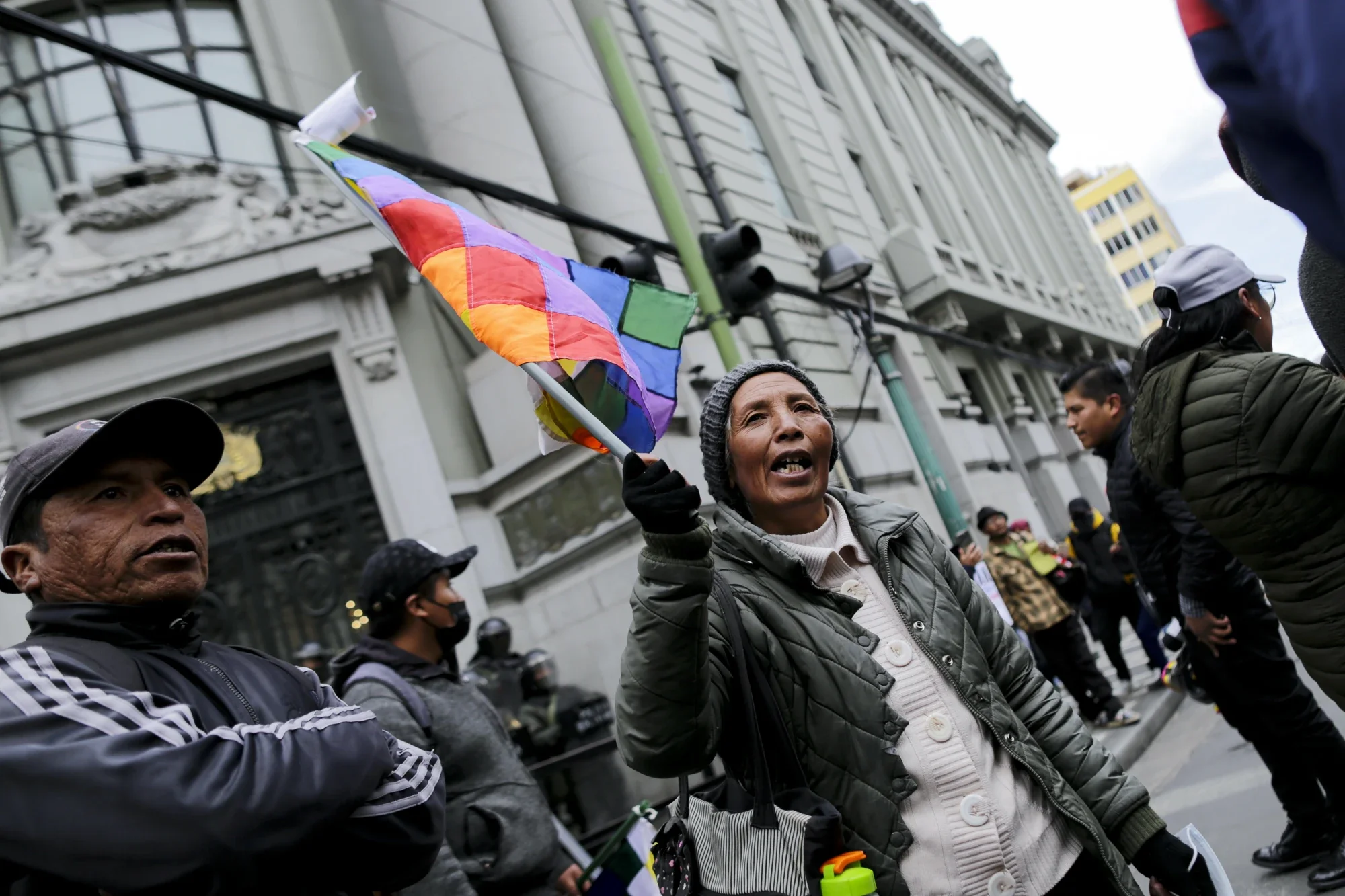
A woman waves a wiphala, an Indigenous flag, in front of a riot police line near the Office of the Vice President in La Paz, Bolivia, while shouting slogans alongside self-organized protesters demanding the resignation of President Rodrigo Paz on May 25, 2026. Photo © Josué Córtez.
Fanning the flames
Over the past week the government and the Bolivian elites who are members of the Legislative Assembly decided to gear up for repression.
On May 27, which is Mother’s Day in Bolivia, thousands of rural women, working class women, and women from low-income neighborhoods in La Paz held a mass demonstration. The same day, the government enacted the repeal of Law 1341, which previously curtailed the executive's authority to declare a “state of emergency.” That law established that in cases of serious injury or death resulting from police or military repression, members of the armed forces could not evade responsibility by appealing to their duty to obey.
This decision was akin to pouring gasoline on the fire. What was intended to be a mechanism to neutralize the continuation of the protests—which were now threatened by the possibility of widespread repression—ended up being a new reason to demand Paz’s resignation.
An Aymara show of force
Without a doubt, the most robust energy behind the diverse and heterodox blockades and the siege of La Paz has come from the campesinxs from the 20 provinces of La Paz and the Ponchos Rojos.
Historically, in the provinces surrounding Lake Titicaca, the wearing of red ponchos and the name “Ponchos Rojos” have symbolized readiness for action among members of the Aymara nation.
During several years the Ponchos Rojos formed an alliance with the MAS, aligning themselves with its political practices. But in the 2025 national elections they cast their votes behind Rodrigo Paz and Edmand Lara, votes that were crucial to the current government’s victory.
With the non-negotiable demand for Paz’s resignation on the table, some of the deeper implications of these difficult weeks of struggle are beginning to emerge.
David Mamani, a leader of the Executive Committee of the La Paz Campesino’ Federation-Tupak Katari, explained in an interview with journalist Laura Quispe from the YouTube channel teleSISA that they are seeking to “rebuild another economic model” beyond extractivism.
Mamani pointed out that the progressive phase of the plurinational state failed to implement an economic model that went beyond extractivism. He insisted that this is what they intend to discuss now, without going into details.
For that reason, his organization aims to “rebuild the plurinational state” that right-wing groups want to erase. Mamani emphatically states that “we will not allow a republican reconstruction” that eliminates social rights while favoring the traditional landowner class and transnational corporations.
Williams Colque, a leader from the Salar de Coipasa in the department of Oruro, noted in an interview with the same outlet that in previous years “Indigenous peoples emerged as political actors capable of enshrining collective rights in the constitution.”
That is what is at stake, according to Colque, which is why this major show of force against the Paz government was necessary. In line with Mamani, Colque argued that today’s “dispute is over the economic model of the plurinational state,” clarifying that Indigenous peoples must take part in broader decisions regarding the state and economic policies.
Mobilized campesinos must open a discussion on how to “rebuild a development plan that is no longer extractivist,” in Colque’s words, and avoid one that creates only “sacrifice zones.”
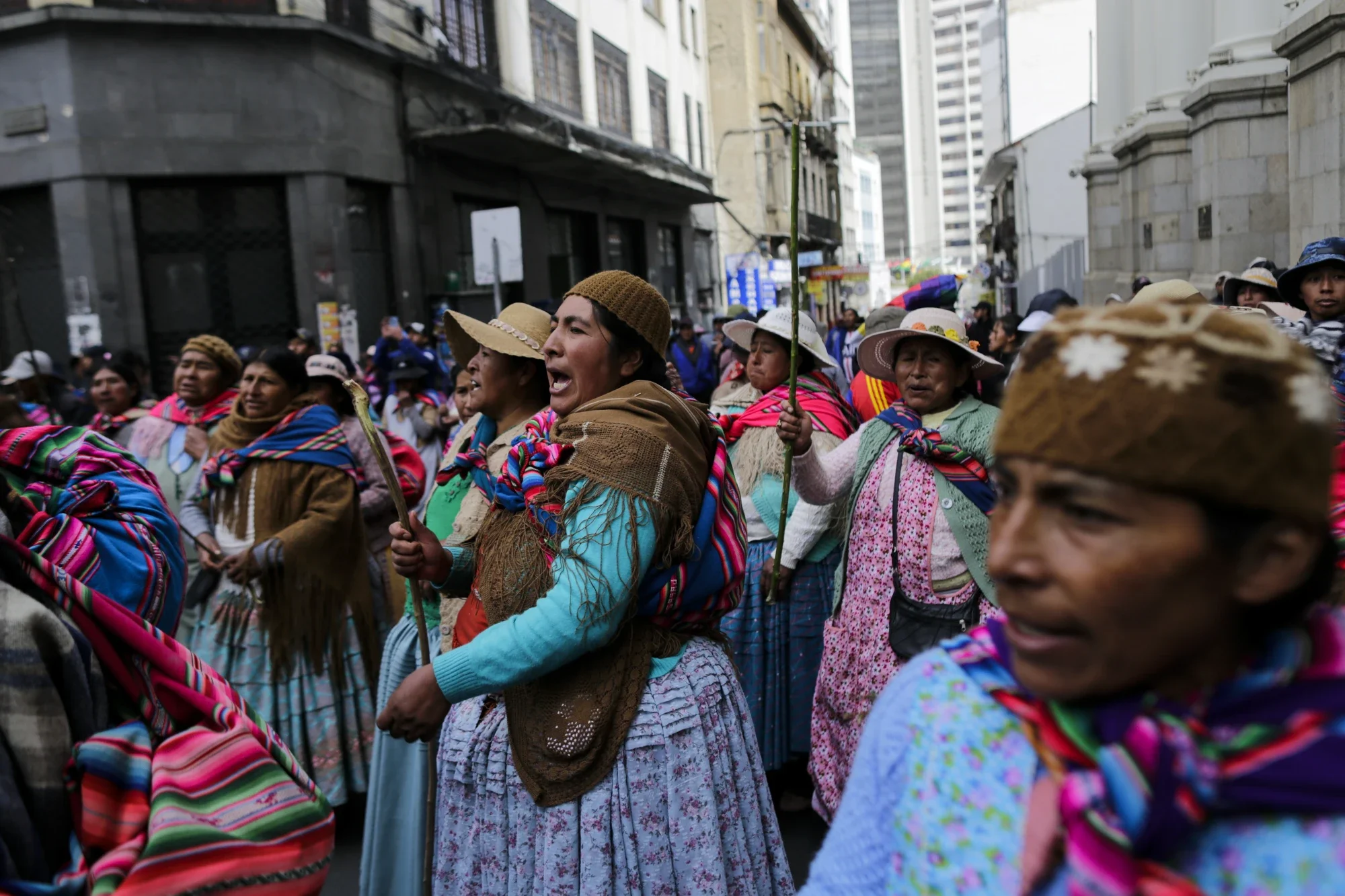
A group of women chant the slogan “The people united will never be defeated!” during a protest near Plaza Murillo in La Paz, Bolivia, on May 25, 2026. Photo © Josué Córtez.
Legislative maneuvers
It seemed that by Monday, June 1, the political elites were beginning to realize that there would be no resolution until Paz stepped down. But they continue to refuse to acknowledge the power in the streets and the country roads, and remain unwilling to follow the constitutional order of succession in the executive branch. This process, in the event of Paz’s ouster, would place Vice President Lara as Bolivia’s new president.
Congressman Carlos Alarcón, of the National Unity Party, proposed holding a recall referendum so that the country's political fate is decided “at the ballot box, not in the streets.”
But this would be unconstitutional because, by law, the mechanism for holding a recall referendum can only be activated during the second half of a president’s term. Paz has been in office for just over six months of his five-year term.
Alarcón’s proposal did open another line of debate, this time within parliament. Some, like Tuto Quiroga, the far-right candidate who lost to Paz in the last general election, are calling for a state of emergency and demanding the militarization of the country to “pacify” the defiance of the lower classes.
Others, like Juan del Granado, former mayor of La Paz and a centrist political figure, insist on a process of dialogue mediated by the Catholic Church. For his part, congressman Alarcón and several others—including Andrónico Rodríguez, a coca grower leader who also ran for president in the last elections—are insisting on amending the rules to launch an early recall referendum.
The immense dispute over Bolivia’s fate remains unresolved.
But the question of moving toward a change in the economic model, abandoning extractivism, and reorganizing productive life by once again harnessing the political capacities of the grassroots without party intermediation is, without a doubt, a much needed intervention in Latin America today.