

Popular uprising sets hard limits on Bolivian government
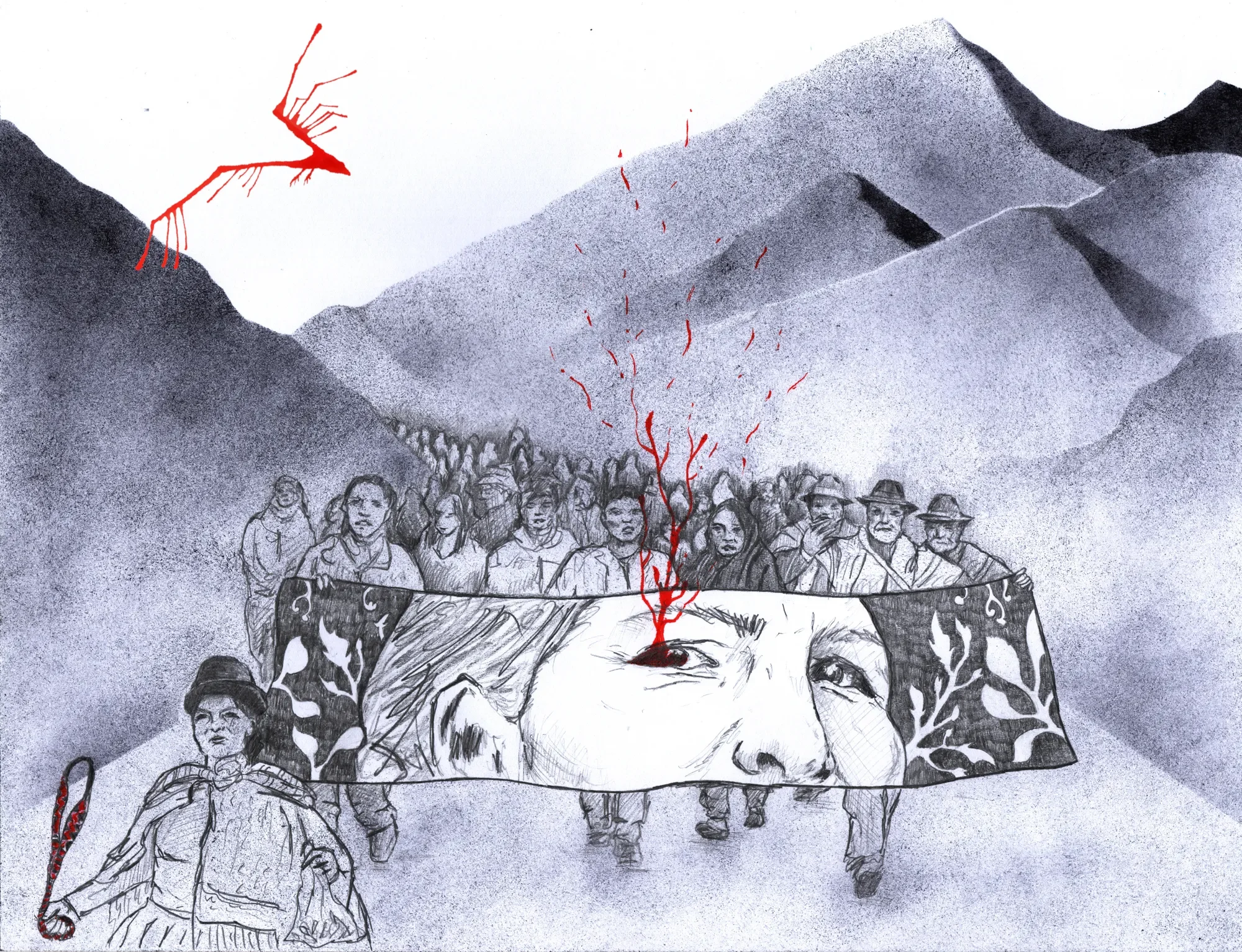
Kuntur. Original art for Ojalá in stencil, pencil drawing, and blown ink © @su.tura.
Opinion • Huáscar Salazar Lohman • May 29, 2026 • Leer en castellano
Bolivia is experiencing a period of unrest, tension, and exhaustion. There are more than 50 active roadblocks across the country; shortages have been reported in several cities. At least six people have died in connection with the protests—some due to state repression, others due to roadblocks—dozens more have been injured, and almost 90 arrested.
The first part of the protest began on April 8, when an Indigenous and peasant march left Porvenir, in the lowland province of Pando, toward the capital, La Paz. The initial protest was against land privatization Law 1720, and it the march kicked off the same day the law was enacted by President Rodrigo Paz.
On May 1, the Bolivian Workers’ Union called a general strike, and the demands of protesters broadened to include opposition to Paz’s economic package and fuel shortages.
On May 13, the government relented, repealing Law 1720, but the fire had already been lit. The lowland marchers disbanded, but roadblocks remained and began to intensify as demands for the president’s resignation gained traction.
On May 18, violent clashes took place in the city of La Paz, and arrest warrants were issued against the leaders of some of the mobilized organizations. On the 24th, an operation involving nearly 3,000 troops in Calamarca left at least one protester dead from a gunshot wound. And there has yet to be dialogue.
The question raised by these weeks of protests and blockades is whether Paz, after a mere six months in office, will stay or go.
There are compelling reasons why this has become the rallying cry. But as the uprising is framed by this dilemma, the crisis drags on.
In this context, it is important to recognize that what these protests have brought to the table goes beyond Paz’s resignation.
Today, the mobilizations align intermittently and in flux, having failed to coalesce into a unified movement. Collectively, they have set a limit from below around what the Bolivian state can and cannot do.
Bolivia’s working class has been bearing the brunt of a deepening crisis for at least three years. Skyward inflation, the scarcity of dollars, and chronic fuel shortages have led to a severe deterioration in living conditions.
The current crisis is rooted in the exhaustion of the primary-export model that sustained the gas boom from 2005 to 2014, and which serves as the backdrop for Bolivia’s current juncture. The protracted nature of this uprising is due, in large measure, to the Paz government’s handling of the situation.
Grounds for legitimate outrage
During his election campaign, Paz promised to look out for working-class communities, including maintaining public transport subsidies. In practice, he did the opposite, implementingneoliberal economic reforms and shifting heavy cost burdens onto the most vulnerable. In doing so, he failed to alleviate even the most pressing problems.
The most illustrative case is that of fuel. As the government raised prices, lines at the pumps continued. To make matters worse, the importation of lower-quality gasoline damaged thousands of vehicles.
Shortly after taking office in December 2025, Paz launched a series of economic measures to benefit the banking sector, agribusiness, and private and cooperative mining.
Supreme Decree No. 5503 hiked fuel prices and included 100 provisions ceding foreign control over strategic resources. It also liberalized agro-industrial exports and granted extraordinary tax benefits to big business.
Next came Law 1720, which aimed to convert small agricultural properties, constitutionally exempt from seizure, into medium-sized properties that could be bought and sold as financial assets. This last measure is what triggered the current cycle of protests. Minimum wage has remained frozen, and real wages continue to fall.
Then there is the President’s open display of contempt towards voters, which is by no means a minor issue. Paz won the presidential runoff with a large share of the popular vote. Many sectors voted for him in rejection of thedegraded Movement Toward Socialism (MAS) and an electoral landscape dominated by right- and far-right candidates like Samuel Doria Medina and Tuto Quiroga. His running mate, Edman Lara, played a decisive role in capturing the popular vote.
Once in power, the government of Paz released itself from that mandate, instead governing openly with the same men he had opposed at the polls.
What's more, he did so in disregard to the existence of the very sectors that had voted him in. The message he sent to voters was that their role is to obey and be grateful.
Since taking office on November 8, Paz has governed more in line with instructions from Washington and the international organizations that oversee the economic crisis, than with the urgent needs of the people that voted for him.
Systematic disregard for the working-class has compounded the impacts of austerity, and symbolically exacerbates them. Dealing with rising costs is one thing, but doing so while being told you do not exist is another.
Setting limits from the ground up
Today, the deepest issue in Bolivia is centered around the terms under which the Bolivian government—this one, or the one that comes after it—will address the economic crisis, and on the position social organizations will take with regards to power.
This turbulent moment emerges in the context of a fraying social fabric, dismantled by 20 years of progressivism that exploited and sought to dismantle social organizations, leaving a difficult legacy in its wake. That legacy includes a culture of clientelistic leadership, public policies subsumed to electoral calculations, and political horizons defined by the party rather than by the organizations themselves.
Thegeneral elections in 2025 and local elections in March 2026 made clear that a significant portion of these organizations have lost their ability to influence policy and are trapped between electoral calculations and potential alliances with both left and right parties.
These circumstances have given rise to a growing capacity for the resistance that is reemerging in new forms: less organized than in previous cycles, more reactive than proactive, and, to date, lacking unified demands.
In spite of it all, resistance exists. And it is producing tangible effects that are profoundly disrupting national politics.
Organizations are looking inward and regaining their own strength at a time when the MAS—or what remains of it—continues to see its role in mobilizing popular politics shrink.
Attempts to co-opt the uprising
The composition of this uprising—lacking in singular leadership, diverse and multifaceted, and emerging from weakened organizational frameworks—leaves no room for romantic, reductionist, or polarizing takes.
If we have learned anything from 20 years of progressivism, it is that pointing out weaknesses and naming threats is not playing into the hands of the right. Rather, it focuses attention and energy on the strength we want to protect and grow.
There is no denying thatEvo Morales and the new party organization he has built, EvoPueblo, intend to capitalize on the unrest currently sweeping Bolivia.
For their part, numerous mobilizing organizations and a significant portion of critical voices have made it clear that what drives them is not—by any means—a desire to prop up the coca-growing leader.
Morales and his followers are not interested in the government being held accountable to the demands of Bolivian society, but rather in opening, by hook or by crook, a path of return to the presidency. This could happen if the Paz government ultimately falls.
Other maneuvers to instrumentalize collective efforts have taken place by mining cooperativists in the name of the people, and have employed revolutionary veneer and rhetoric.
Over the last 20 years, this sector has been consolidated into a bourgeoisie linked to networks of foreign capital and to predatory operations in protected areas that engage in increasingly violent practices. It seized on these mobilizations to extract government concessions regarding taxes, forgiveness of debts to the social security system (as outlined in Decree 5618), and the opening of protected areas to mining.
The fact that both Morales and the gold-mining cooperatives are attempting to seize the moment confirms the importance of this uprising’s outcome. The terms of the order being imposed from below could allow, or deny, the conditions of success for their political strategies.
What lies ahead
At this point, the main achievement of the ongoing protest in Bolivia lies in the limits it has already established, whether Paz falls or not.
If Paz does not resign, new limits will circumscribe anything the executive branch might attempt. That said, there is also reason to think the cornered government will double down on its positions. It may try to divide the movement, seek to wear down social organizations over time, and intensify repression when it calculates it can do so without paying too high a political cost.
If the government falls, the incoming government will have to govern from that baseline, knowing full well how far it can go and who is willing to take to the streets to constrain it. A new, exhausting electoral circus would begin.
In both scenarios, what matters is what the people who are mobilized can sustain, while building upon what’s already been achieved.
The urgent and open question is not just about how to confront the economic crisis without pandering to the banking sector, agribusiness, and mining. We must ask how to do so while placing the reproduction of human and non-human life—which is what capital and extractivism systematically subordinates, disdains, and destroys—at the center.