

Sheinbaum’s ‘last mile’
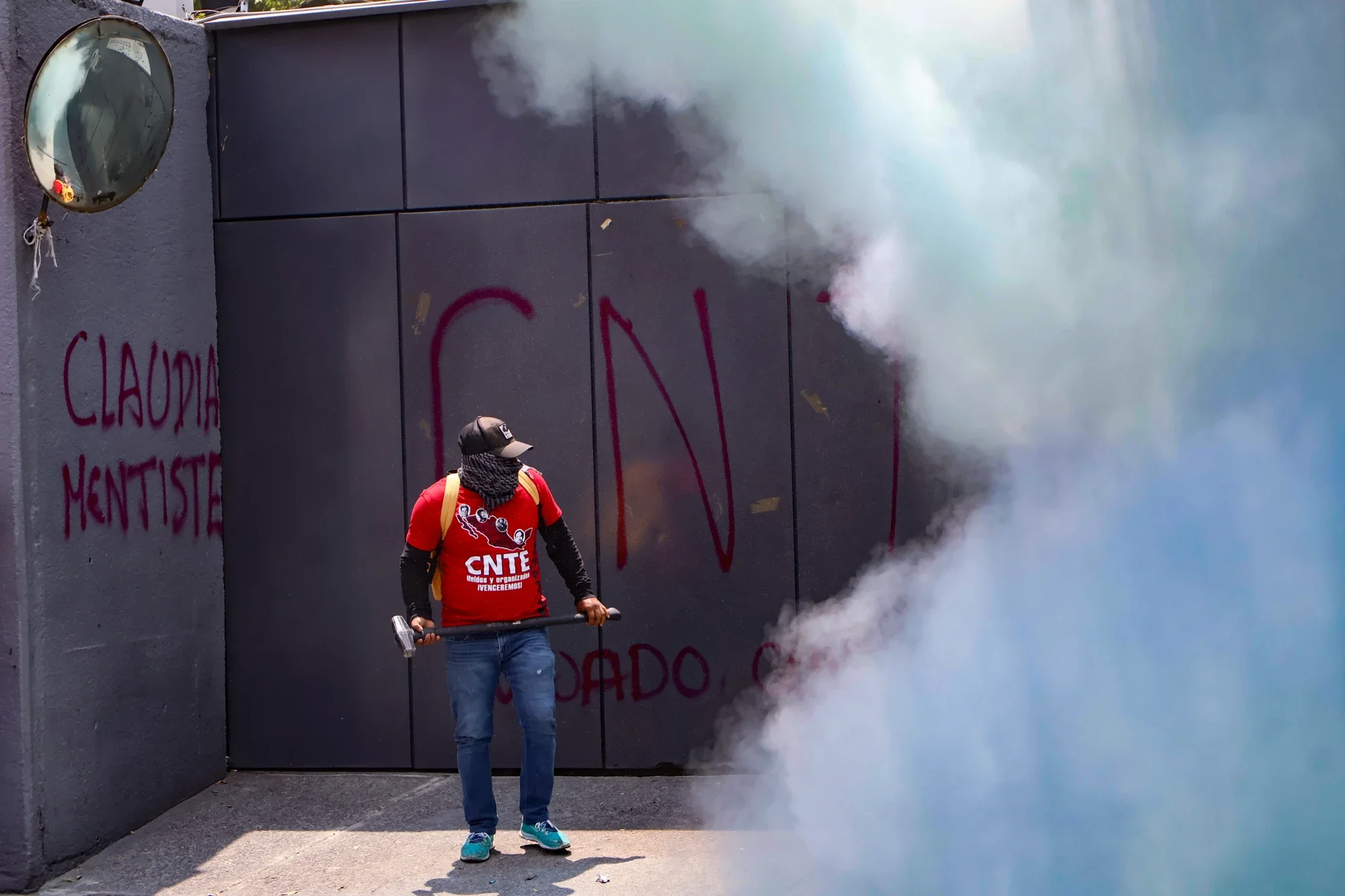
A teacher from the Guerrero State Coordination of Education Workers is gassed during a protest outside the Ministry of Public Education in Coyoacán, Mexico City, on June 3, 2026. Photo © Norberto Soto Sánchez.
Opinion • Norberto Soto Sánchez • July 10, 2026 • Leer en castellano
It’s June 11, the first day of the 2026 World Cup. Around 50,000 elementary and secondary school teachers are preparing to march in Mexico City.
Dozens of other organizations joined the cause. Our fight is for the recognition of our rights and labor justice, and in solidarity with families searching for the more than 135,000 victims of disappearance in Mexico, other demonstrators advocated for many more causes.
We were united by a shared, implicit goal: to use this sporting event to draw the world’s attention to the injustices that persist in México.
President Claudia Sheinbaum—who calls herself a progressive—continues to refuse to fulfill many of the promises that helped her win the 2024 election.
That day, we set out around 10 a.m. from the Tasqueña metro station heading toward Azteca Stadium, where the first match—Mexico against South Africa—was set to take place in a few hours.
But we never made it.
Two trucks from the Mexico City Mounted Police Unit, along with concrete barriers and a cordon of precaritized workers from various departments of the capital’s government—who were forced to mobilize under threat of being fired—blocked our path about an hour after we set out.
“This is the last mile,” government officials said.
Meanwhile, at Gate 8 of the stadium, students, anti-gentrification activists, and members of the black bloc were brutally repressed by the Mounted Police.
The night before, on June 10, we had joined another large march led by the families searching for their disappeared loved ones. It followed the same route.
That demonstration was blocked by a human chain of government workers under Mexico City’s Secretary of Government, César Cravioto.
The governments of the nation’s capital and the republic are both led by the National Regeneration Movement party—which claims to be center-left. But they planned a police and military security operation involving nearly 100,000 law enforcement officers, which they dubbed “Plan Kukulkán.”
Under no circumstances could the World Cup’s opening match be marred by protests against the government of so-called Mexican humanism.
Smear campaigns and riot shields
At the same time as the demonstrations were repressed, a campaign of stigmatization and criminalization was launched. This was aimed primarily against education workers engaged in protests, teacher-training students—notably those from Ayotzinapa—and families searching for their disappeared loved ones.
The president accused them of acting like “the far-right,” while the federal Secretary of the Interior, Rosa Icela Rodríguez, threatened searching families with police investigations.
Rodríguez is the head of an agency that has historically been responsible for political espionage, staging false incidents, intelligence, and counter-insurgency. She claimed the government had information indicating protestors had received funding to travel to the city.
Any and all protests were deemed right-wing, viewed with suspicion, and treated as though they were driven by shadowy interests, not legitimate demands.
According to this logic, being a leftist would mean supporting efforts to project a positive image of the country during the tournament, regardless of whether that meant remaining silent in the face of the calamities imposed by financial capital and war throughout the country.
A world turned upside down.
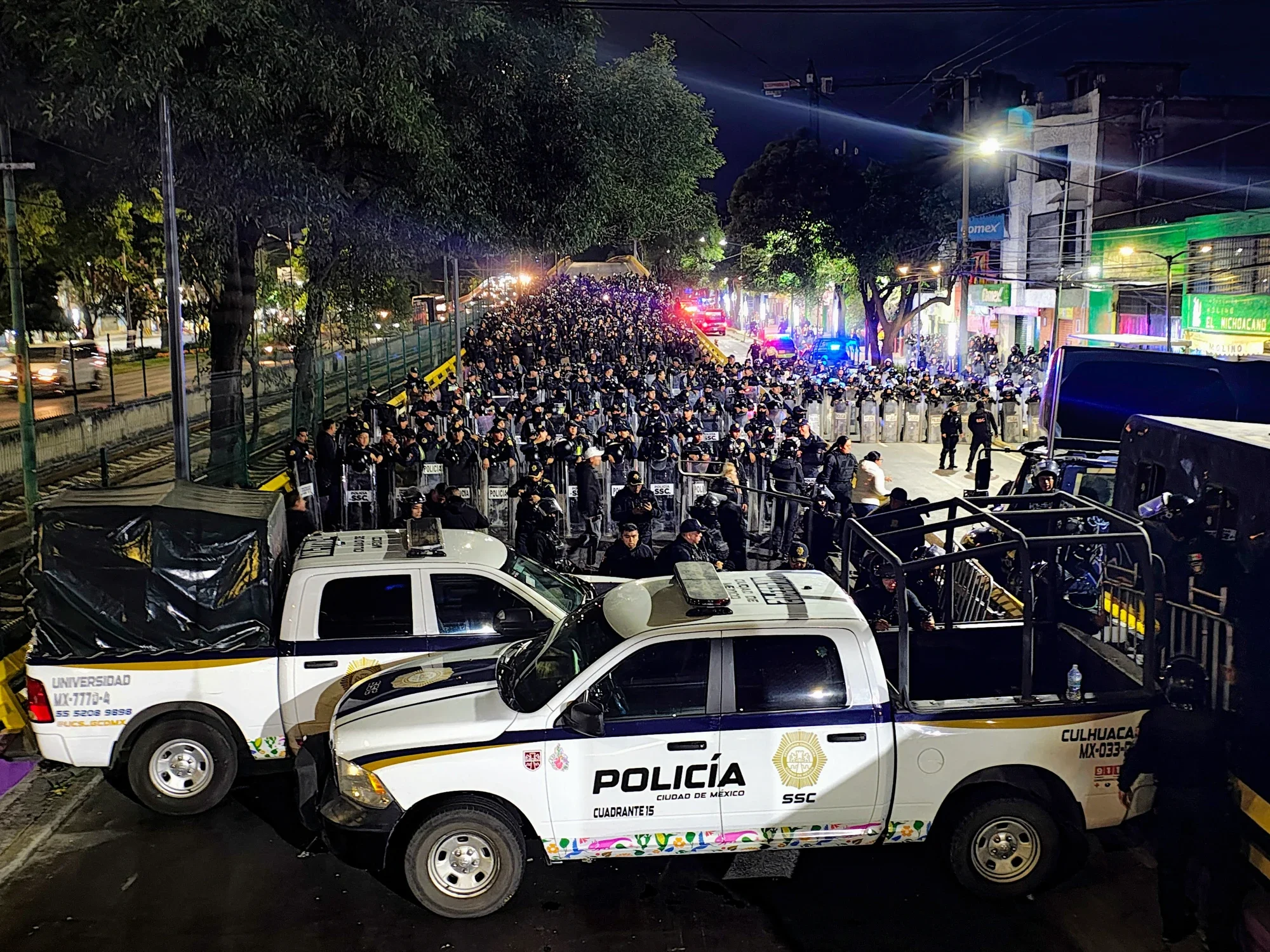
Mexico City police block families searching for victims of disappearance, solidarity groups and CNTE teachers near the entrance to Azteca Stadium on June 10, 2026. Photo © Norberto Soto Sánchez.
Mobilized teachers come together
By inauguration day, teachers from almost every state in Mexico had been camping out on the streets of Mexico City’s downtown for over 10 days. The education workers who initially converged in the city were from states that achieved unanimous participation, including Oaxaca, Guerrero, Chiapas, and Zacatecas. In other states, the strike was more limited.
Hundreds of government workers joined the teachers’ encampment and the protests. I am an administrative worker at the Ministry of Public Education (SEP), where my employment status is not formally recognized; which means I have no formal labor rights.
We work under a contractual sham known as “professional honoraria,” which allows the government to fire workers without just cause and denies us access to social security and benefits. Although many workers were unable to organize work stoppages due to a lack of organization, we did stay overnight and march shoulder to shoulder with the teachers.
The teachers’ strike, which lasted until June 20, came together around several objectives, key among them the repeal of two laws: the 2007 ISSSTE Law and the 2013 education reform.
The most harmful elements of the education reform include the mandatory nature of evaluation processes in the hiring, promotion, and recognition of teachers, which are applied according to discretionary administrative criteria.
This is compounded by the increasingly acute overexploitation of teachers. Teachers are working longer and longer hours, often exceeding their scheduled work time. These hours go unrecognized and, of course, are unpaid.
The continued enforcement of both laws constitutes what researchers have labeled the “neoliberal continuity” of the self-proclaimed Fourth Transformation, which began in 2018 with Andrés Manuel López Obrador’s presidency.
The organization spearheading the cycle of protests by teachers during the World Cup was the National Coordination of Education Workers (CNTE).
Founded in September 1979, the CNTE is the dissident, democratic faction of the National Union of Education Workers (SNTE), which was founded in December 1943.
Initially, the SNTE defended the rights of its members. Over time, though, it gave rise to educational fiefdoms, and its leadership subordinated itself to the interests of the SEP, which is to say, to the federal government.
The CNTE is an organization that has advocated for an education system that serves working-class and Indigenous people. Throughout its history, too many of the teachers who have joined its ranks have been killed in acts of repression.
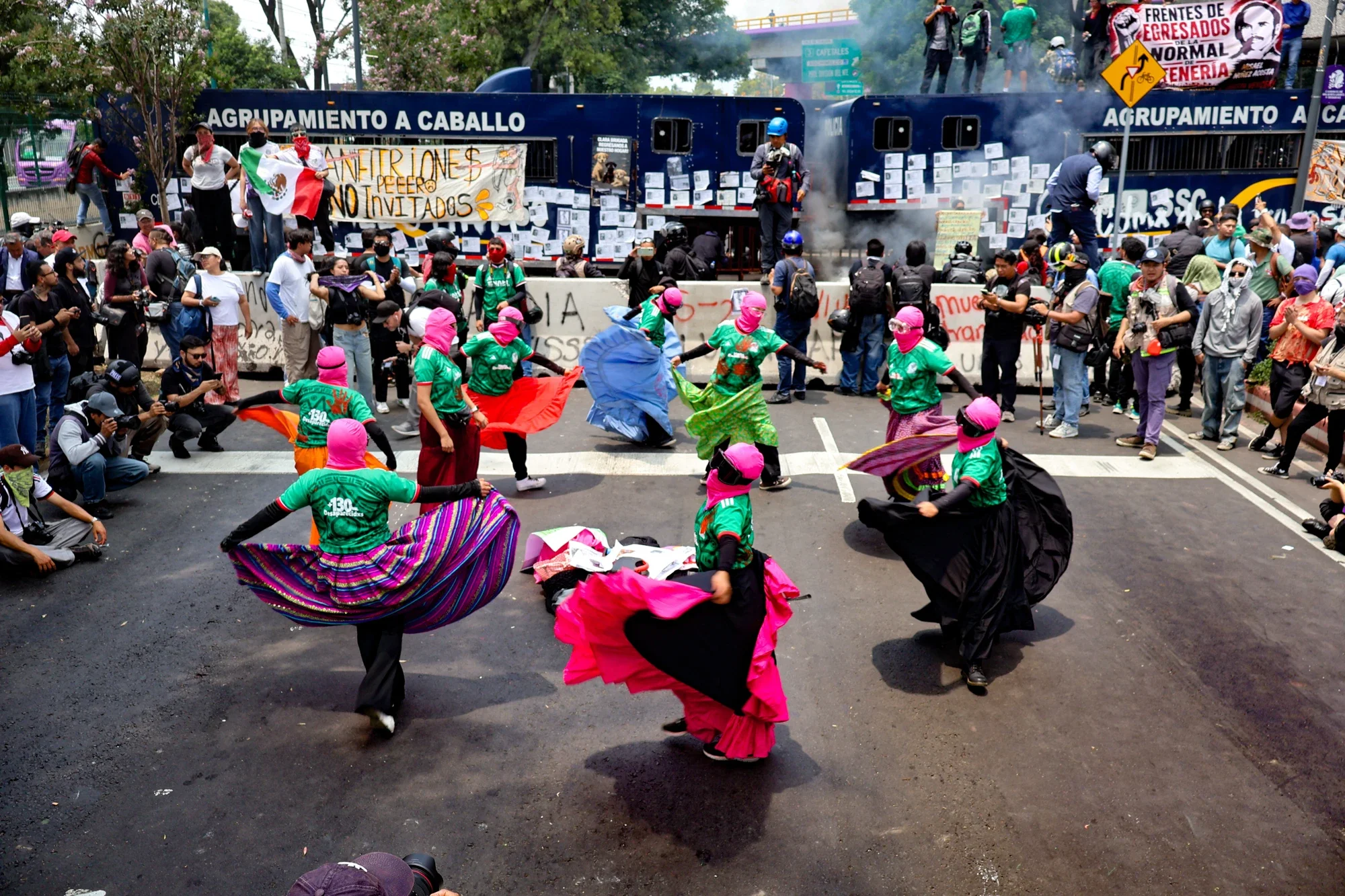
CNTE teachers, collectives fighting against gentrification, animal rights activists, and families searching for their loved ones were blocked by Mexico City Mounted Police trucks on Calzada de Tlalpan on June 11, 2026. Photo © Norberto Soto Sánchez.
A pension-destroying maze
Teachers are enrolled in the Institute for Social Security and Services for State Workers (ISSSTE), and their retirement benefits and pensions are governed by ISSSTE regulations.
In 2007, the right-wing government of Felipe Calderón Hinojosa put forward a reform to the ISSSTE Law that established a pension system based on “individual accounts.”
This created a model in which teachers’ pensions depend on the savings they accrue in their Retirement Fund Savings Account (AFORE), provided they complete 28 years of service for women and 30 years for men, among other criteria.
The main issue with this pension system is that it does not guarantee a comfortable retirement. When a teacher finally retires, they receive a pension that is 70 percent less than their original salary, which is meager to begin with. At the same time, banks make millions by managing those funds.
The problem is so serious, and the 2007 ISSSTE Law so unjust, that both López Obrador and Sheinbaum promised to repeal it. Sheinbaum even included its cancellation in the first version of her 100 commitments for transformation.
One of the main slogans chanted by the CNTE teachers during World Cup protests was: “Claudia, you lied about the ISSSTE law reform, and we all know it!”
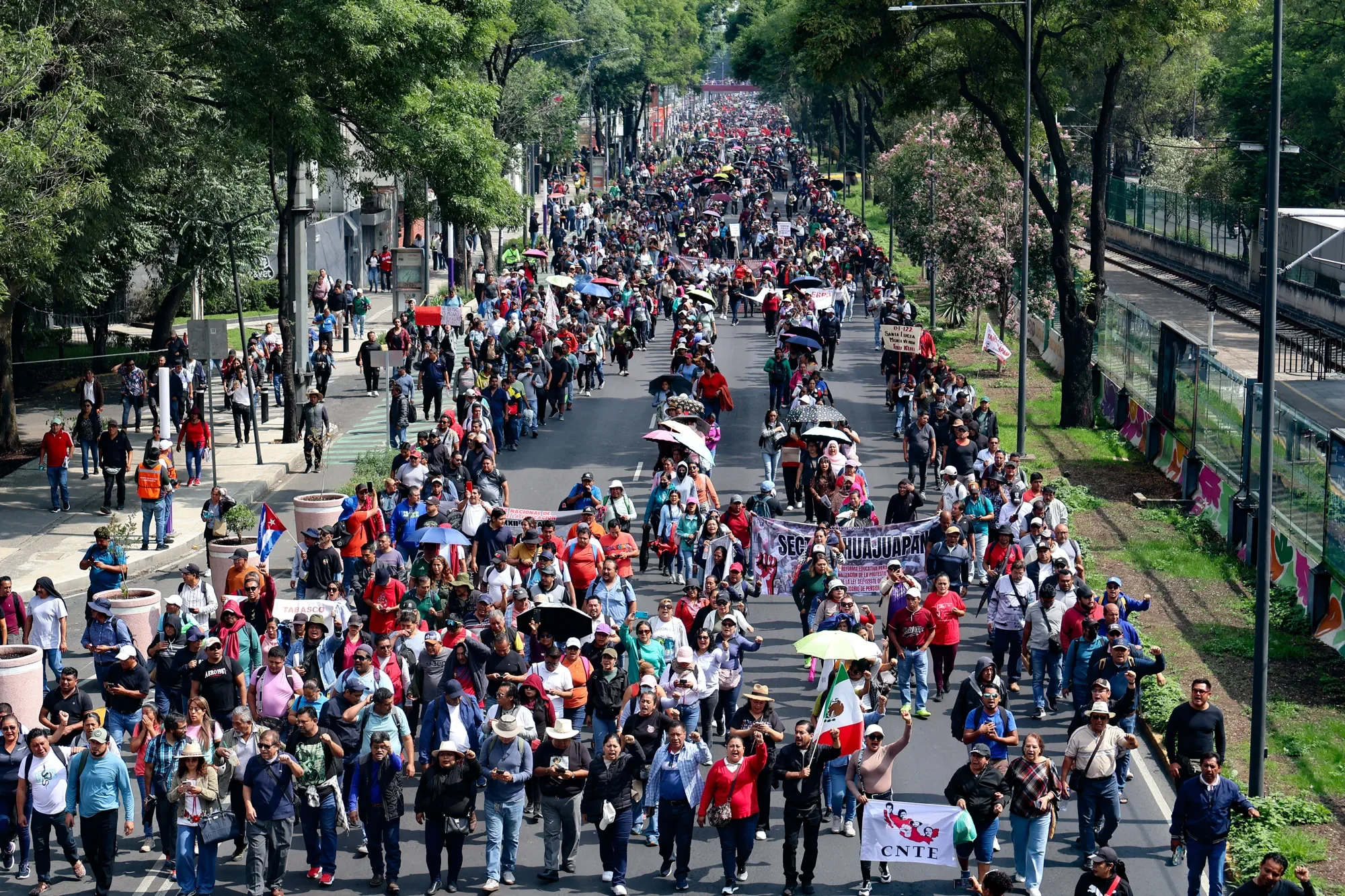
Tens of thousands of CNTE teachers marched along Calzada de Tlalpan toward Azteca Stadium to protest in the hours before the opening ceremony of the 2026 World Cup in Mexico City on June 11, 2026. Photo © Norberto Soto Sánchez.
What remains after the World Cup
These days of protest did not lead to the laws in question being repealed. Nor were we able to secure a tangible commitment to truth, justice, and the safe return of more than 130,000 victims of disappearance.
What we did achieve was the exposure of the limitations and hypocrisy of the governments of the Fourth Transformation, and the way said governments have bowed down to big finance and promoted impunity.
On June 28, as part of International LGBTQIA+ Pride Day and following a tactical hiatus called by the CNTE, some groups involved in the protests joined an anti-capitalist pride counter-march. Their demands were united in opposition to the government-organized pride march held in collaboration with commercial brands.
The searching families organized demonstrations and scrimmages during every Mexican national team match to demand truth, justice, and the safe return of their loved ones.
They made no exception on July 5, when Mexico was eliminated by England. At the end of the “World Cup party,” in the empty stands of the Azteca Stadium, the fact that football matches cannot mitigate the humanitarian emergency we’re living through—not even for those of us who are football fans —was laid bare.
No amount of excitement from FIFA’s “fan fests” could drown out the cry that families raised that day on Reforma Avenue: “Mexico is the champion of enforced disappearances.”