

Puebla residents push back against ecocide
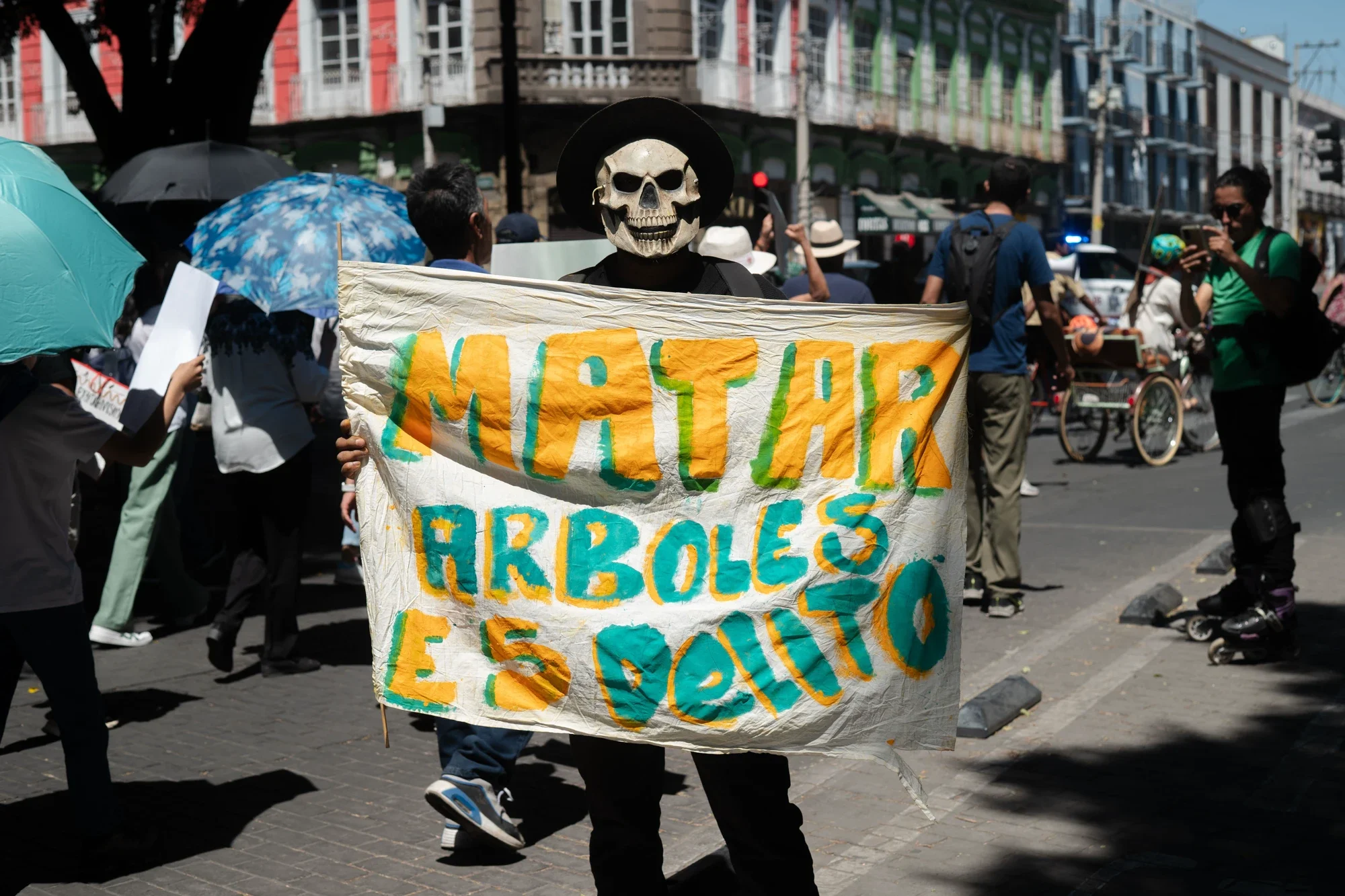
A masked protester holds a banner reading “Killing trees is a crime” during a march against the proposed Cablebús in Puebla, Mexico, on March 1, 2026. Photo © Daniel Chazari.
Opinion • Verónica Barreda • May 7, 2026 • Leer en castellano
Over the past three months, residents and community organizations in Puebla, Mexico, have voiced sustained opposition to a proposed cable car transit system. The project, known as Cablebús, is being pushed forward by the state government despite public resistance and threats to the city’s already scarce green areas.
According to information compiled by local organizations, the proposed Cablebús stations are to be located in areas with the highest tree density in Puebla’s metropolitan area. This would involve tree removal and potential damage to infrastructure in public parks, schools, greenbelts, sports fields, recreational areas, and Amalucan Hill, an ecological reserve east of the city.
Opposition to the Cablebús, which is voiced by residents, public park-goers, athletes, students, environmentalists, and academics, is not only about the environmental impact. Puebla is facing a mobility crisis that the Cablebús would fail to solve.
Those of us who are daily users of public transport deal with accidents, theft, long journeys, a lack of vehicles, poor service, overcrowding, and excessive wait times.
In February, the state government began inspecting vehicles operated by transportation contractors. Some of these vehicles had been operating uninspected for up to 10 years. A significant number of them failed to meet standards, reducing the number of buses and transport vans from 34,000 to 21,000. This reduction caused further delays and overcrowding in public transportation, the state government has yet to adequately address the issue.
In addition, the city’s transportation systems—such as the Urban Articulated Transport Network (RUTA), a bus rapid transit network; the Puebla-Cholula train; and the bike-sharing system—have been abandoned or left to fall into disrepair.
It is in this context that the state government, led by Governor Alejandro Armenta from the ruling party, the National Regeneration Movement (Morena), announced the start of construction on the Cablebús with an investment of $391.8 million, the largest investment in public transport in Puebla in decades.
According to statements made by state officials, there will be no investment in existing transport, with all new funds going toward the Cablebús.
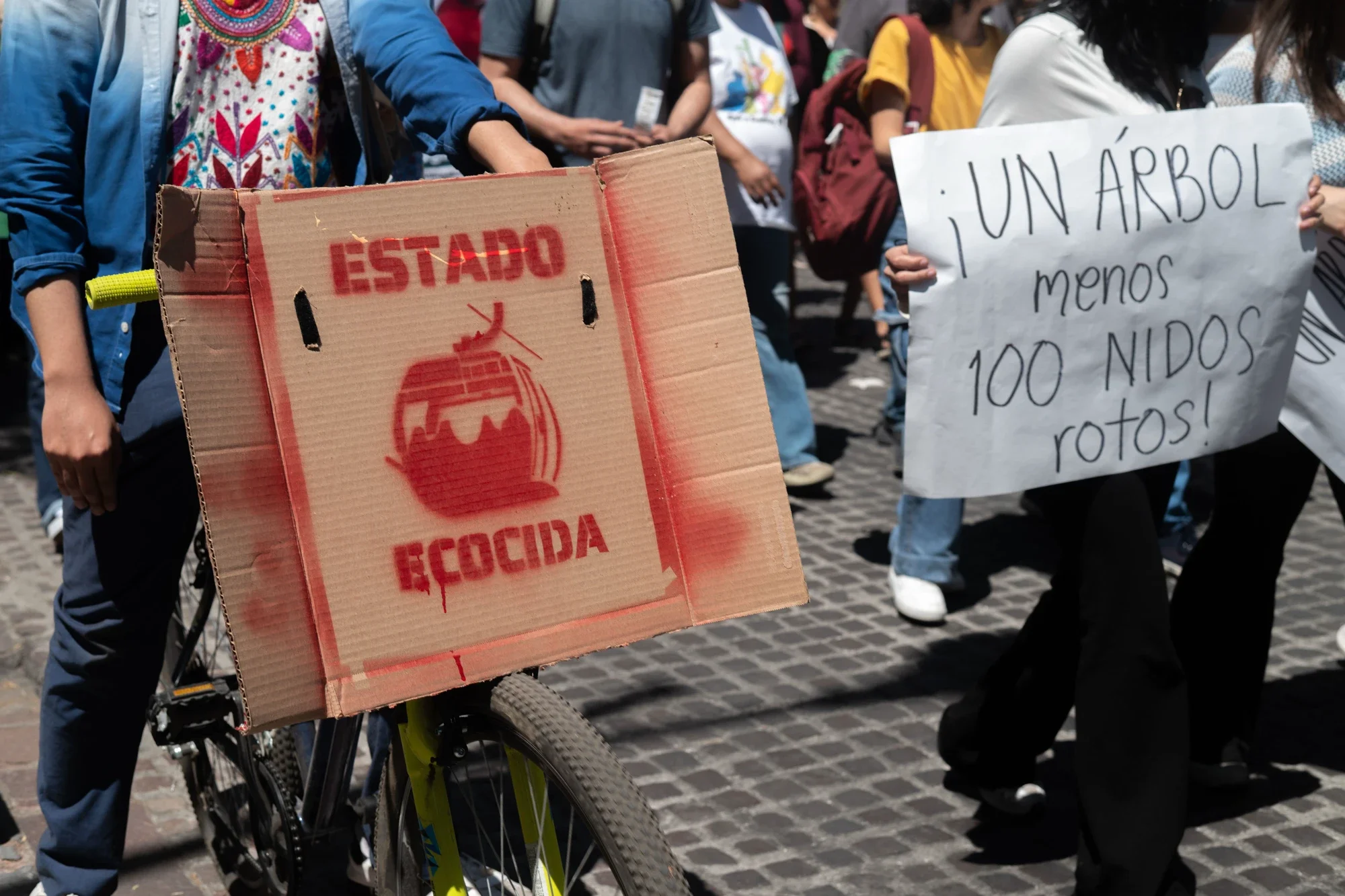
Signs reading “Ecocidal State” and “One less tree, 100 broken nests” during a march against the proposed Cablebús cable car in Puebla, Mexico, on March 1, 2026. Photo © Daniel Chazari.
A murky project
The contract to build the cable car system in Puebla was awarded to Doppelmayr in November 2025, completion is scheduled for 2029. The Austrian-Swiss conglomerate entered the Mexican market in 2005 amid a boom in urban mobility with a focus on tourism.
In 2021, the company completed Line 1 of the cable car system in Mexico City, which allows for easier travel in mountainous areas due to their complex terrain or the presence of physical barriers that make bus travel impossible. There, it works as a viable form of public transportation.
In Puebla, the Cablebús does not appear to be integrated with existing transportation systems. On the contrary, its service area overlaps with the RUTA, and its lines do not meet the needs of geographically complex areas or the needs of users.
No official technical planning studies are known to exist. Nor is there an origin-destination study or an Environmental Impact Statement. Not only that, but there was no public consultation, and a dozen other studies required to build such a project have been classified.
The Urban Charter, a planning document in Puebla, forbids the construction of overhead transport systems in parks. Puebla’s mayor, José Chedraui, also of Morena, has announced that the regulation will be amended so that the Cablebús can be built.
Public concern in Puebla intensified in February after the head of the State Infrastructure Secretariat, José Manuel Contreras de los Santos, revealed that the cable car would directly threaten 980 trees located in four parks and green spaces in the state capital.
On February 20, a small group of people gathered in Benito Juárez Park—a wooded area on the outskirts of the historic downtown threatened by the cable car’s construction—marking the first protest. Various social media accounts were launched to organize and share information about the project, information the state government has kept strictly under wraps.
Technical information about the project has been classified for five years—a period coinciding with the governor’s term in office—on the grounds that its disclosure could harm the state’s interests.
Three further mass demonstrations were called by park-goers, residents, and academics in March, giving shape to the movement against the imposition of the Cablebús and accusing the government of ecocide and environmental degradation.
Working groups were also organized at the request of collectives and residents to gather information on the project. Requests for information were made, signatures were collected, complaints were filed, and two injunctions were filed by neighborhood residents and parkgoers.
Organizers have already faced harassment. In March, for example, park staff interrupted recreational and informational activities under the pretext of conducting an inspection.
On March 3, Armenta dismissed accusations from the public, urging those opposing the Cablebús to demonstrate its environmental impact—an absurd demand given the lack of information.
Similarly, through various media outlets, the governor has emphasized that there is no cause for concern. The cable car, he says, is a sustainable solution to address carbon emissions in the city.
The government used state funds to pay influencers to spread a counter-narrative on social media, primarily TikTok and Instagram. It accused opponents of the project of being paid bots, claiming the accounts criticizing the project are located outside the country.
In a statement released on April 14, the Benemérita Universidad Autónoma de Puebla expressed support for the project as a sustainable alternative following a “careful analysis of the proposal.” It should be noted that the proposal was never presented, because the project’s technical information has been withheld.
The state government’s response to opposition to the project was, initially, to publicly reduce the number of affected trees from 980 to 560, and subsequently to 350.
Recently, the number of trees slated for relocation or pruning has been reduced to 97, in addition to a reforestation plan that would involve planting 10,000 new trees—ignoring the ecological role of these trees in their habitats and reducing them solely to numbers, in an act that the public has characterized as ecocide.
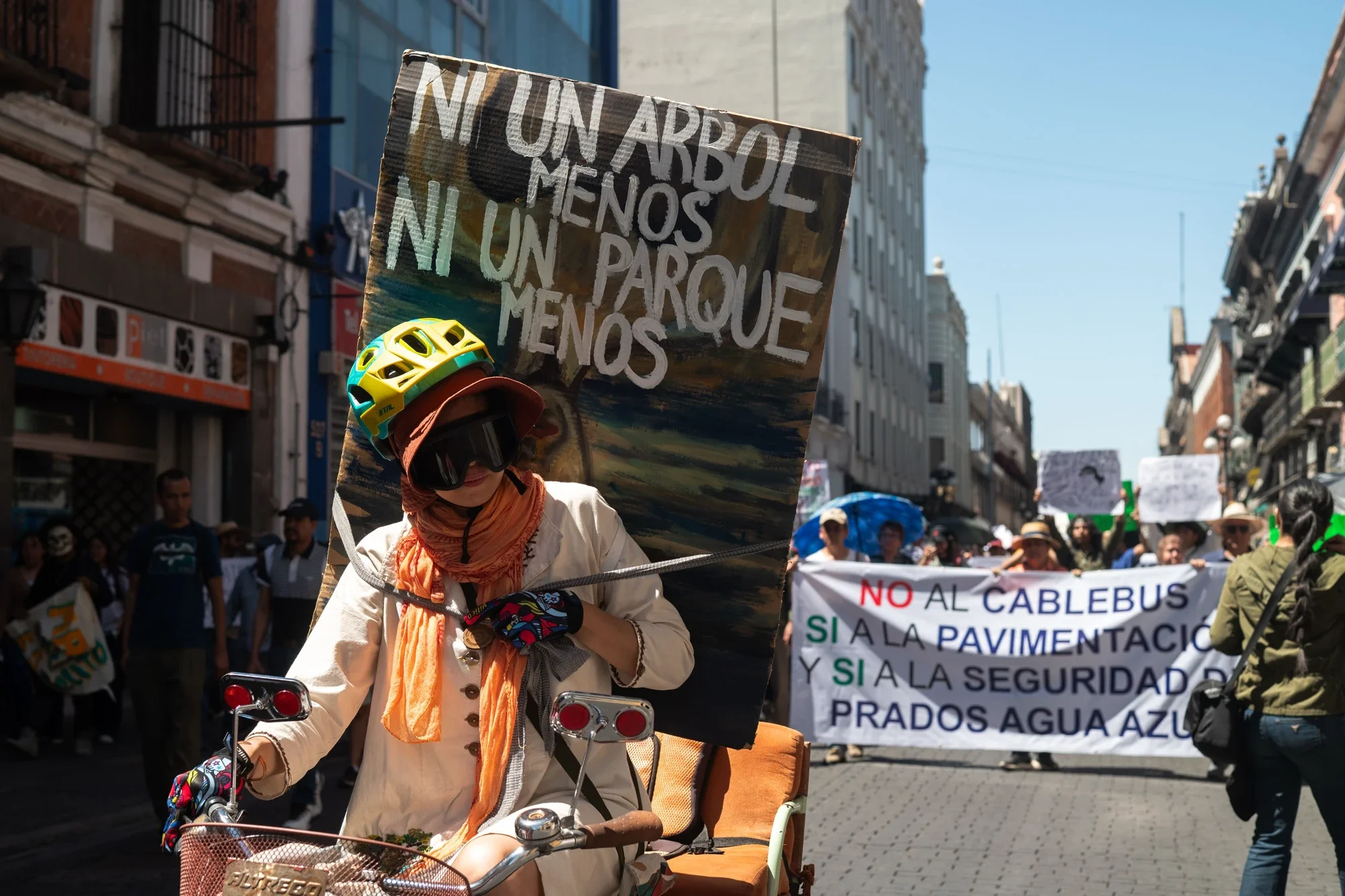
A woman on a bicycle with the slogan “Not one less tree, not one less park” during a march against the proposed Cablebús in Puebla, Mexico, on March 1, 2026. Photo © Daniel Chazari.
Resistance continues
Despite the promises, the public has continued to demonstrate against the project. Through a social media campaign, they have raised awareness of the importance of preserving green spaces and recreational areas and highlighted the imposition of this destructive project. Activists have shown that other alternatives are possible, including a potential modification of the route.
The first legal injunction was filed in March, resulting in the project’s provisional suspension. But Judge José Arroyo Martínez’s latest ruling denied a permanent suspension on the grounds that the environmental impact alleged by the plaintiffs could not be verified. But how could it be confirmed if there is no Environmental Impact Statement?
In the face of massive, well-argued, and reasoned criticism from the public, and despite the repeated dismissal of their demands, the state government committed to preparing and presenting the project’s technical information by March 31.
The information was presented only partially on April 13, during a morning press conference in which García Parra, Puebla state’s Cabinet Secretary, presented a series of propaganda slides that do not fully meet the technical requirements the public has been demanding.
The Cablebús is not the only project that has sparked public outcry in Puebla. Other government projects that threaten the environment persist, including a landfill planned in San José Chiapa, in the eastern part of the state, a tourism project in the Flor del Bosque State Reserve, and the Tlalli-Malinche Ecopark.
The struggle against the Cablebús in Puebla is legitimate and diverse. The city’s ecosystems are already damaged, and the remaining natural environment is worth defending.
In spite of the injustices that threaten green and recreational spaces, the people of Puebla persist and resist. Their collective actions highlight the fragile relationships of interdependence and the need to nurture them beyond abstract projects attuned solely to political and economic interests.