

Why does Fujimorism still haunt Perú?
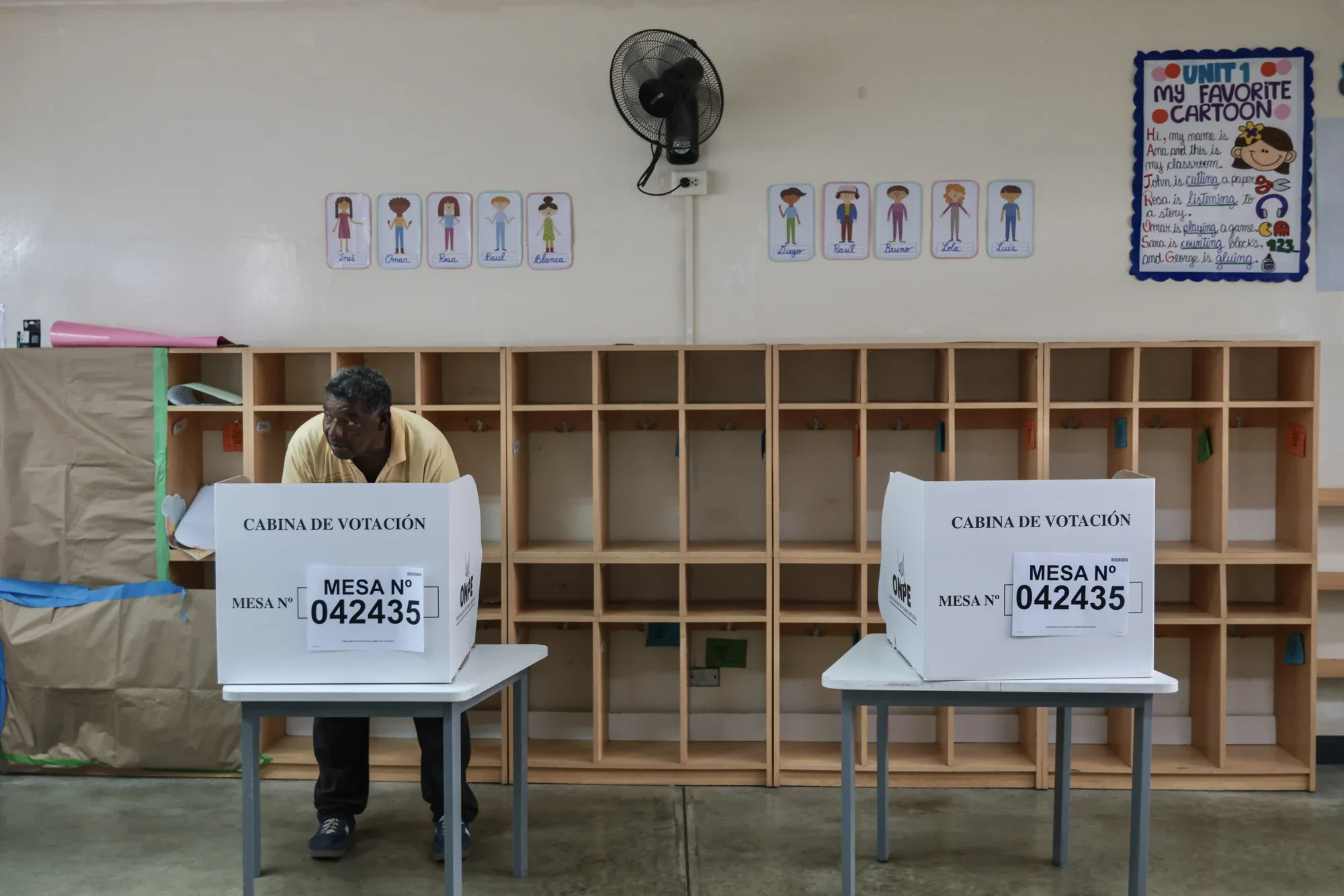
A Peruvian citizen casts his vote at Innova School in the Chorrillos district of Lima, Peru, on April 12, 2026. Photo © Connie France.
Opinion • Víctor Miguel Castillo • May 1, 2026 • Leer en castellano
A specter is haunting Peru. It isn’t the same one that terrorized the elites in the 20th century, or that of revolutions that promised to sweep away the old order. It’s something stranger, and even more disturbing: the specter of Fujimorism.
The April 12 elections saw 35 candidates run for the presidency of Peru, and failing to inspire enthusiasm from even a fifth of the electorate.
Keiko Fujimori, daughter of dictator Alberto Fujimori and candidate for the Fuerza Popular party, led the first round of the general election with around 17 percent of valid votes. It was the fourth consecutive election in which she has advanced to a presidential runoff since 2011.
She will be challenged in the runoff by Roberto Sánchez, the center-left candidate from Juntos por el Perú. He earned 12 percent of the vote, narrowly edging out far-right candidate Rafael López Aliaga of the Renovación Popular party, who has alleged fraud without providing any evidence.
To understand what is happening in Perú today, we must return to its history. Peru entered the 1990s in a state of crisis, as hyperinflation under Alan García’s government decimated the purchasing power of working families.
The armed conflict between the state and Shining Path guerrillas rendered vast areas of the country uninhabitable. The government—weak, centralized in Lima, and historically distant from the majority of the population—was overwhelmed.
Fujimori Sr. arrived in that context, presenting himself as an outsider: an engineer and the son of Japanese immigrants with no established party behind him. He defeated “the caste,” represented in 1990 by Mario Vargas Llosa, and even gained support of a segment of the left.
When people spoke of Fujimori’s populist cronyism in the 1990s, they did so by referring to Tupperware food containers. It was said the dictator bought votes by handing out containers full of food in the poorest neighborhoods.
The Fujimori brand has faced moments of rejection at the polls. In 2011 against Ollanta Humala, in 2016 against Pedro Pablo Kuczynski, and in 2021 against Pedro Castillo, a large social majority associates the memory of Fujimori with crimes against humanity, forced disappearances, rampant corruption, and the moral decay of republican institutions.
That might lead one to think that the strongest political identity in Peru is anti-Fujimorism.
In reality, Fujimorism continues to play a leading role in every presidential election in Perú, and always comes with the real possibility of victory. The real question is a very uncomfortable one: why does this continue to surprise us?
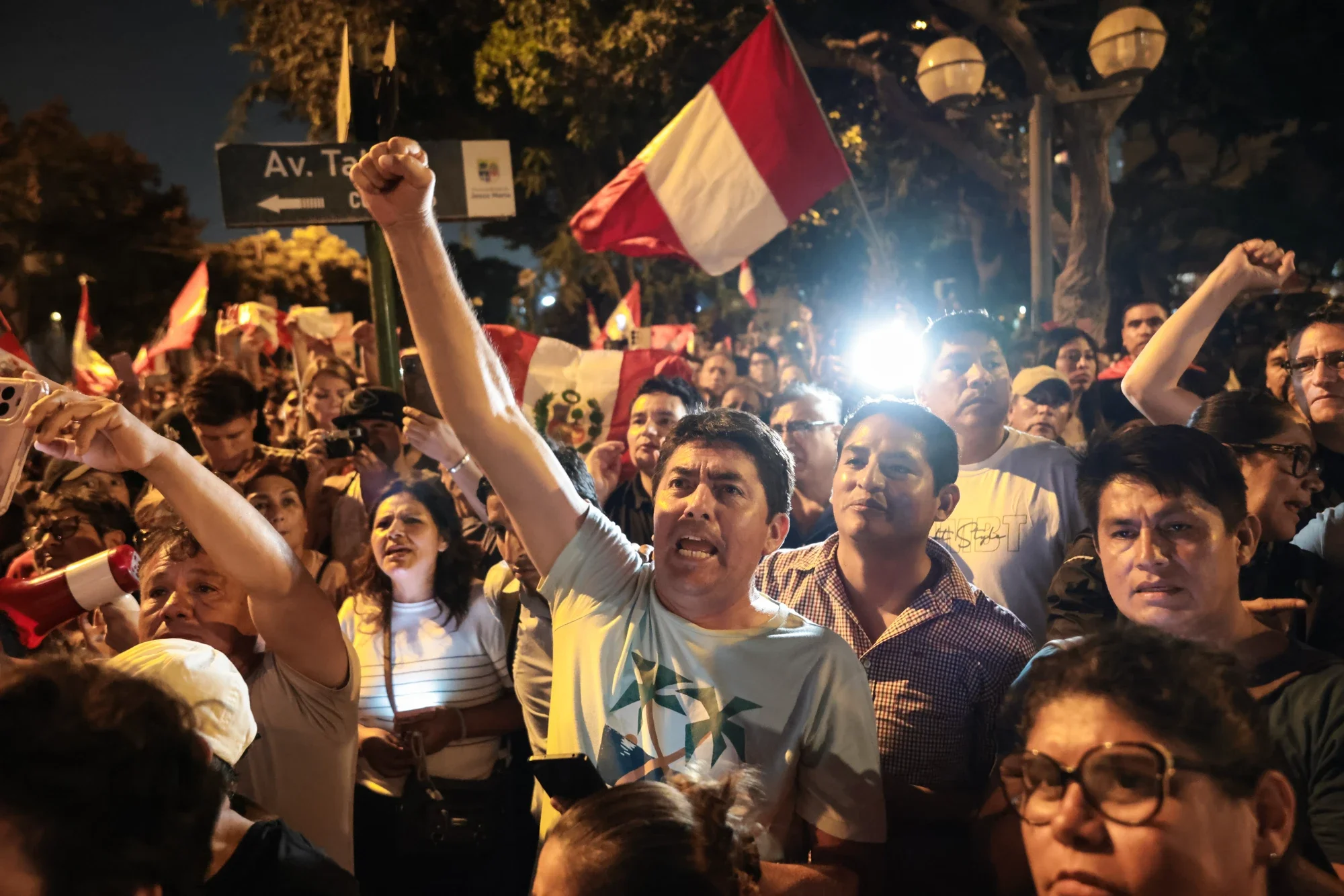
Hundreds of people carrying Peruvian flags and emblems, gathered outside the National Elections Board (JNE) in the Jesús María district of Lima, Peru, on April 14, 2026, to protest and express their dissatisfaction with the irregularities they believed occurred during the electoral process. The demonstration was called by Rafael López Aliaga, the candidate for the Popular Renewal Party, who claims that the election was fraudulent. Photo © Connie France.
Voting patterns among Fujimori supporters
In this year’s presidential campaigns, Jorge Nieto, one of several left-wing candidates from the Good Government (Buen Gobierno) Party, brought up an awkward topic on more than one occasion. He repeatedly suggested that redistributive policies during Peru’s 20th Century dictatorships were more extensive than they were in periods of democracy.
Nieto drew a parallel —which sometimes felt contrived— between the National Popular Dictatorship of Juan Velasco Alvarado (who came to power through a coup d’état in 1968) and enacted the Agrarian Reform in 1969, and Fujimori’s dictatorship, during which a macroeconomic crisis was averted in Perú.
The political legitimacy of Fujimorism is directly related to the importance different sectors of the population attach to the “pacification and economic stability” achieved during his government.
That foundational memory—even though it was bound up with authoritarianism, systemic corruption, and egregious rights violations—was etched into an entire generation as the moment order was restored. And that is why Keiko Fujimori does not govern: she inherits.
In a political system where alternative alliances have discredited themselves one after another, inheriting something—even if it is tainted and controversial—is a structural advantage no campaign can easily erode. It is no coincidence that the government plan Fujimori presented in these elections was titled “Order in Perú,” directly echoing her father’s legacy.
Today, the major support bases of Fujimorism include small and medium-sized business associations, part of the informal sector of street vendors, and various evangelical groups.
These coalition is more revealing and complex than it seems. Big business supports Fujimorismo and other right-wing candidates, including the far-right López Aliaga. But the coalition also draws the votes of those who built their livelihoods outside the state.
Fujimorism lacks a concrete ideological foundation. Its strength lies in identity rather than policy. It offers no vision for Perú. It taps into the desire for security by promising chaos can be averted, and brings back old ghosts by vowing that what little one has managed to build will not be stolen by Shining Path communists operating under new democratic guises.
That vow, in a country in which the informal sector makes up over 70 percent of the economy and nearly three out of every 10 Peruvians live in poverty, cannot be weakened by yet another allegation of corruption.
Securitization campaigns
“Perú doesn’t vote ‘the wrong way,’ it votes the way it lives: with an empty stomach and a besieged mind,” said Héctor Béjar once April’s electoral results became known. Béjar was a founder of the National Liberation Army (ELN) in the 1970s and served as Foreign Minister under Pedro Castillo.
In this electoral cycle in Perú, it wasn’t just the right that campaigned on crime, punishment, and security. The left adopted a hardline security discourse, mistakenly believing “the people” want a heavy hand.
Ronald Atencio, the candidate for the “Venceremos” electoral alliance, went so far as to say in televised debates that if elected president, he would lead an “annihilation squad” against organized crime. That was the language of Fujimori Sr. in the 1990s.
In a country where extortion has become a de facto tax on labor, that kind of promise has a real audience. But people also know how to spot impostors.
The promise of order doesn’t address any of the underlying causes of unrest. It is the pressures of daily life that make increasingly extreme candidacies possible—and not just on the right.
For its part, the left speaks the truth: that the current economic and political model is exclusionary, that wealth is not redistributed, and that the 1993 Constitution enshrines established privileges.
But truths alone are not enough.
They fall short geographically, they fall short emotionally, and they fall short in the moment a person decides, alone in a voting booth, who best responds to their most immediate fears.
There is a gap between analytical truth and the ability to reach people living on the edge. That gap is a political responsibility, and not just a communication or campaign issue.

Fuerza Popular candidate Keiko Fujimori during a campaign rally at a public square in the Ventanilla district of Callao, Peru, on April 2, 2026. Party supporters and attendees gathered to hear her speak and show their support. Most of the crowd consisted of elderly people who recalled Alberto Fujimori’s leadership and support during his time in power. Photo © Connie France.
An enduring specter, a contested memory
In her three previous bids for president, Keiko Fujimori fell just short of the presidency. She has a base no crisis can fully erode, because it is built not on enthusiasm but on something more resilient: memory, networks, and an identity forged in opposition to everything else.
Fujimorism 1.0 captured something real: the energy of marginalized sectors that wanted a place in the economy and in politics. Not only was this the period when the Washington Consensus was implemented (with the all violence and repression that implied). It was also a period in which “popular capitalism”—first sketched out by Hernando de Soto for Vargas Llosa—took shape. This has remained relevant not only in theory, but in practice.
Marx and Engels wrote that a specter was haunting Europe, and that all the powers had allied to exorcise it. The Peruvian specter is harder to exorcise because it does not come from outside: it comes from within, from a wound that has not healed, from a question no one has managed to answer.
Every time Fujimorism advances to a runoff in elections, a segment of progressive Latin American analysts exhibits the same knee-jerk reaction. They chalk it up to popular alienation, invoke the term clientelism, talk about mafias and corruption, and quickly shut down the debate.
But votes for Fujimori cut across the board, refusing class segmentation or straightforward electoral divides. Rather than the vote of the manipulated and disenfranchised poor or that of a satisfied elite, support for the party now known as Fuerza Popular cuts across social classes and geographical regions (along the coast and in eastern Peru).
This is a sign that there’s something more complex at play.
The Fujimori vote is not a fleeting phenomenon, it is a preference consistently expressed over time.
The hypothesis that the electorate that supports Fujimorism is manipulated infantilizes the complex rationalities of the working classes in contexts of dispossession and daily violence. It is an excuse for the failure to critically engage these issues.
On June 7, some of Perú’s 27 million voters will return to the polls. Their choice in the runoff election will be between Fujimori and Sánchez, who, according to the polling firm Ipsos, are currently neck-and-neck in a technical tie, with each candidate polling 38 percent.
The question remains the same: will anti-Fujimorism be enough to contain the specter that haunts Perú?