

Storytelling as resistance in Puel Mapu
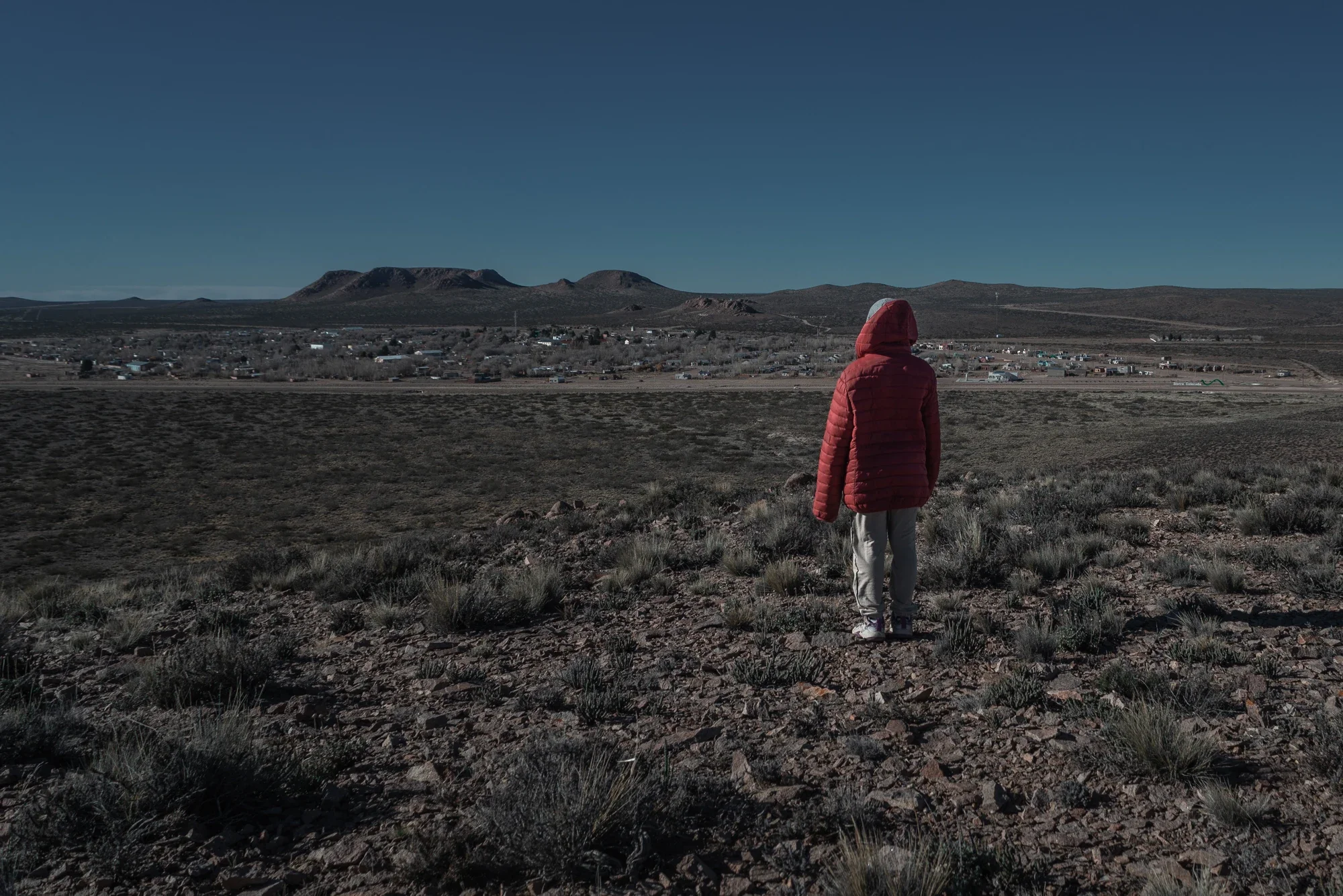
A boy looks down from the hills at the town of Sierra Colorada, Río Negro, Argentina, on June 9, 2026. Photo © Carolina Blumenkranc.
Reportage • Carolina Blumenkranc • July 8, 2026 • Leer en castellano
“Dear diary,” said Azul Rondeau into a golden microphone that was part of a home recording setup in Sierra Colorada, in the Patagonian province of Río Negro, Argentina. “The Jalils said they’ll come pick me up in 10 days and take me to the village to work for them.”
Josefa Paillacoy stood next to 19-year-old Rondeau. The story that the two ñañas (Mapuche women) were performing was inspired by Paillacoy’s childhood. It’s called La Niña Choique (The Rhea Girl), after a native bird similar to an ostrich, known locally as the ñandú petiso.
This is part of how one of the recordings for Radioteatro de la Estepa (the Steppe Radio Theater) is made. The project recovers memories, stories, and lifeways in Puel Mapu—now known as Argentine Patagonia—and transforms them into audio plays voiced by the people who live there.
These stories have sparked intergenerational conversations about the history of rural families, forced displacements, the loss of territory, and the ways in which genocide continues to shape daily life. These are memories that have been silenced by state policies of assimilation and discrimination against Indigenous people for decades.
From genocide to silence
In the late 19th century, the Argentine state perpetrated a genocide against the Mapuche-Tehuelche peoples in order to seize their territories and subsume them under the national project.
This process, officially known as the “Campaign of the Desert,” went beyond a purely military offensive that included attempted extermination, and the plundering of lands. Historical studies and Indigenous leaders maintain that its objectives and effects persist to this day.
The war brought racist and patriarchal state policies that shaped individual, family, and collective experiences, and introduced power dynamics that have since become normalized. One of the longer term impacts is the silencing of Mapuche identity.
“Many people find it hard to call themselves Mapuche. Sometimes they say, ‘My grandmother, my great-great-grandmother was Mapuche,’” said Noe Valenzuela, a member of Radioteatro de la Estepa who voices La Tejedora (The Weaver). “And I tell them, ‘Then you are too—in the present.’”
Although Valenzuela publicly affirms her Indigenous identity, she grew up seeing how racism turned that sense of belonging into a source of shame.
“When my mom arrived at school, they’d throw talcum powder on her head; they assumed she was dirty and full of lice because she was from the countryside,” Valenzuela said in an interview with Ojalá. “So people weren’t exactly eager to share their stories!”
The episode featuring La Tejedora—a woman who dreams of weaving the world’s largest blanket to keep the entire community warm—brought about something unexpected in Sierra Colorada.
As the script was being written, the stories of other weavers began to come together, giving voice to their experiences. The conversations kept growing after the listening sessions. Local women began talking about their aunts and grandmothers again, remembering the lawen (plants) they used to dye wool—like mallow and wormwood—and the significance of the weaving patterns that appeared on the Mapuche loom as the weaving ñañas sang.
One elderly woman approached the group after a collective listening session held on March 8, International Working Women’s Day and said, “My grandmother's story is missing here." Through this work, Radioteatro de la Estepa creates a space for those stories to overcome the silence.
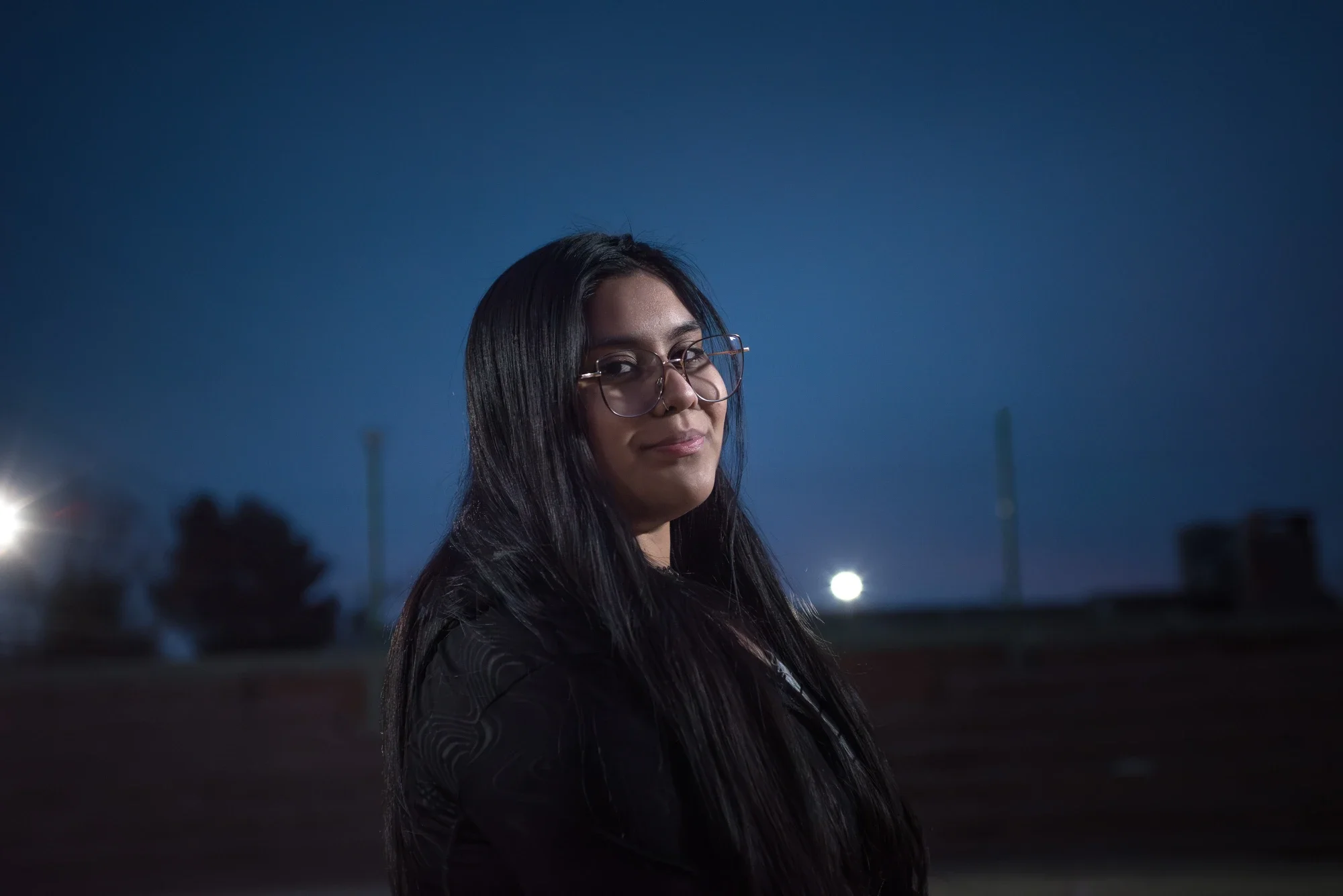
Azul Rondeau, a youth who is active in Radioteatro de la Estepa, in Sierra Colorada, Río Negro, Argentina, on June 9, 2026. Photo © Carolina Blumenkranc.
Forced displacement
In La Niña Choique, Rondeau plays an adolescent born at the foot of a mountain in the rural Sierra Blanca region. She doesn’t know where her father is. She lives with her grandmother and, for reasons she doesn’t quite understand, she must go live with a family as a servant.
The story unfolds in a radio drama episode, but it is rooted in Paillacoy’s firm decision to tell her truth, even if doing so brings up sadness. “By getting it out, I was able to heal my childhood and, above all, let go of the shame,” she said.
For much of the 20th century, the expansion of private property, barbed-wire fences, and various forms of fraud, indentured servitude, and pressure on surviving Mapuche families deepened the processes of dispossession that had been triggered by earlier military attacks.
In that context, families were forced to leave their lands, move away from the countryside, or remain as farmhands on their own lands. They were also forced to hand over their young daughters to a fate that was said to be better: the master's house. In many cases, the families who took in these children changed their last names, physically and sexually abused them, and subjected them to all kinds of violence.
There is no official record of the processes by which Mapuche children were taken—during the military campaign or afterward—and the total number of victims of these family dismemberments is unknown. Pilar Pérez, Lorena Cañuqueo, and Laura Kropff have studied the subject via oral histories, called nütram, and conversa, and they trace them beyond historical documents.
One of their sources, Manuela Puelman, who is 100, recalled, for example, that during the genocide, “they took the children [...] captive; they took them far away.” Úbeda Catalán describes a more recent form of this same uprooting: merchants from the region “were in charge of taking girls to Buenos Aires... They’d send six girls, five girls” to work as domestic servants.
The girl in the story wants to become a choique, a flightless bird native to the Patagonian region that can reach high speeds as it runs across the steppe. She wants to escape the violent fate being imposed on her as an Indigenous child.
By choosing this particular animal—whose dance is honored by the Mapuche people in ceremonies—as a narrative focus, the story highlights the healing power of finally embodying one’s territorial identity.
In the name of progress
Today, Argentina is experiencing a sharp rollback of public funding, including for culture, communication, and public media. Budget cuts pushed by Javier Milei’s far-right government have affected efforts for the production and sharing of culture throughout the country.
Despite this unfavorable context, actor and broadcaster Rodrigo Ramírez Castiglia decided to launch the Radioteatro de la Estepa on a self-managed basis. Despite the effort involved, the group is enthusiastic and pleased, not because they have secured the necessary funding or recognition, but because every bit of feedback—no matter how small—has confirmed their belief in the pressing need to discuss these issues.
“We were told that our culture, our millennial knowledge, and our way of life were those of the poor; that we had to pursue ‘progress,’” said Valenzuela, pointing out that this narrative is rooted in genocide. “Recovering these stories helps us remember and realize that no, that wasn’t the case. That ancestral knowledge is what we’ve always needed.”
The struggle over memory draws on the past, but it also defines what futures are imaginable.
For more than a century, the Puel Mapu was portrayed by national governments as an empty, backward, or unproductive land that needed to be brought into the fold of progress. That narrative was used to justify genocide and various cycles of territorial occupation in the service of capital.
In a region where new mining initiatives—grounded in the idea of the global energy transition—are once again being presented as the inevitable path to development, conversations prompted by the radio theater reopen questions about who lives on the land, what memories have been silenced, and what ways of life are considered expendable.
Recovering local histories, family genealogies, and memories of resistance is a way to challenge the meaning of territory and the right to remain within it.
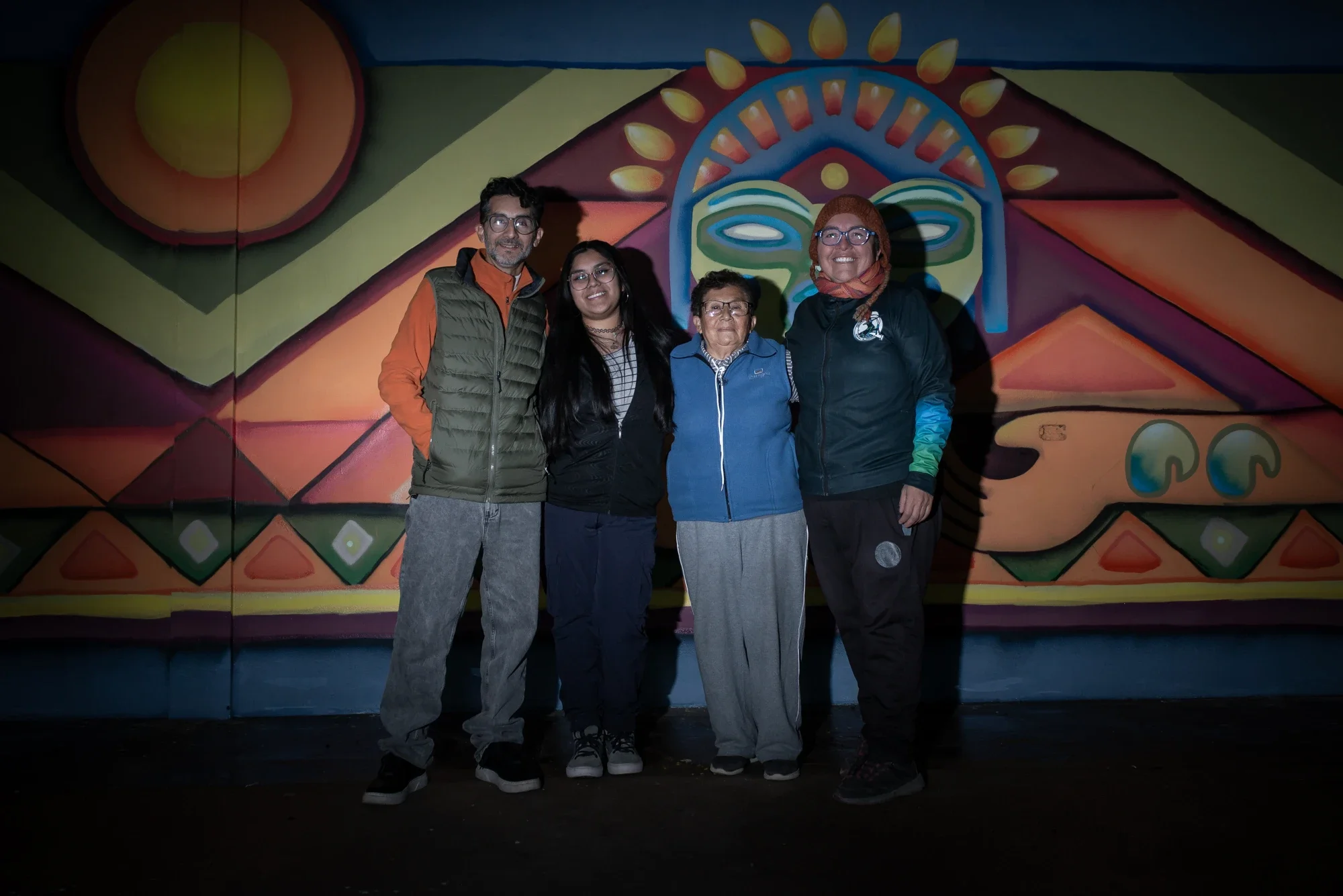
Rodrigo Ramírez Castiglia, the project’s initiator, with Azul Rondeau, Josefa Paillaco, and Noe Valenzuela, who are actresses in the radio theater, on June 9, 2026, in Sierra Colorada, Río Negro, Argentina. Photo © Carolina Blumenkranc.
A new generation of choique children
“First they took our fertile lands, they forced us to live in the quarries, they relocated us to arid areas, and now that they’ve found gold here, and they want to drive us out again,” said Fernanda Neculman, a werken (spokesperson) of the Mapuche-Tehuelche Parliament of Río Negro in 2024.
Rocks in the region are rich with gold, silver, copper, lead, zinc, molybdenum, indium, vanadium, and lithium. Within a relatively small radius, there are a constellation of extractive projects: El Bagual, Cerro La Mina, Cerro Choique, Toruel, La Luz, Dos Lagunas, Esperanza. These names spread across the maps of the steppe, proposing a new cartography of so-called progress.
There are more than 66 mining projects scattered throughout the province of Río Negro. This figure speaks to the shift in the productive matrix. Whereas for generations communities were told they lived in a barren desert, they’re now told the ground beneath their feet now holds the promise of salvation.
La Niña Choique (the Choique Girl) tells the story of a displacement that marked Paillacoy’s childhood. Her story repeats whenever a family is forced to leave the countryside to access education, or wherever a community is deprived of water in the name of the energy transition.
In the process of becoming a shared narrative, this story embodies living memory, which is renewed and challenges established meanings. The Choique Girl also appears wherever someone breaks the silence and, after several generations, again identifies as Mapuche.