Chile’s uprising, seven years on
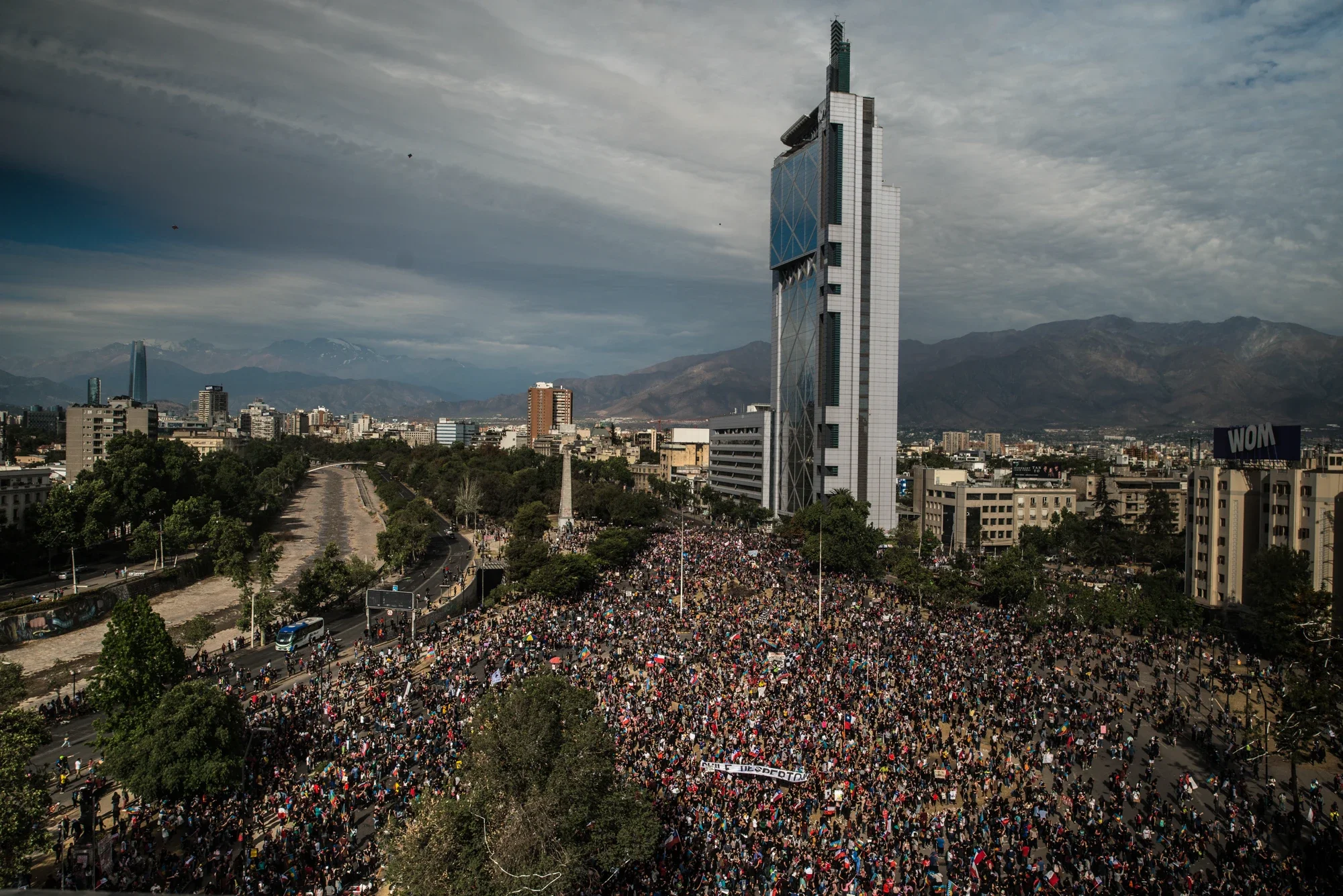
One million protesters gathered in Plaza de La Dignidad (Plaza Italia) in Santiago in October 2019. Photo © Nicole Kramm Caifal.
Opinion • Fernanda Cavada & Laura Manzi • October 16, 2026 • Leer en castellano
Over the last few years we’ve been reflecting on what the uprising in Chile meant from the perspective of the feminist movement. What was expressed through the street protests? What was it that erupted on that Friday, October 18, 2019?
Our answers to those questions are varied, and we continue to grapple with them because it’s impossible to think through the present without reflecting on what the uprising meant for our lives.
Seven years ago, a 30-peso increase in public transportation fares in Santiago, Chile, was the last straw. During that week in October, hundreds of high school students rose up in protest against rising fares, jumping turnstiles and sitting on the platforms of the capital’s subway system to demand fairness.
In response, the government declared, that the protest “didn’t catch on,” implying that it had no impact. That statement, combined with police repression, lit the spark.
The uprising drew on months of previous protests and demonstrations by various sectors. No+AFP, a movement against the private pension system, was active at the time. Teachers had been striking for two months, led by the Teachers’ Union, one of the country's largest active labor organizations. And a cycle of struggle had already begun with Niunamenos, followed by March 8 and the Feminist General Strikes throughout Latin America.
These struggles brought the lives of women and gender dissidents (as well as children) to the forefront as a political issue. They paved the way, both politically and socially, for the uprising.
From the first weekend, the uprising spread to major cities across the country, evolving into a nationwide movement of street protests. The movement remained active—with varying degrees of intensity and despite intense repression in the streets, including the loss of lives—over the months that followed. It lasted until Chile declared special measures due to the pandemic in March 2020. Those measures came after the International Working Women’s Day strike on March 8 brought two million people onto the streets.
What remains in our memory of what began to unfold on October 18, 2019 are images that have become like postcards of resistance, evoking the people’s ability to protest across all sectors of society, driven by a desire to transform a violent, crisis-ridden neoliberal reality.
Pressure from within and from without
During the 2019 protests, various expressions of similar discontent emerged in succession. Cries for change rang out in the streets. One in particular caught our attention: “It’s not about 30 pesos, it’s about 30 years.” That became a rallying cry against nearly 30 years of neoliberal rule and the broken promises of social justice for a better life made in the wake of years of economic growth.
At the 8M Feminist Coordinating Committee, we named this momentum for transformation as a process or drive for change through refusal. Echoing the voices that preceded us during the dictatorship, we said, “No more! Together we can,” reaffirming feminism’s power to reject a reality that oppresses, subjugates, impoverishes, and precaritizes us.
The momentum for refusal that emerged in the streets opened the door to change: a National Plebiscite, popularly known as the “I approve” vote for a new constitution. In October 2020, with nearly 80 percent of the vote, the creation of an institutional framework tasked with drafting a new constitution for Chile was underway.
We joined this process convinced we were representing the history and substance of a program driven by social organizations across the country. We exerted pressure from inside and outside the process.
We did so from within by coordinating sectors and building positions that would ensure real progress in people’s living conditions. And we did so from without by protesting in the streets, organizing activities in local communities, and developing grassroots legislative initiatives—giving a voice to those without seats in Congress.
We focused on championing a draft constitution grounded in a feminist perspective. We succeeded in ensuring that historic demands remained at the heart of the new draft: recognition of domestic work, the right to care, the right to decent housing, the enshrinement of gender parity in democracy, the right to live free from gender-based violence, the right to security in its broadest sense, to sexual and reproductive rights, and so on.
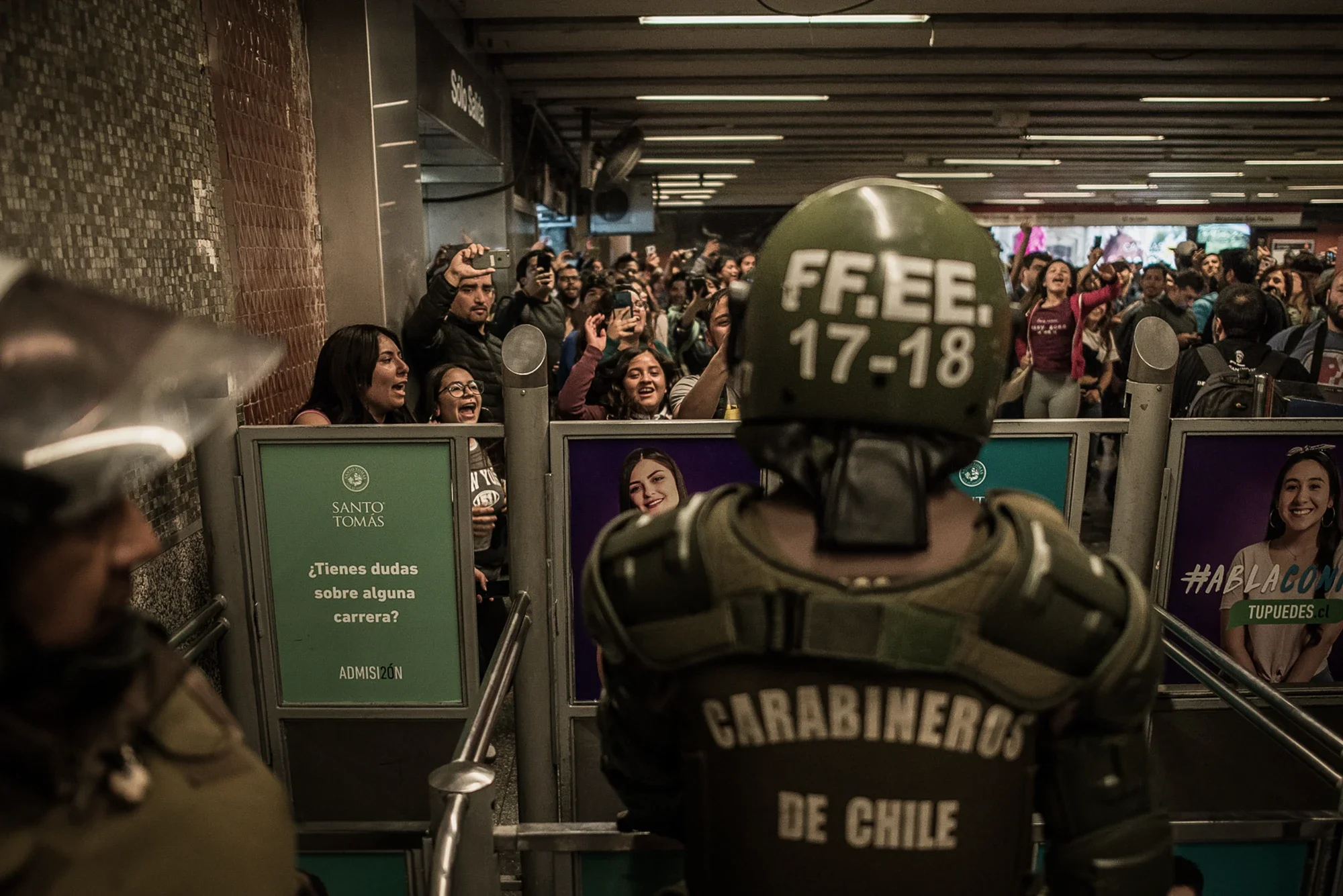
Students confront Chilean military police who violently cracked down on demonstrations against rising public transport fares in the metro in Santiago de Chile in October, 2019. Photo © Nicole Kramm Caifal.
What was opened up and what was administered
The constitutional process unfolded against the backdrop of a global pandemic that hindered mobilization, increased the burden of care work, and accelerated impoverishment, leading to historically high unemployment, particularly among women.
Against that backdrop, on September 4, 2022—during Chile’s first election featuring automatic voter registration and mandatory voting—nearly 62 percent of the population rejected the new constitutional proposal.
Capitalizing on this result, both the right and the institutional left promoted a critical, conservative, and reactionary narrative regarding what the process meant for the country. For us, it’s been a challenge to develop an analysis that provides insights into what we gained.
On behalf of the 8M Feminist Coordinating Committee, we assert and act on the importance of sustaining democratic participation through a process that transcends limits set by institutions.
Those who hold the de facto power in Chile orchestrated a media campaign in collusion with the private transnational corporations that manage the pension funds (the AFPs). Their campaign succeeded in shifting the demand for social security toward individual ownership of each worker’s pension funds.
This took the form of a fear campaign in the media, which falsely claimed pension savings would be expropriated if a new Constitution were approved. The same thing happened with other key rights, such as housing. We saw how the media, ads in public transportation, and every aspect of daily life were flooded with the lies spread by the right wing.
There is no doubt that the defeat of the constitution was not determined solely by the contents of the draft. Polls after the plebiscite made it clear that people agreed with the majority of the constitutional text’s provisions.
In December 2021, while the Convention was in full swing, Gabriel Boric won the runoff election against José Antonio Kast with the highest vote total in history up to that point.
The Boric government hitched its wagon to the constitutional process, and after the “No” vote, it changed course. It brought in figures from the more conservative parties of the transition to democracy, and the vision of transformation gave way to governance.
A second constitutional process was negotiated among parties, with appointed experts and without the participatory process that had characterized the first. In this context, the far-right Republican Party was the most-voted-for force in the Constitutional Council and drafted its own proposal. In December 2023, Chileans once again voted “no” to a new constitution.
Boric, consciously or not, introduced a securitization narrative which he maintained following the defeat of the new constitution on September 4, 2022. This paved the way for the advance of anti-immigrant rhetoric and laws, legislation that criminalizes protest, and measures that promote impunity for acts of state violence. These are all policies that the Kast government is further entrenching. To date, Boric and his faction have avoided any self-criticism and fail to acknowledge the role they played in bringing an era of social transformation to a close.
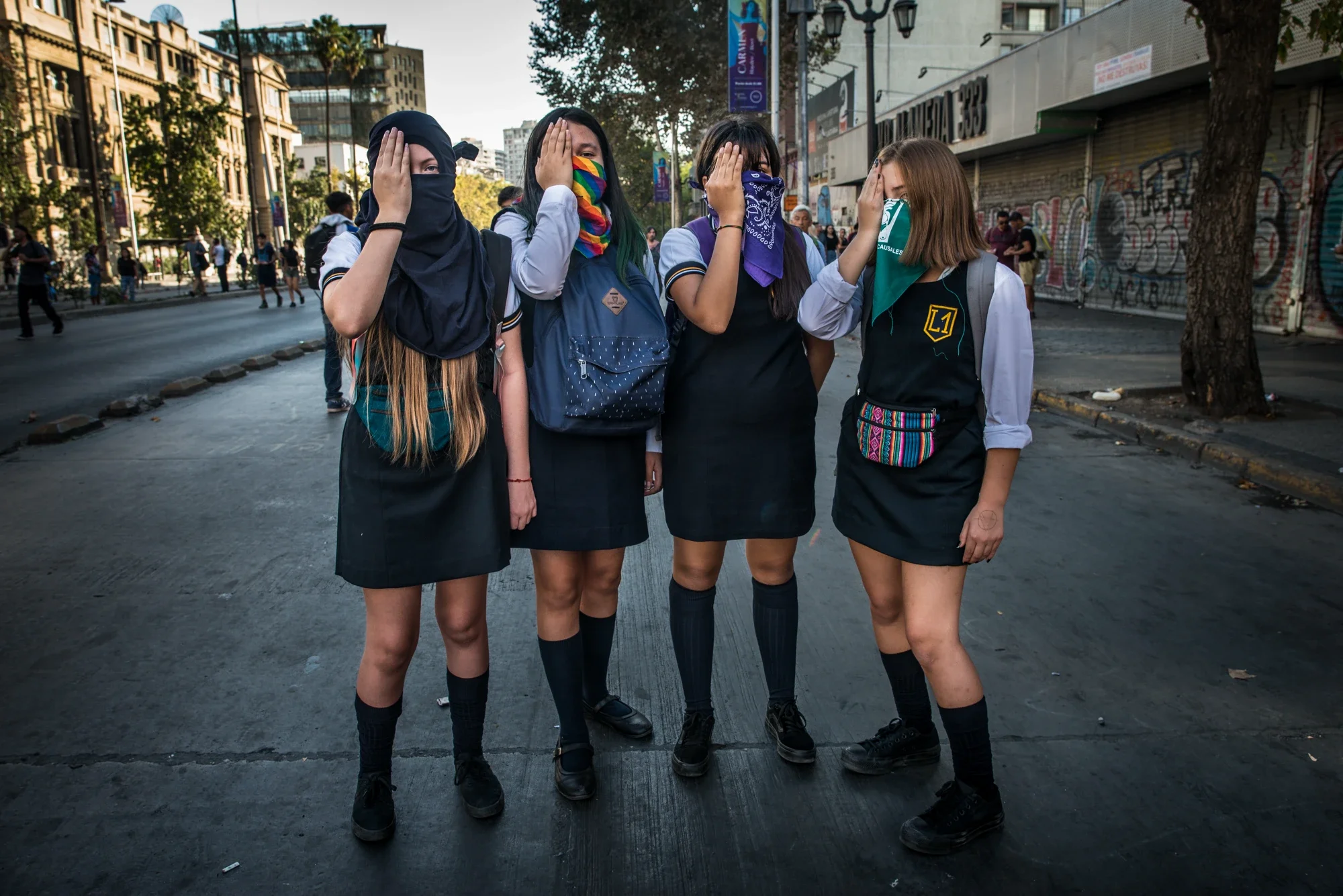
High school students cover one of their eyes as a gesture of solidarity with victims of eye trauma during the Chilean social uprising in Santiago in October 2019. Photo © Nicole Kramm Caifal.
The far-right agenda
The far right's political agenda in Chile did not begin with the inauguration of the Kast government earlier this year, or with the electoral victory of his faction. Instead, its roots lie in a long process of capitalizing on the political discontent spawned by the continuation of Augusto Pinochet’s neoliberal legacy—a legacy perpetuated by the parties in power throughout Chile’s democratic era.
The far right appropriated this discontent by attaching labels to it: fear, insecurity, disorder, and enemies. These labels allow the right to structure its proposals without further explanation.
The combination of fear, insecurity, and enemies creates a political framework of increased control and repression that’s characterized by expanding police power, prisons, and the persecution and criminalization of migration.
Interweaving narratives about disorder and enemies have provided fertile ground for economic reforms that favor the wealthiest, cuts to social rights, and contempt for public sector workers, labeling them as “dead weight” or “crony appointees.”
Over the past few months, life in Chile has become more complicated. The cancellation of oil price stabilization has led to a rise in the cost of living. The economic impact is just beginning, but unemployment rates have already reached historic highs, marking the sharpest increases in five years and hitting women and youth especially hard.
The World Bank estimates growth of less than one percent this year, and the economic slowdown is intensifying in Chile like never before. It is the far-right government in power that’s exposing us to this. It has just enacted an economic reform that reduces taxes for the country’s wealthiest sectors.
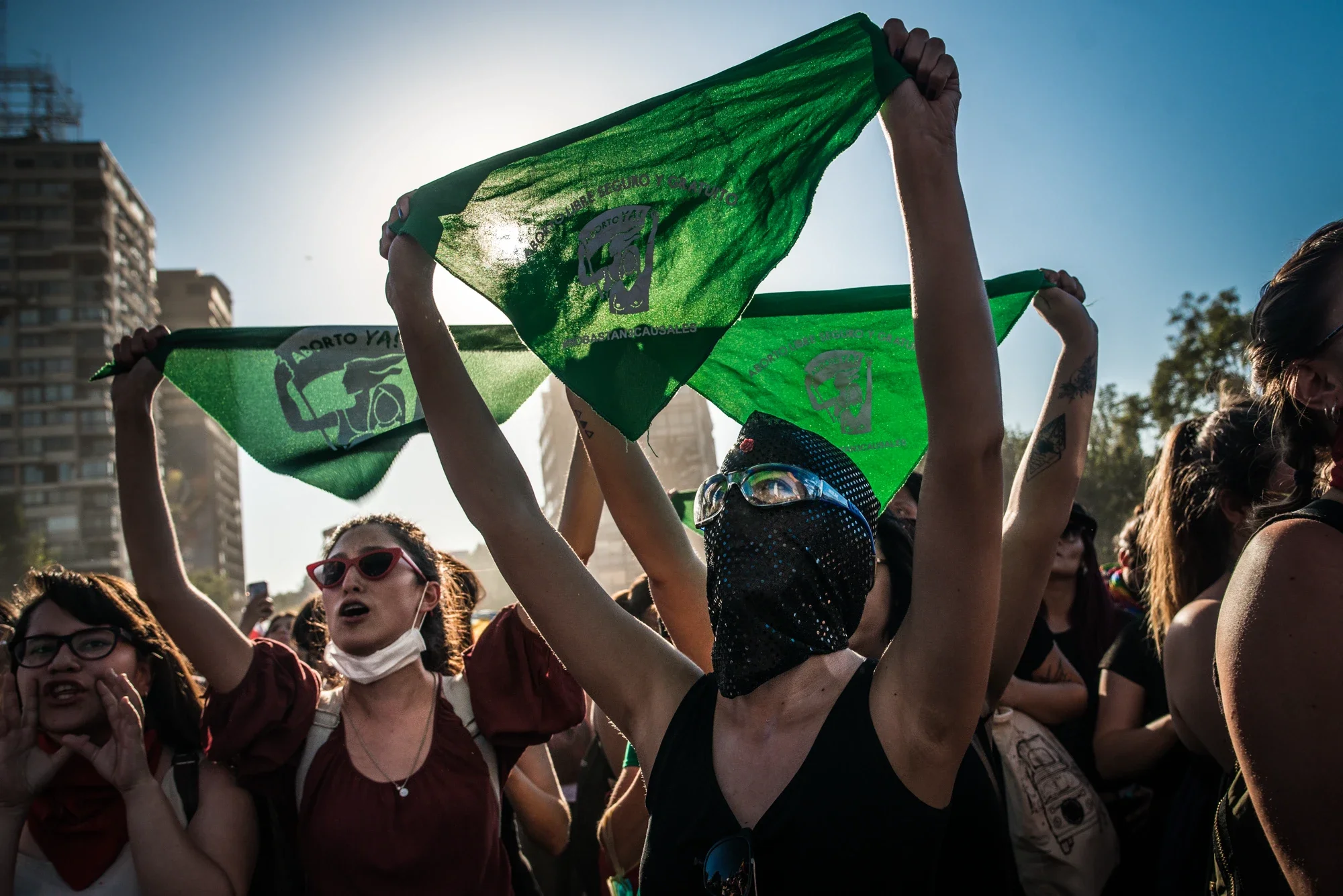
Protesters take the Alameda, Santiago’s main street, during a feminist march against gender violence and political violence against women during the October 2019 protests. Photo © Nicole Kramm Caifal.
Institutional dismantling and grassroots reorganization
As part of the dismantling of government institutions, the Kast administration has proposed a 2027 budget that—under the guise of so-called “partial cuts”—dismantles the state and shifts the burden of economic austerity onto working families.
Those in power are canceling the resources that allow us to feel that life is about more than working to make ends meet. They are cutting the budget for decent housing while planning to increase funding for the construction of places of worship in a secular state.
They are reducing children’s access to cultural activities and libraries (cuts of 50.8 percent and 57.9 percent, respectively) while increasing budgets for Defense (10.2 percent), the Gendarmerie (18.2 percent), and immigration—with a focus on deportations.
While still a candidate, Kast said the budget reflects a government’s priorities. To us, his plan suggests that the only priority is to restrict our freedoms.
Not only are there cuts to sexual and reproductive health, but the Ministry of Women and Gender Equity’s “Women, Sexual, and Reproductive Rights” program is being renamed to “women, sexuality, motherhood, and shared responsibility.” This shifts from a recognition of sexual rights and identity in plural to focusing on women as a homogeneous group, removing the notion of rights, and linking sexuality to motherhood.
Conservative and patriarchal restoration processes are currently underway, driven by alliances of the global far right of which the Chilean government is a part. Their aim is to send us back to our homes to become baby-making machines in the face of a falling birth rate, caused by the very same people who seek to govern through their policies of budget cuts and economic austerity. An anti-women legal framework is being built by pushing laws such as the “anti-complaint” law and the fetal heartbeat law, which criminalizes abortion support networks.
The demands articulated by millions during the October 2019 uprising and debated during the constitutional process remain valid today. Now, when our rights are at risk, we must sustain our organization, expand political mobilization, and foster transformation.