

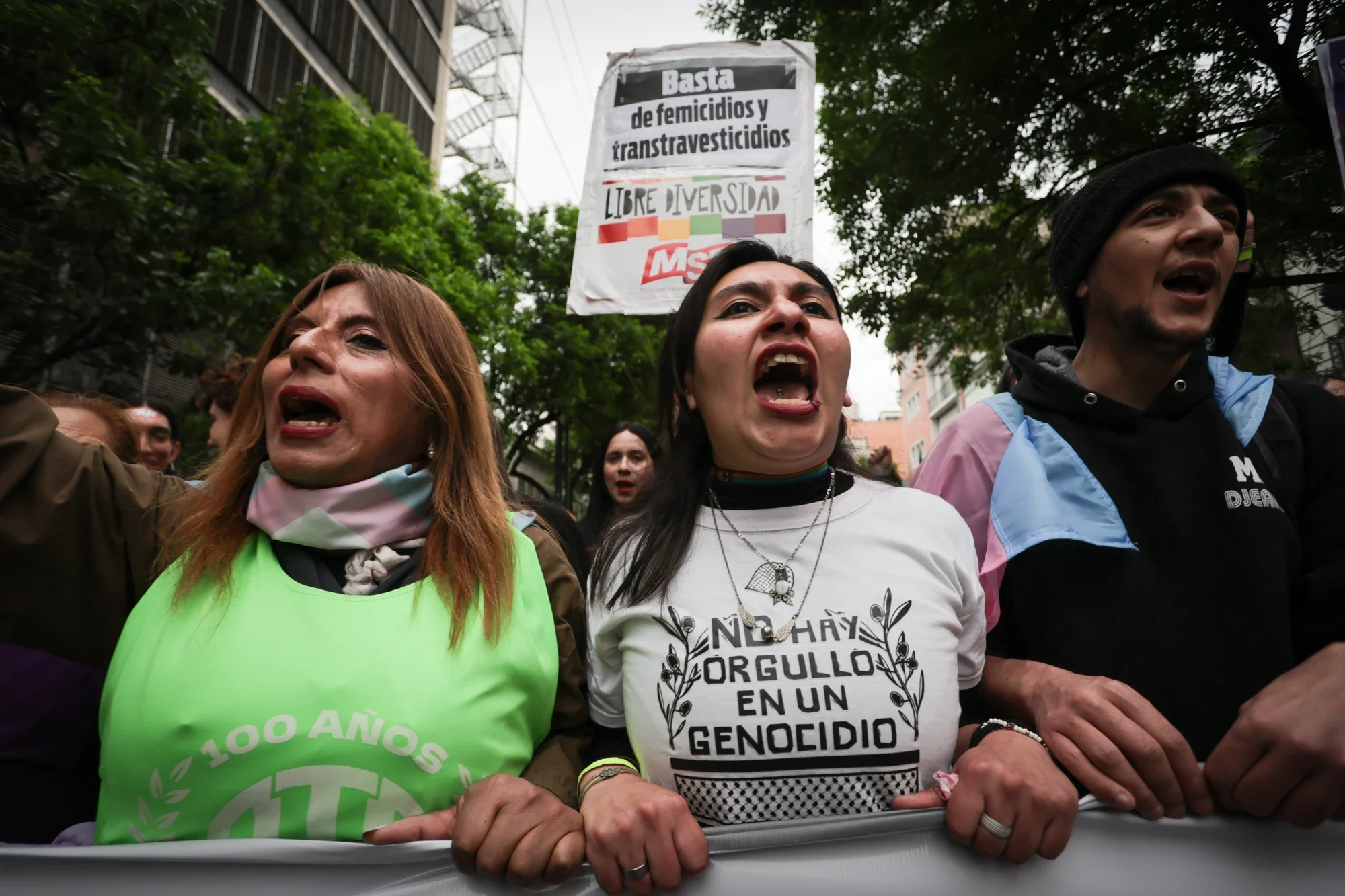
A sign reading “Stop femicides and travesticides, freedom for diversity” leads the march against travesticides, lesbicides, and transfemicides at the 39th Plurinational Gathering of Women, Lesbians, Travestis, Transgender, Bisexual, Intersex, and Non-Binary People on October 10, 2026, in Córdoba City, Argentina. Photo © Susi Maresca.
Reportage • Susi Maresca • October 21, 2026 • Leer en castellano
Argentina’s 39th Plurinational Gathering of Women, Lesbians, Travestis, Transgender, Bisexual, Intersex, and Non-Binary People kicked off on October 10 with a ceremony beside the Suquía River. More than 150,000 women and gender dissidents from across Abya Yala gathered in the city of Córdoba, 700 kilometers from Buenos Aires.
Nearly 40 years after the first Encuentro, which changed the course of history for transfeminisms, coming together remains essential in a context that is increasingly hostile to all life.
We came together to continue weaving networks of solidarity, resistance, organization, and healing, from the streets to school classrooms, public squares, and protests. These gatherings are a concrete way of knowing that the individual stories each of us carries can become collective—and, above all, political.
The city of Córdoba, capital of the province of the same name, recieved us for the three day event with cold weather and drizzle. Many unhoused people were sleeping in the doorways of buildings and schools. We’re in the third year of Javier Milei’s administration and his repressive, austerity-driven policies. Daily life has been getting increasingly precarious and difficult.
The Encuentros are never detached from the world’s historical and sociopolitical moment. They serve as barometers and spaces where transformative actions take shape. I’m always struck by how they can put what we’re going through right out in the open.
In order to get there and cover travel expenses, folks from around the country organized parties, raffles, gatherings, community potlucks, and group trips. We could feel the accumulated exhaustion in our bodies. But the sun peekeing out from time to time, the hugs, and the transfeminist strength that, thankfully, once again overflowed everything worked to revitalize us. Despite our differences, that fabric continues to expand year after year to embrace us in our differences.
Exist and persist
“Stolen lands will be reclaimed,” chanted Indigenous women and gender dissidents among the growing crowd along General Paz Street, clearing the way with incense smoke after the ceremony at the Suquía River.
This year, for the first time in the history of the Encuentros, a Commission of Pre-existing Peoples (Comisión de Pueblos Preexistentes) was formed. Its aim was to give visibility to those defending their territories against extractivism, which takes the form of evictions, state violence, and enforcement of the emergency presidential mega-decree issued by the Milei administration, which sanctions these actions.
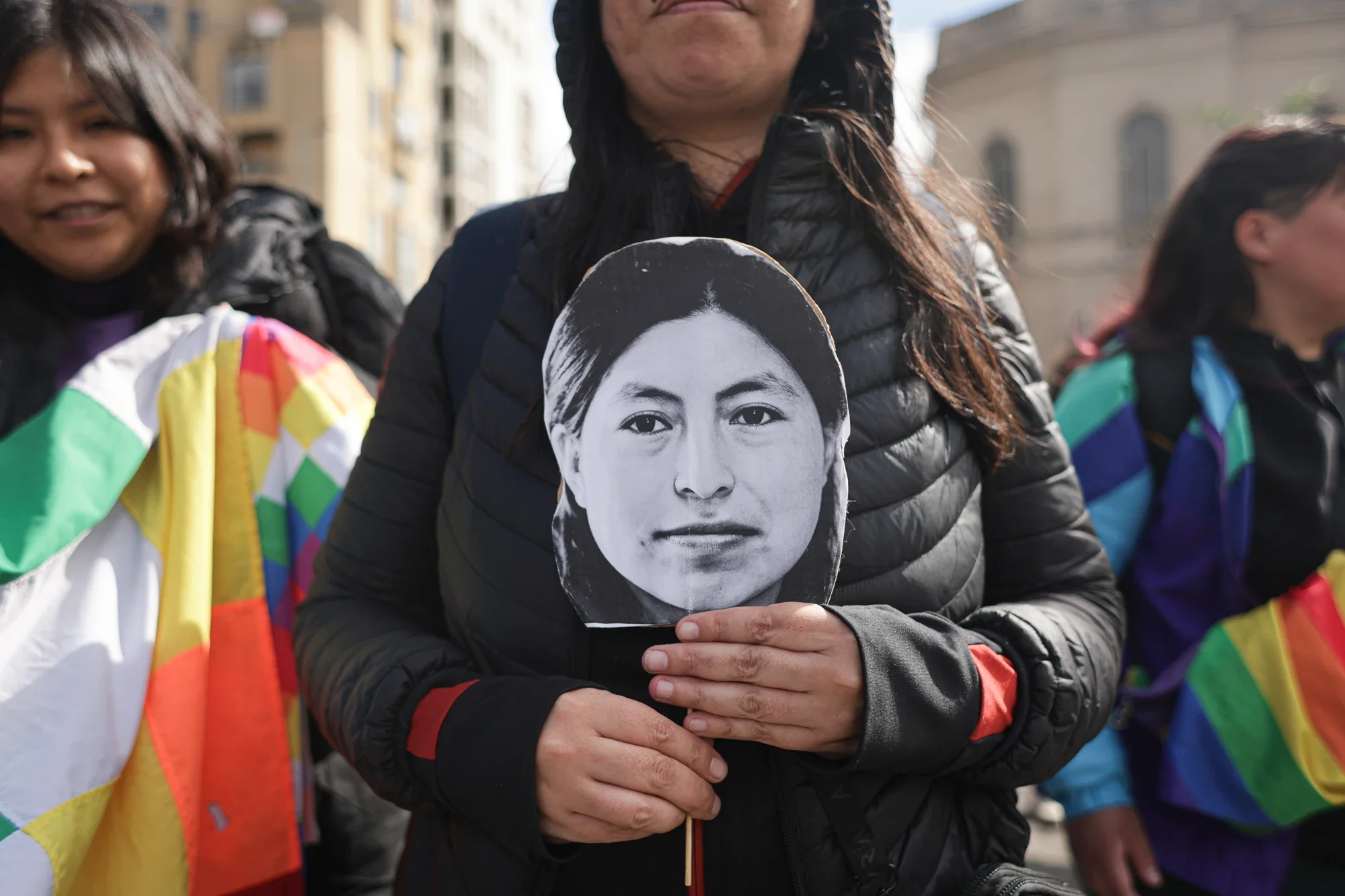
A young woman holds a picture of Delicia Mamani, a Bolivian student and migrant who lived in Córdoba and has been disappeared since November 21, 2025. October 10, 2026, Córdoba City, Argentina. Photo © Susi Maresca.
“We have always existed, and we persist. We have been fighting for 500 years,” said one of the women who led the march carrying a wiphala Indigenous flag. Another carried a portrait of Delicia Mamani, a Bolivian student and migrant who has been missing since November 21, 2025, after leaving her home in Punta de Agua, a remote district in Córdoba. Protesters are demanding that she be returned alive.
The opening ceremony took place on Hipólito Yrigoyen Avenue in the city of Córdoba and featured the reading of the main document, collectively drafted by the Organizing Committee. It highlighted the progress made in the Encuentros and demanded the government comply with Argentina’s hard-won human-rights laws.
“Here we are. Forty years ago, we created this Encuentro, which belongs to everyone. It exists because it is horizontal, self-managed, autonomous, democratic, federal, and plurinational. It exists because, even during one of the hardest times for our people, we decided to come together to share and organize our struggles,” stated the text. “This is a space where our struggles are strengthened, despite our differences, to deliver a political blow to the far right, which challenges our rights both internationally and in Argentina.”
The struggle, according to Argentine labor lawyer, political activist, and feminist Nina Brugo in an interview—who has participated since the first gathering held in Buenos Aires—is against fascism.
Organizing against debt and precarity
Discussions over the weekend focused on 13 key themes organized across nearly 100 workshops. These included social movements and activism, care and parenting, human rights, emancipatory horizons, food sovereignty, and Indigenous and Afro-descendant communities, among others.
There was also a pañuelazo (handkerchief protest) for the right to legal, safe, and free abortion, a demand to condemn the genocide in Gaza and support internationalist struggles, artisan fairs, and parties. Three key moments brought together a large portion of the 150,000 of us who were there.
There was a march against travesticides, transfemicides, transhomicides, lesbicides, and hate crimes and hate speech, with chants of “We exist because there is memory, we resist because there is struggle” and demands for justice regarding the triple lesbicide in Barracas. According to organizers, it was one of the largest marches since the first one in 2018.
This year also saw the addition of the Travesti, Trans, and Non-Binary Commission, as well as the Disability Accessibility Commission, two outstanding issues that are gradually being addressed.
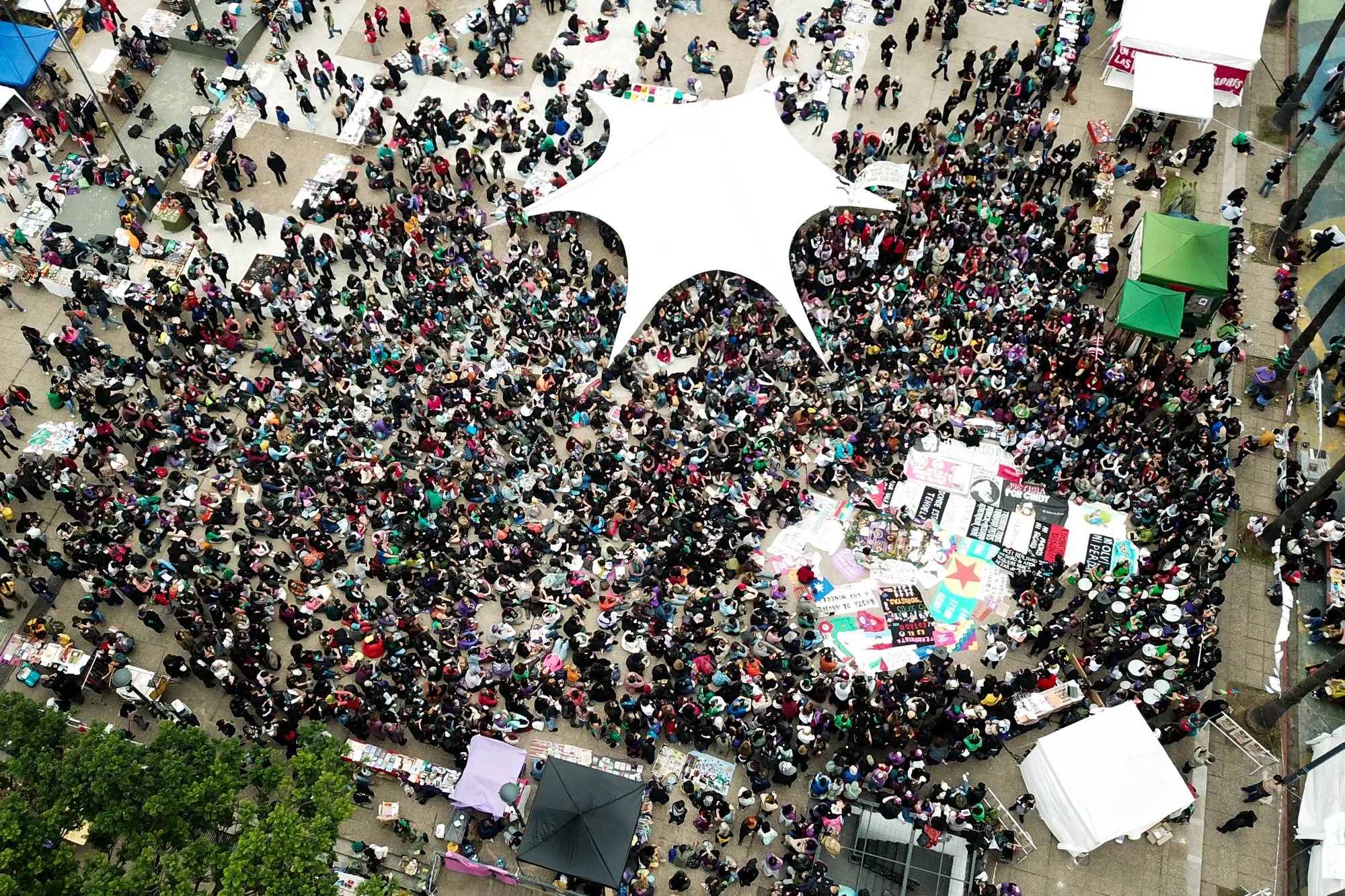
Panoramic view of the massive assembly of feminists from Abya Yala in Plaza de la Intendencia on October 11, 2026. Córdoba, Argentina. Photo © Susi Maresca.
The tree-lined, historic Plaza Colón in the city center hosted the transfeminist assembly for debt relief, one of dozens of assemblies held during the Encuentro. It drew a diverse crowd. It was organized by multiple organizations, with representatives from sectors affected by this crisis: women working in the informal economy, union members, university students, female legislators, rural women, retirees, and transfeminists from Abya Yala in Ecuador, Brazil, Guatemala, and Honduras, among others.
Talking about debt is essential. And not just the debt governments incur to enrich themselves and exploit us. Also, the debt that many women and gender dissidents are forced to take on to sustain their daily lives, like buying food, paying for basic utilities, buying shoes for their children, accessing healthcare and medications in an underfunded system, and commuting every day.
Debt emerges as something we can understand as a form of social control. It undermines diversity, creates isolation, and, as demonstrated in recent months, leads to high suicide rates.
One by one, speakers took the stage, which was overflowing with people.
In rural areas, debt is primarily linked to the advance of extractivism and corporate dispossession of territories, in collusion with governors and officials. It is further linked to the proliferation of drug trafficking and the rise of churches control social unrest.
In bigger cities, debt is more closely tied to sustaining life and care work: buying food and medicine, going into debt to obtain an abortion, paying for education, covering rent, commuting to work, and paying for basic utilities such as water, electricity, or gas. The right to housing and land is not guaranteed for anyone.
“Debt has become a national priority because it is one of the most evident aspects of Javier Milei’s administration,” Luci Cavallero, one of the event's organizers, said in an interview with Ojalá. “In this assembly it became clear what the feminist methodologies are for talking about [debt], and that intersectionality is where its power lies.”
At the end of the assembly, organizers distributed a financial self-defense manual titled the Practical Guide to Organizing Against Debt, which provides straightforward advice on what debt is and how to defend ourselves against financial abuse.
Do we sustain the collective, or does the collective sustain us?
The Abya Yala assembly brought together nearly 2,000 people in the Plaza de la Independencia, uniting women farmers, members of socio-environmental assemblies, and Indigenous transfeminists from Aymara, Kolla, Quechua, Mapuche, Qom, Guaraní, Chorote, Nasa, and other Indigenous nations. The gathering began with a multi-spiritual ceremony and a call to the four elements—water, fire, earth, and air—for liberation from fascism.
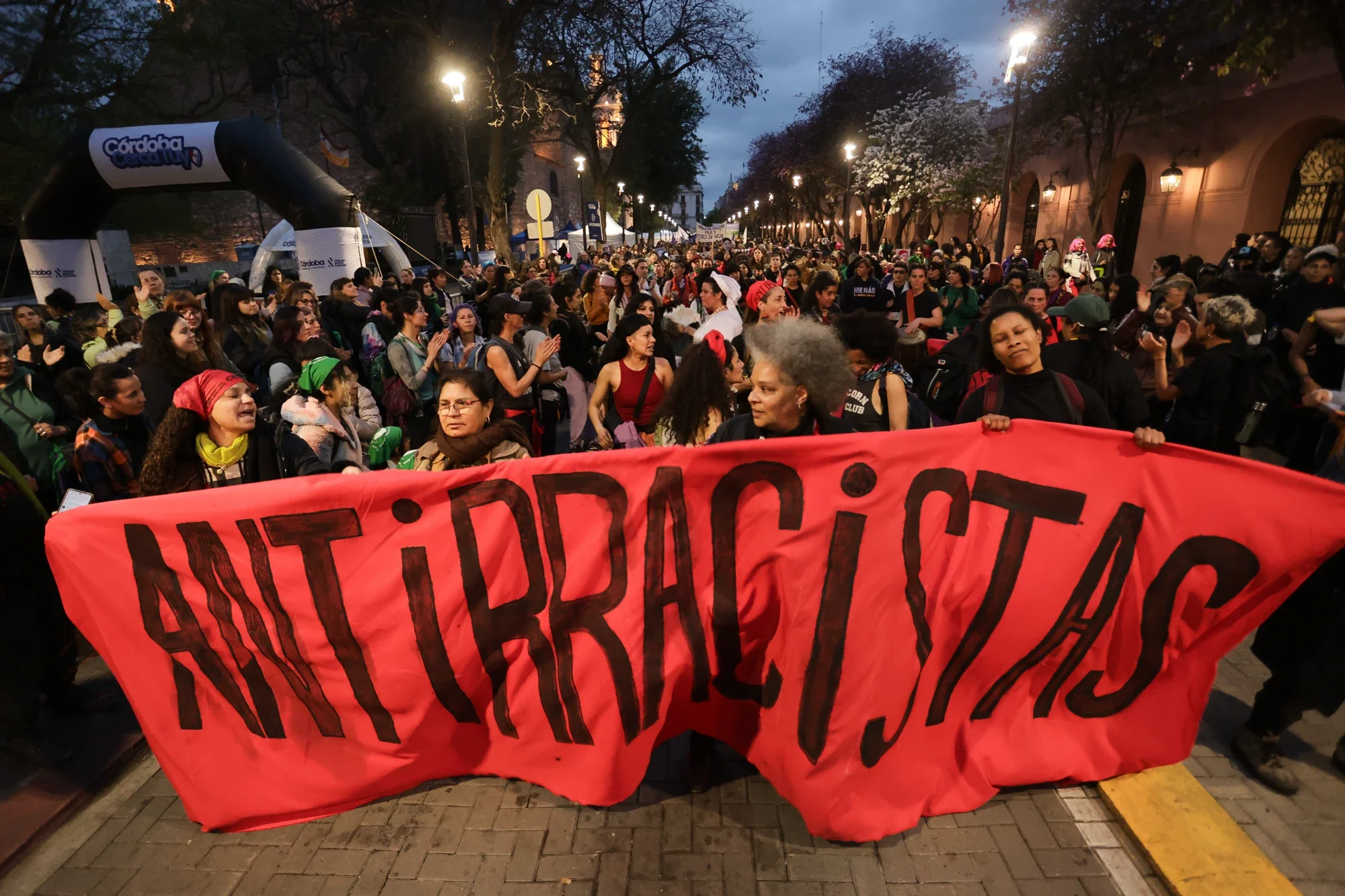
A banner reading “Anti-racists” is displayed during the main march of the 39th Plurinational Gathering of Women, Lesbians, Travestis, Transgender, Bisexual, Intersex, and Non-Binary People on October 11, 2026, in Córdoba, Argentina. Photo © Susi Maresca.
“We come with all our strength, our energy from water and the mountains, a tremendous force for cosmic justice and feminist justice,” said Aura Lolita Chávez Ixcaquic, an Indigenous feminist from Guatemala. “We cannot allow fascism to advance. We know about self-defense, we just have to remember it.”
Sunday ended with a final march. Black and rural communities were strongly represented in the overflowing streets, as were young people. In the darkness, cell phone flashlights glimmered like little stars in the vastness.
Ultimately, whether Encuentro is written with a capital “E” or a lowercase “e,” it’s about collectively addressing and challenging what oppresses us, about returning to the streets and engaging in politics there, about being able to reflect on what we want, what we did well or not so well, about seeking agreements, and trying to coexist with our disagreements. It’s about continuing to strengthen this growing resistance and take concrete steps to confront dispossession.
The next event in 2027 will be held in the Autonomous City of Buenos Aires (CABA, in its Spanish initials), where the first Encuentro was held. “CABA, CABA, CABA, let’s take the Casa Rosada!” shouted the euphoric voices at the closing ceremony of this Encuentro, which brought us together and renewed our struggles to shape the future.
