

Of strongmen and strawmen
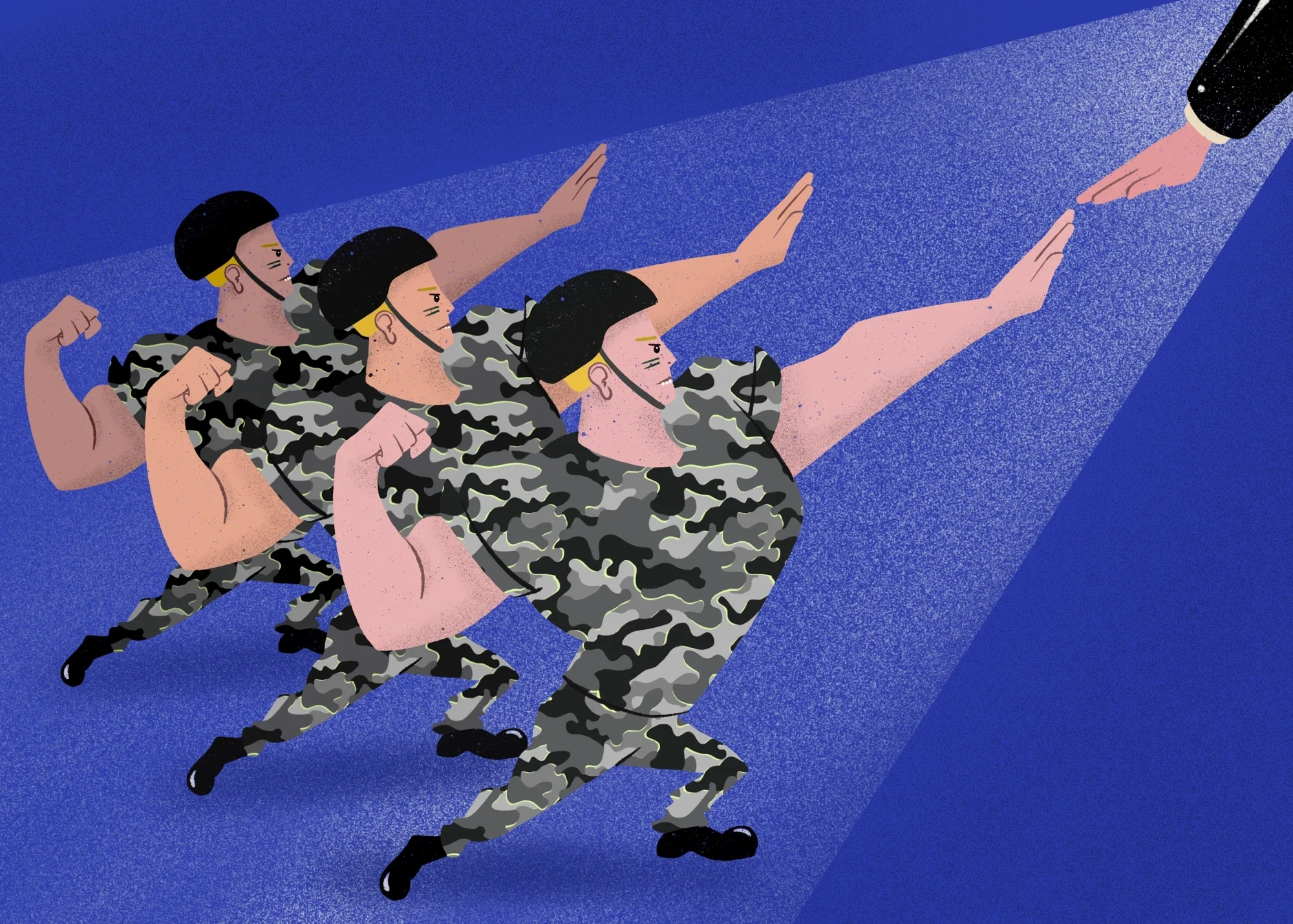
Original drawing for Ojalá by @pazconadie.
Opinion • Marcela Gottschald • October 1, 2026 • Leer en castellano
This is the second in a series of articles examining militarization organized by Ojalá. —Eds
Latin American militarism did not disappear when dictatorships ended between the 1970s and the 1990s. In Brazil and Argentina, whose dictatorships ended in 1985 and 1983, respectively, the armed forces lost ground as direct political actors, but the association between strength, discipline, authority, and order and a certain idea of masculinity remains present in political discourse to this day.
In Brazil, this association is particularly evident in Bolsonarism. Jair Bolsonaro turned his defense of the military dictatorship and his shameful military past—including conflicts with his superiors and an army discharge following accusations of participating in plans to carry out bombings— into central elements of his political identity.
During Bolsonaro’s administration, the glorification of the armed forces went hand in hand with an official discourse that exalted authority, violence, and a traditional notion of masculinity.
His defeat by Luiz Inácio Lula da Silva in the 2022 election led thousands of people to set up camps at military barracks around the country in protest, calling for the military to stop the democratic transition. There were also scenes—that were simultaneously sad and funny—of elderly men marching as if they were soldiers.
Then, on January 8, 2023, thousands of Bolsonaro supporters stormed and destroyed the offices of all three branches of government in Brasília. Many participants were later prosecuted and convicted, others remain in pretrial detention awaiting a court decision.
Argentina is undergoing a similar process of increasingly militarized discourse, but with striking differences due to the way the country dealt with its last dictatorship. Following the return to democracy, Argentina prosecuted those primarily responsible for the dictatorship. Both countries enacted laws shielding the military from prosecution. Brazil's 1979 Amnesty Law remains in effect, while the immunity laws were repealed in Argentina in 2003.
Although Javier Milei does not champion the armed forces with the same intensity as Bolsonaro, his government strengthened their role and systematically undermined policies targeting gender-based violence. Both of these fit into a vision that highlights authority, strength, and a traditional notion of masculinity.
In Chile and Argentina, right-wing governments have sought to rewrite the dictatorial past. In Argentina, this has taken the form of narratives that downplay the crimes of the dictatorship, question the numbers of victims, and portray state terrorism as a legitimate response to violence by armed organizations.
None of this happens by chance. Milei, Bolsonaro, and so many other far-right leaders didn’t simply wake up one day and decided men should be more masculine and more power should be given to the armed forces. The current historical moment and the similarities in their rhetoric reveal a convergence around certain ideas about masculinity, authority, strength, and order.
Different pasts, similar present
Argentine sociologist Verónica Gago and Brazilian anthropologist Rosana Pinheiro Machado link the rise of male resentment to deteriorating economic conditions. In both countries, that resentment has found a target in those fighting one of the major forms of inequality plaguing our societies. Feminism has become a rhetorical scapegoat, an enemy of social and economic progress.
Gago put it bluntly in an interview with El País: the far right takes social frustrations, such as the lack of jobs, housing, and opportunities for young people, and transforms them into resentment against women and gender dissidents. Instead of discussing why these conditions have worsened, it offers a simpler explanation: someone got what should have been theirs.
This is what Pinheiro Machado called the “crisis of the macho,” which is linked to the loss of economic potential and the questioning of men’s traditional role as providers. For her, this crisis feeds directly into Bolsonarism and its violent and authoritarian manifestations.
In Argentina, a report by the Heinrich Böll Foundation on masculinity among young men who voted for the ruling party, La Libertad Avanza, and share its cultural agenda, reveals a similar dynamic.
Some of the interviewees highlight the impossibility of achieving the same standard of living their fathers had when discussing their financial difficulties. In some of their accounts, women and gender-nonconforming individuals are portrayed as part of the problem. If men are having more trouble finding work, some believe it is because women now have advantages they did not have before. Economic frustration thus once again becomes a dispute between men and women.
That is why the perceived imperative to fight against the “mental virus of ‘woke’ ideology,” in the words of Milei at the Davos Forum in January 2025, is gaining momentum. The idea that men have lost something that belonged to them has transformed economic frustration into a dispute over their place in society. That's where the discourse on masculinity begins to intersect with a specific notion of authority.
Far-right militarism
In Brazil, Bolsonaro made the armed forces part of his political agenda, appointing thousands of military personnel to civilian positions during his administration. He also deployed the armed forces in security operations in the Amazon.
In 2022, the armed forces participated in overseeing the voting process that brought Lula da Silva to the presidency, while Bolsonaro publicly cast doubt on the security of the electronic voting system. Although the military was already involved in election-related tasks, its intervention in 2022 took on a political dimension well beyond its traditional roles.
But this was not accompanied by an increase in the military budget. According to the Ministry of Defense, when adjusted for inflation, spending was lower in 2022 than in 2019. What changed under Bolsonaro was the role the military played within the government.
In Argentina, Milei moved to roll back restrictions that had limited military intervention in internal security matters. In 2025, the government launched Operation President Julio Argentino Roca along the country’s northern and northeastern borders, where the armed forces carried out “surveillance and control.” Milei has stated that he is “reconciling the armed forces with politics”. In December 2025, he replaced civilian Luis Alfonso Petri as head of the Defense Ministry and appointed the then-Army chief, Lieutenant General Carlos Alberto Presti. It’s the first time since the return of democracy that a member of the military has led the armed forces at the cabinet level.
In both Brazil and Argentina, the far right has expanded the political scope of the armed forces, either by incorporating them into the government or by extending their functions within the national territory.
Masculinity as authority
The man who emerges in response to this supposed loss of economic status and social standing is not merely the provider who reclaims his place in the family. He is also the man in charge, refusing to be displaced and willing to confront his enemies. The masculinity championed by the far right has much in common with the traditional image of the soldier.
Not all men who espouse anti-feminist rhetoric necessarily want a military government. Nor do all of Milei’s or Bolsonaro’s supporters necessarily have the same relationship with the armed forces. The question is what kind of authority is seen as desirable when the world in which these men hoped to live seems to have crumbled.
The men camped out in front of the barracks after Bolsonaro’s defeat provide a rather clear picture of that relationship. They were not military personnel, but they marched as if they were and hoped that the Armed Forces would intervene. The scene might seem ridiculous—and indeed it was—but it also revealed an identification with an institution that, for them, represented something democracy no longer seemed to guarantee: the strength to restore an order they considered lost.
Although they are not synonymous, anti-feminism and militarism are linked, and can express a similar reaction to social transformations that challenge traditional roles and hierarchies. Rejection of feminism, nostalgia for a traditional family, and the defense of more rigid hierarchies express, to varying degrees, a reaction to advances in women’s rights, such as the right to divorce, reproductive autonomy, and legal equality.
Changes in gender relations are no longer considered part of a broader social process but are instead presented as a loss for men. Democracy, in turn, may be portrayed as incapable of recovering what was supposedly lost.
In this scenario, the strongman figure takes on a political utility that transcends Bolsonaro or Milei. It imagines a specific type of authority as a way to restore stability to a world that no longer offers the certainties of the past. The soldier is one of its clearest embodiments, but the same logic also appears in the glorification of the leader who does not negotiate, the father who commands, or the man who refuses to be displaced.
Militarism does not disappear when the military ceases to rule. It has endured as an idea of authority, a nostalgia for hierarchies that once seemed natural, and as the promise that someone will finally put things back in their place. And when an electorate believes that promise is the antidote to their fear of change, strongmen cease to belong to the past. They once again become a threat to the present and the future.