

Negligence and complicity amplify pain of Mexico’s searching families
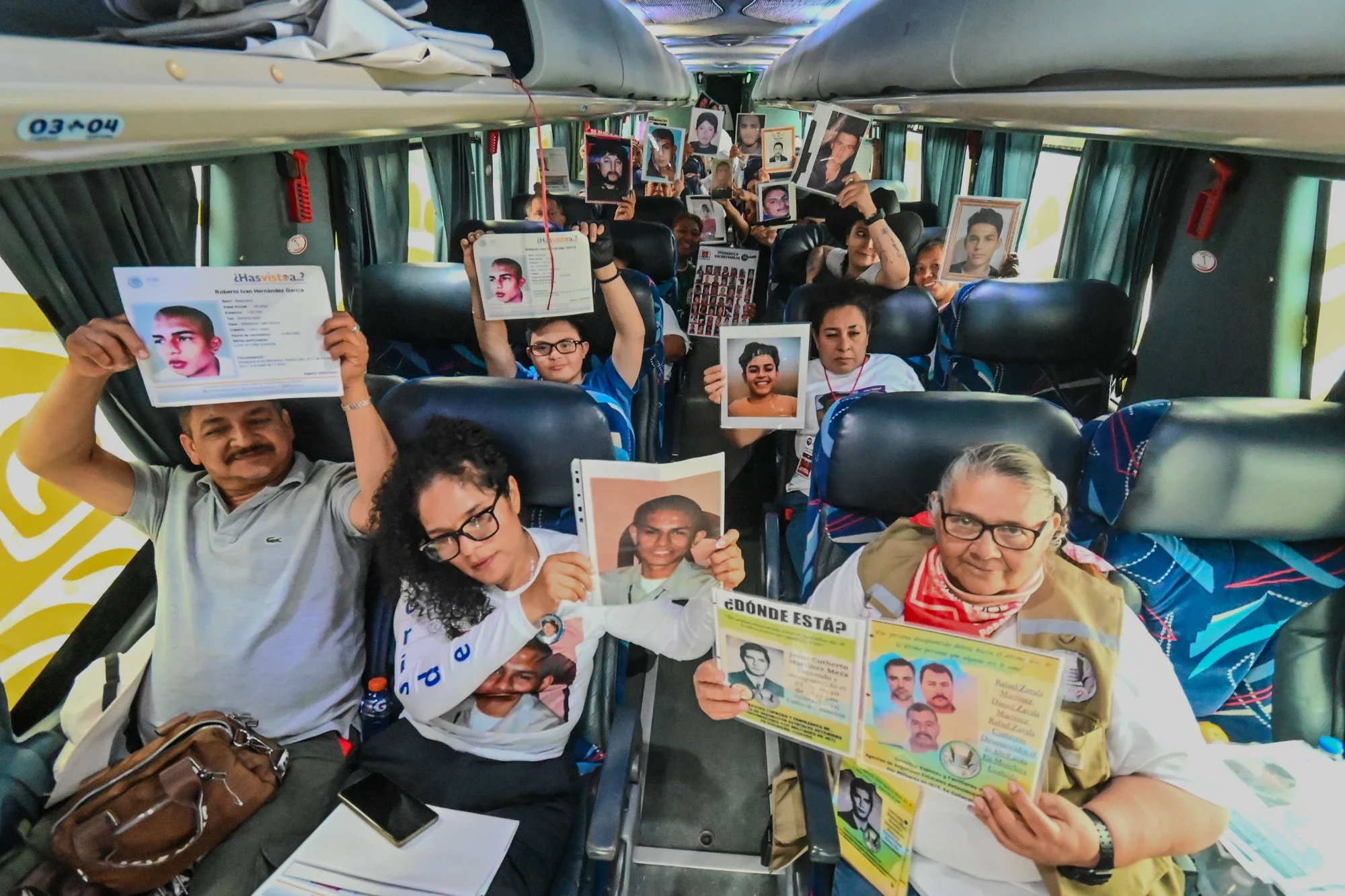
Families participating in the National Search for the Living aboard a bus in Monclova, Coahuila on their way to a paste-up event on September 24, 2026. Photo © Haarón Álvarez/ObturadorMx.
Reportage • Aranzazú Ayala Martínez • October 9, 2026 • Leer en castellano
Over two weeks this fall, family members of the disappeared in Mexico entered prisons and rehabilitation centers to search for their loved ones as part of the National Search for the Living.
Their activities began on September 21 with a march in downtown Monclova, a city ravaged by widespread violence during the early years of the “war on drugs.” In the state of Coahuila, where Monclova is located, 3,691 people were reported disappeared by October 7, 2026, according to official data.
These search efforts are part of a broader landscape of protests, campaigns, and search efforts that have been underway for over a decade in states throughout Mexico.
After the march, a local approached families after seeing the banners with photographs. They told the families that they, too, had a disappeared loved one but did not report it at the time, partly out of fear.
This is an example of how every demonstration activates a kind of network for those searching for a loved one. The march in Monclova came just five days before the 12th anniversary of the disappearance of the 43 teacher-training students from Ayotzinapa, who still have not returned home.
For the most part, families have organized search efforts autonomously, occasionally counting on support from the authorities. Despite progress on paper, new laws and procedures have not led to fewer disappearances or more successful recoveries.
Searching families and civil society organizations say the Mexican state has been more focussed on administering the crisis and bureaucratizing pain than on attending to the issue. This comes through in an increase in disappearances, reports of forced recruitment, and the small number of cases that are solved.
Crisis in broad daylight
The day before the World Cup's first opening match, a massive demonstration was held in the south of Mexico City. Searchers from more than 17 states and from various collectives gathered to march toward Azteca Stadium.
Tlalpan Avenue was blocked by Mexico City government workers as the marchers advanced. Among the workers were high-ranking officials such as Secretary of Government César Cravioto and the local search commissioner, Luis Gómez Negrete.
“What you have to ask yourself is: What were authorities at that level doing trying to curb the demands of a march? That’s not their place,” said Humberto Guerrero, an attorney with Fundar, an analysis and research group in the city. “The way to address these demands is through substantive work—through search efforts—not at a march,” Guerrero said in an interview.
Jorge Verástegui is a searcher and a member of the Roundabout for the Disappeared in Mexico City. He’s been searching for his brother, Antonio Verástegui González, and his nephew, Antonio de Jesús Verástegui Escobedo, since they were disappeared on January 24, 2009.
He said that on August 30, the International Day of the Disappeared, many people joined their activities, which he saw as being a result of the efforts made during the soccer World Cup.
These protests are part of a difficult reality in which impunity reigns, with over 133,000 disappearances recorded according to official figures.
As more people have become aware of the issue of disappearances, it has become increasingly complex and continued to worsen.
“I think the fact that there is now an indeterminate number of search groups speaks to the severity of the crisis and, above all, to the state’s lack of response,” said Verástegui. “The groups continue to shoulder the government’s responsibility when it comes to search efforts.”
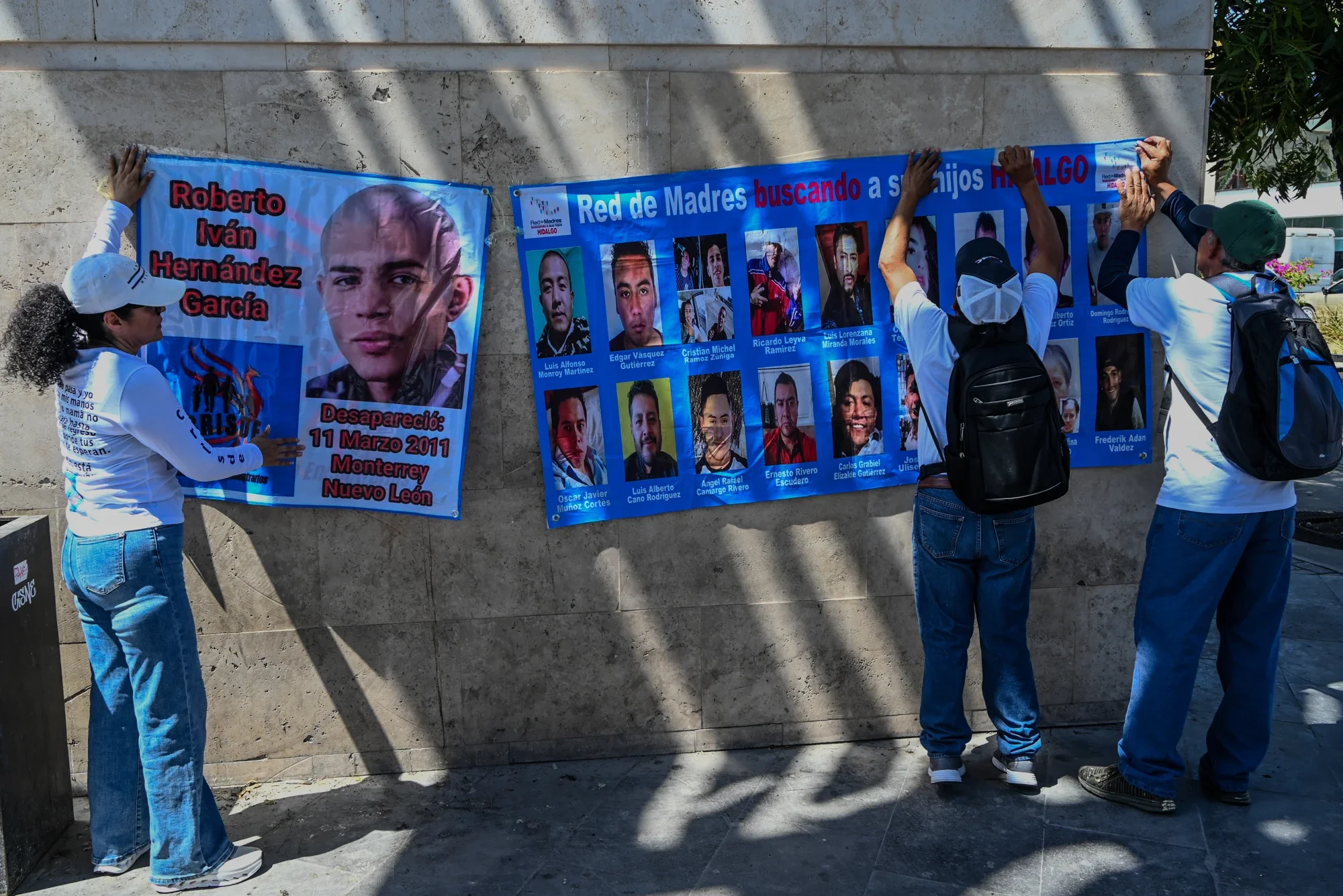
Families searching for their disappeared relatives display banners with photos of their loved ones in the Main Square of Monclova, Coahuila, on September 21, 2026. Photo © Haarón Álvarez/ObturadorMx.
The bureaucratization of disappearance
Nearly 20 years after the so-called “war on drugs” began in December 2006, disappearances in Mexico continue to multiply in parallel with search efforts.
Verástegui, one of the activists with the most time in the struggle, noted that over nearly two decades, the situation has become increasingly convoluted, in part because the institutional framework has been gradually established and expanded.
The laws and agencies created during these years—including the Victims’ Law, the Law on Enforced Disappearances, Disappearances Committed by Private Individuals, the National System for the Search for Missing Persons, and as the state and federal Search Commissions and Victim Assistance Commissions, as well as special Prosecutor’s Offices specializing in disappearances, among others—have generated a massive amount of additional bureaucracy.
Today, in cases of forced disappearances, the agency that should investigate the crime is the Prosecutor’s Office at the local or federal level. The Search Commission is supposed to conduct the searches. At times, gray areas arise where Prosecutor’s Offices and Search Commissions pass the buck to one another or limit their own scope of responsibility, leaving evidence and leads unfollowed.
In addition, many families take their case to federal authorities—specifically, the Attorney General’s Office (FGR in Spanish)—because of the perception that those cases move faster or receive better treatment. This involves traveling to Mexico City and longer wait times to schedule working meetings and follow-ups.
In this increasingly bureaucratic system—with more paperwork and more links in the chain of action—the actual search “ends up being the last step,” according to Verástegui. This is compounded by the extremely low percentage of cases in which perpetrators are arrested, and an even lower percentage in which they are convicted.
For Verástegui, public prosecutors’ offices remain a major obstacle. They have not been reformed beyond changes on paper, and they are ultimately in control of investigative actions.
“It appears that they are the ones operating this pact of impunity, which does not distinguish between one political party and another," he said in an interview with Ojalá. “It seems ingrained in Mexico’s institutions, as they try to hide the fact that disappearances are happening.”
Nallely Guarneros has been searching for her husband, Sergio Rueda Daniel, and her sister-in-law, Liliana Rueda Daniel, since they were disappeared in Tehuacán, Puebla, on July 16, 2019.
“Institutions have indeed been created, from the National Search Commission to the state-level commissions, protocols, the national search system, and so on,” said Guarneros. “But it has always been driven and motivated by our compañeras [fellow relatives of the disappeared].”
Government attempts to downplay the issue of disappearances have continued. In mid-2023, the National Comprehensive Search Strategy (known as the “census of the disappeared”) was created. It was spearheaded by Andrés Manuel López Obrador and continued by Claudia Sheinbaum. Today, it is considered an attempt to reduce the official number of missing persons.
The census involved calling families with a report of a disappearance to confirm whether that person remained unaccounted for.
Throughout his administration, López Obrador claimed the actual number of the disappeared was much lower than the reported figure and that the strategy would reduce the numbers instead of dedicating resources to investigative efforts. His administration saw the highest number of disappearances on record, outstripping the number of disappeared during the administrations of Calderón and Enrique Peña Nieto.
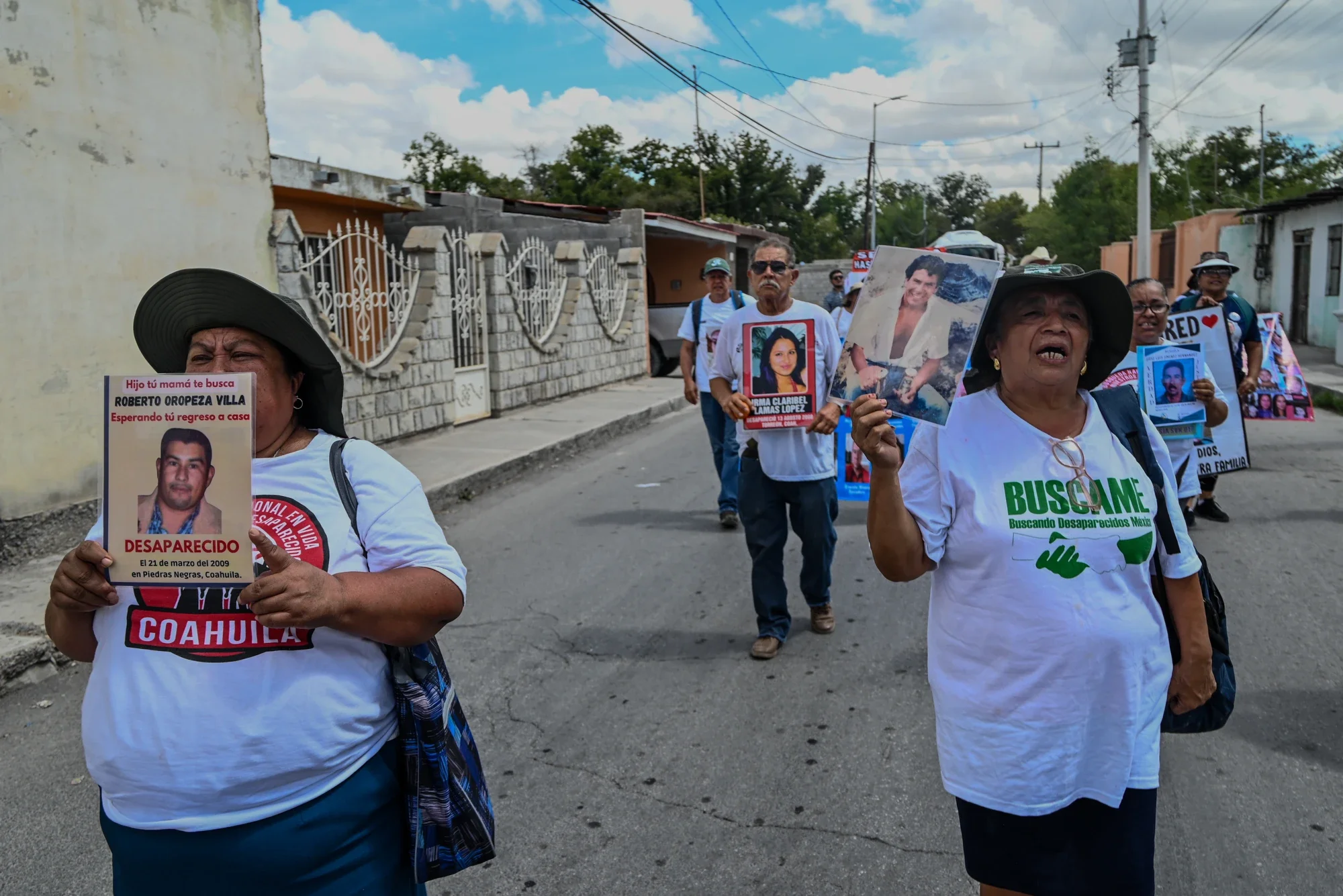
Families searching for the disappeared hold photos of their missing relatives during the march through the streets of San Buenaventura, Coahuila, on September 24, 2026. Photo © Haarón Álvarez/ObturadorMx.
Enforced disappearances and the military
The role of the military stands out as one of the major unresolved issues today, and remains a key concern when it comes to enforced disappearances.
Throughout Mexico’s history, military activity has been the common denominator in cases of enforced disappearances—including those during the so-called Dirty War. These de facto power structures are fundamental to understanding the dynamics of violence in the country, and they remain unaccountable for rights violations.
Meyatzin Velasco, director of education at the Miguel Agustín Pro Juárez Human Rights Center (PRODH), notes that there have been allegations of collusion or direct involvement by the armed forces.
“Today we live in an era in which public security and militarized security forces have been given power they did not have before in ways we’ve never seen,” said Velasco in an interview with Ojalá. “[This is true] not only with regard to territorial control, but also in terms of involvement in civilian matters where they should not be involved, we’re seeing major setbacks. I wouldn’t even call them pending issues anymore—they’re setbacks.”
The Army withholds information (in cases such as Ayotzinapa), refuses to open classified files (including from the era of the “Dirty War”), is unaccountable, and now controls immigration and infrastructure sectors, according to the PRODH representative. “What we are experiencing alongside the crisis of disappearances is a crisis of impunity,” said Velasco.
Despite this challenging scenario, what became evident through the social organization of collectives of family members of the disappeared after the World Cup was a willingness to engage in dialogue and struggle together, despite their differences.
The National Search for the Living in Coahuila is one such example. During its two-week search efforts, the initiative located one person alive and gathered leads on at least 31 others, showing how the organizing efforts by families themselves have always sustained the struggle.