

In El Salvador, exception is the rule
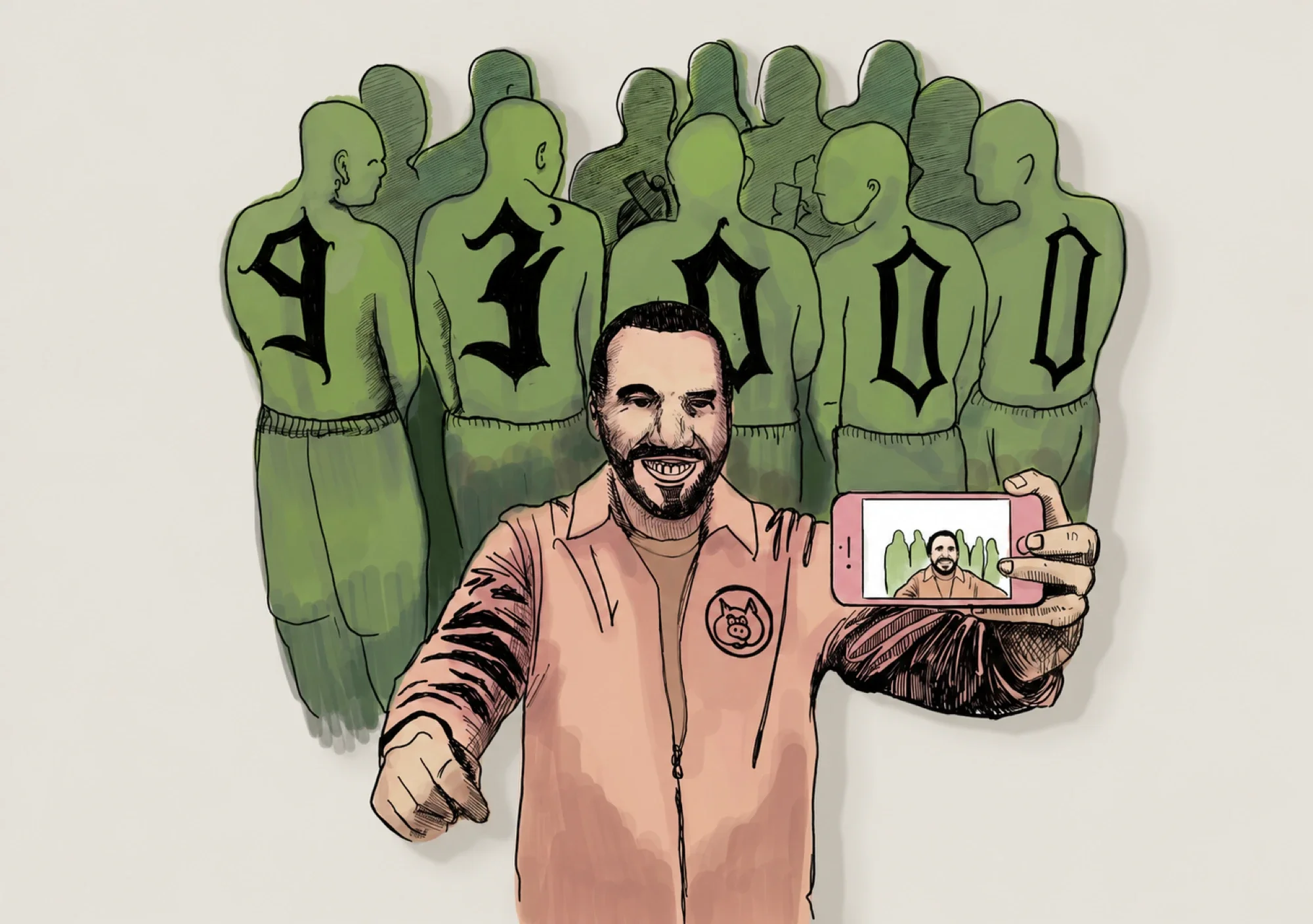
Digital illustration created in Autodesk SketchBook for Ojalá © Andrés Alcalá Rodríguez
Opinion • Andrés Alcalá Rodríguez • October 8, 2026 • Leer en castellano
Víctor Barahona’s body bears the impact of Nayib Bukele’s regime. Barahona is a community journalist who works in radio and television. He was arrested at his home by members of the National Civil Police on June 7, 2022, a little over two months after the state of emergency began. He went on to spend 11 months in the Mariona and Isalco prisons.
He weighed 246 pounds when he went in and 166 pounds when he got out. In Cell 48 at Izalco, 100 men slept in a space designed for 50, lying on their sides to fit. They were given expired medication and punished by being forced to kneel from 6 p.m. until dawn. “They treat you like a rat,” Barahona said in an interview.
After decades of high crime rates, Bukele’s dictatorship claims to have transformed El Salvador into the “safest country on the continent.” In reality the country has been living through back-to-back extensions of the state of emergency since 2022. On September 23, 2026, the Legislative Assembly approved the 55th extension.
Today in El Salvador, experiences like Barahona’s are all too common. There is ample evidence that the state of emergency has reached beyond the fight against gangs. It is used as a tool for selective persecution against anyone deemed critical of the regime, those detained can be in pretrial detention for up to three years before anyone has to prove anything.
A timeline of state capture
Bukele, an advertising executive, came to power in the February 2019 elections under the banner of the Grand Alliance for National Unity (GANA).
In addition to being from the far right, his victory marked a break with El Salvador’s traditional two-party system comprising the Nationalist Republican Alliance (Arena) and the leftist Farabundo Martí National Liberation Front (FMLN).
Bukele’s administration was marked from the outset by an unconstitutional use of state power and highly polarizing campaign slogans. On May 1, 2021, the Legislative Assembly removed every member of the Constitutional Chamber, which ensured compliance on the part of the executive and legislative branches. Government officials alleged that the Chamber acted unconstitutionally in ruling against decisions made by the Ministry of Health during the COVID-19 pandemic. Its members were replaced in a matter of hours.
On September 3, 2021, the new Bukelian Chamber reinterpreted Article 152 and authorized consecutive presidential reelection for the following term.
Previously, a sitting president could not run again for a decade after leaving office. In response to the new Chamber’s decision, attorney Enrique Anaya filed a petition to strip the justices of their citizenship rights, noting that the Constitution at the time mandated that penalty for anyone who promoted or supported immediate presidential reelection. Later, the regime would make him pay the price for his defiance.
The Supreme Electoral Tribunal acquiesced to Bukele’s new interpretation and left the door open for his reelection with Nuevas Ideas in 2024. Those elections were deemed fraudulent by the opposition and directors of the Electoral Oversight Board, one of whom, Jeovany José Maravilla, was arrested this year.
The next step toward autocratic rule came in April 2024, when the outgoing Legislative Assembly voted to repeal Article 248 of the Constitution so that a given legislature could ratify the reforms it proposed.
Finally, in July of that year, it approved indefinite presidential reelection, extended the presidential term from five to six years, and eliminated runoffs—all in a single session.
Entrenching an authoritarian norm
As I write, the state of emergency in El Salvador has been in effect for over four uninterrupted years. Legislators claim the measure has allowed the country to record “1,172 days without homicides, 1,058 [of which] the measure has been in effect.”
The regime thus admits that the conditions justifying the state of emergency have disappeared which means that there would be no need to extend it. Or do the official figures hide something else?
Of course they do. While the Legislative Assembly labels all detainees—including those who have been released and those who were never charged—as “gang members,” the state of emergency is proving increasingly useful for persecuting critics, be they activists, reporters, or human rights defenders.
What remains now is to sharpen the regime, to make it harsher. The Legislative Assembly has amended the Constitution to allow life imprisonment for certain crimes, including “terrorism.” Similar provisions have been used by the Milei administration in Argentina, as well as by the United States, Israel, and Chile against the Mapuche people.
In his book Fascism and Dictatorship, Nicos Poulantzas explains that fascism is a specific form of regime within a capitalist state of exception. Fascism emerges within the state that organizes capitalist relations, and cannot be explained solely by the will of a single ruler.
In El Salvador, the crisis of representation had two sides. For three decades, Arena was the traditional party of the oligarchy. Following economic adjustments, however, the Salvadoran bourgeoisie no longer needed a party of its own This led to a split in its membership ahead of the 2019 elections. And the FMLN, which since the 1992 Chapultepec Peace Accords had represented the working classes, completed two terms in office without transforming the country’s structure and in doing so, it lost its base. Bukele broke with the two-party system by winning the presidency in 2019 as the GANA candidate, and went on to consolidate the Nuevas Ideas party ahead of the 2021 legislative elections.
Poulantzas describes fascism as a process. It is not something that happens overnight, but rather something that advances to the point of no return—the moment when it seizes power.
In El Salvador, the ruling apparatus is repressive (the police and the army) and Nuevas Ideas mobilizes its base at the polls and on social media, not in the streets. The dissolution of the Constitutional Court, indefinite reelection, and four years of a state of emergency reflect how the state has been reorganized to facilitate this process. Whether the point of no return has already been crossed will be determined by the 2027 election—or the lack thereof.
The cost of fascism
According to Amnesty International, at least 470 people have died while in custody since the state of emergency began.
In addition, the International Group of Experts for the Investigation of Human Rights Violations in the Context of the State of Emergency in El Salvador (GIPES) recorded 540 cases of forced disappearance up to February 2025.
These deaths and disappearances are not mentioned in the Legislative Assembly’s communiqués celebrating renewals of the state of emergency. Undoubtedly, these are crimes against humanity, which are denied by the state.
The cost can also be measured by the number of people who are in prison. More than 90,000 of the recorded detentions have been administrative (not criminal) since the regime began.
This year, Amnesty International reported National Civil Police officers admitted that they were given daily arrest quotas and verbal instructions to fabricate arrest reports. The talk is no longer of targeting gang leadership, but of meeting arrest quotas. The instruction to fabricate reports means that anyone can be detained.
Once in prison, it is very difficult to get released. Article 17 of the Law Against Organized Crime allows detainees to be grouped in a single case based on their alleged membership in a criminal organization. It also gives the Prosecutor’s Office up to 24 months—extendable by another 12 months upon a reasoned request to the judge—to file formal charges.
This means that defendants can be kept waiting for an indictment for up to three years while they remain in pretrial detention.
Verónica Delgado is an emblematic case in El Salvador’s prison ordeal. Her daughter, Paola Jimena Arana Delgado, was disappeared in 2022. On March 11, 2024, police entered Delgado’s home without a warrant and detained her because, according to her lawyer, “they viewed her as suspicious.”
She was charged with participating in an illegal organization, and was released on pretrial conditions in April of that year. As of last month she was still seeking dismissal of the charges before a court for organized crime. The Prosecutor’s Office has until 2027 to indict her.
Delgado and Maravilla—the director of the Electoral Oversight Board—were both charged with the same crime: unlawful association. Article 345 of the Penal Code punishes the mere act of participating in a group that the authorities deem unlawful. That’s all it takes. The government’s mere characterization of a social or community organization as a criminal structure is enough to land you a one-way ticket to prison.
Then there’s Fidel Zavala, spokesperson for the Unit for the Defense of Human and Community Rights in El Salvador (UNIDEHC), who publicly condemned the presence of torture in prisons. He was arrested on February 25, 2025, during a raid that included a search of UNIDEHC’s headquarters. On April 2, he was transferred to Mariona Prison by the very guards he had accused of torture.
Ramiro Navas from the José Simeón Cañas Central American University, names this practice the criminalization of “community profiles and civic participation” without clear guarantees of due process.
The Bukele government boasts that El Salvador is “the safest country on the continent.” But Barahona, Zavala, Delgado, and the over 90,000 people detained under trumped-up legislation understand firsthand the cost of living under the “safest” fascist dictatorship in the Americas, where over the past four years, the state of emergency has become the norm.
Special thanks to my colleagues and friends Oswaldo Feusier and Emperatriz Flores, revolutionary lawyers committed to justice and love for their people.