

Popular mobilizations seek to put the break on foreign control of Argentine land
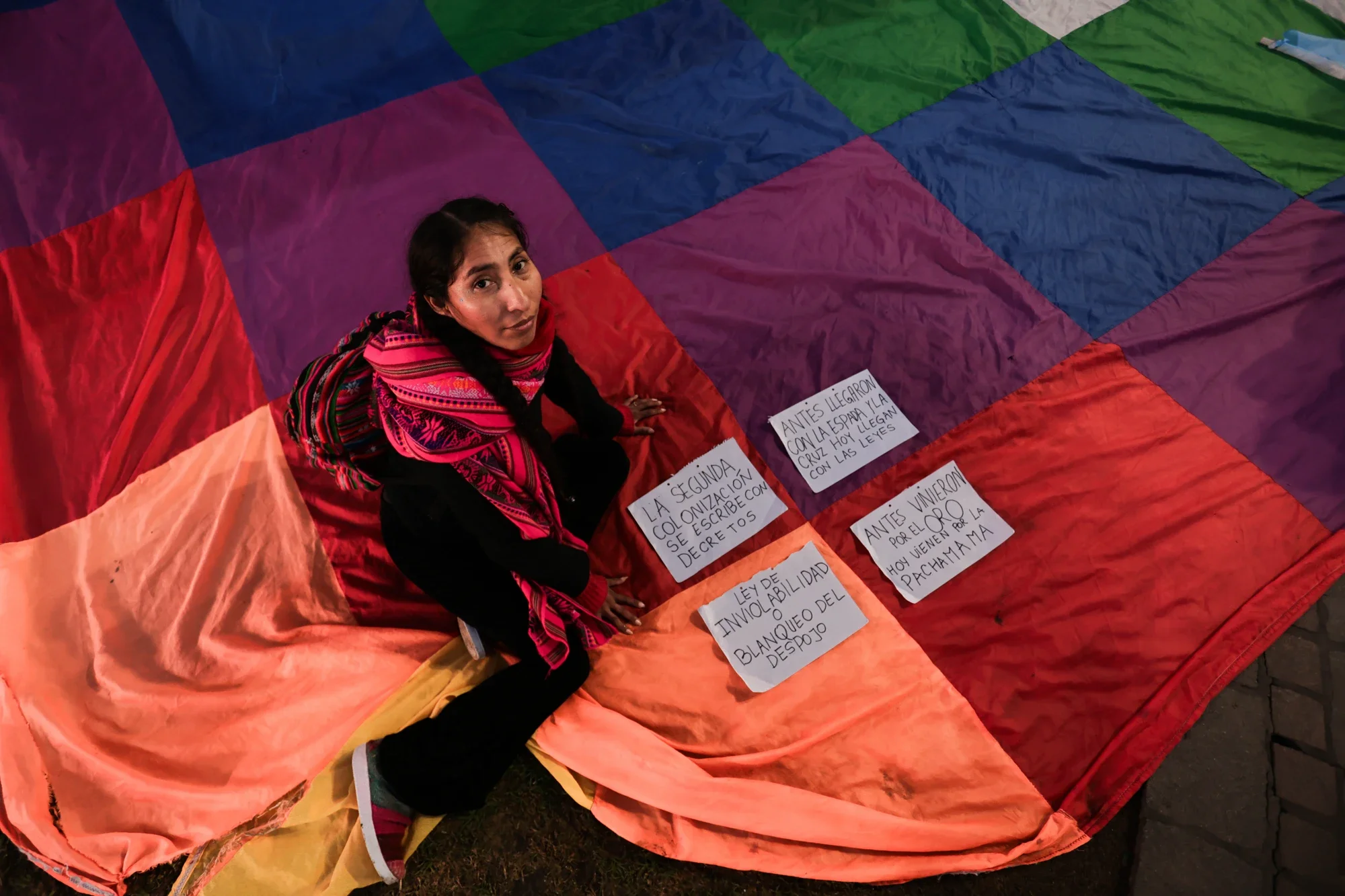
Tati Quispe, a Quechua-Aymara woman and member of the Indigenous media outlet TeleSisa, holding signs proclaiming “The second colonization is written by decree” on August 1, 2026, in Buenos Aires, Argentina. Photo © Susi Maresca.
Reportage • Susi Maresca • September 4, 2026 • Leer en castellano
Torrential rain was predicted in Buenos Aires on August 6. People carrying umbrellas slowly gathered near the Argentine National Congress in an action in defense of national territory in the face of yet another attempt by Javier Milei’s government to push forward what grassroots activists call the “Foreign Ownership Law.”
The bill championed by the La Libertad Avanza (LLA) led government is formally called the Law on the Inviolability of Private Property. Among other things, it was aimed at loosening the protections established by the Land Law, which was enacted in 2011.
Through the bill, the government sought to remove the cap on the amount of land that can be sold to foreign investors, raising it from 15 percent to 25 percent. This includes territories that are home to areas with lakes and rivers, as well as border areas.
Scientists and land defenders dubbed the government bill the “Foreign Ownership Law.” If passed, critics say it could benefit foreign elites tied to the technological sector and artificial intelligence.
Opposition to this bill mobilized thousands of people to protest throughout Argentina on August 6.
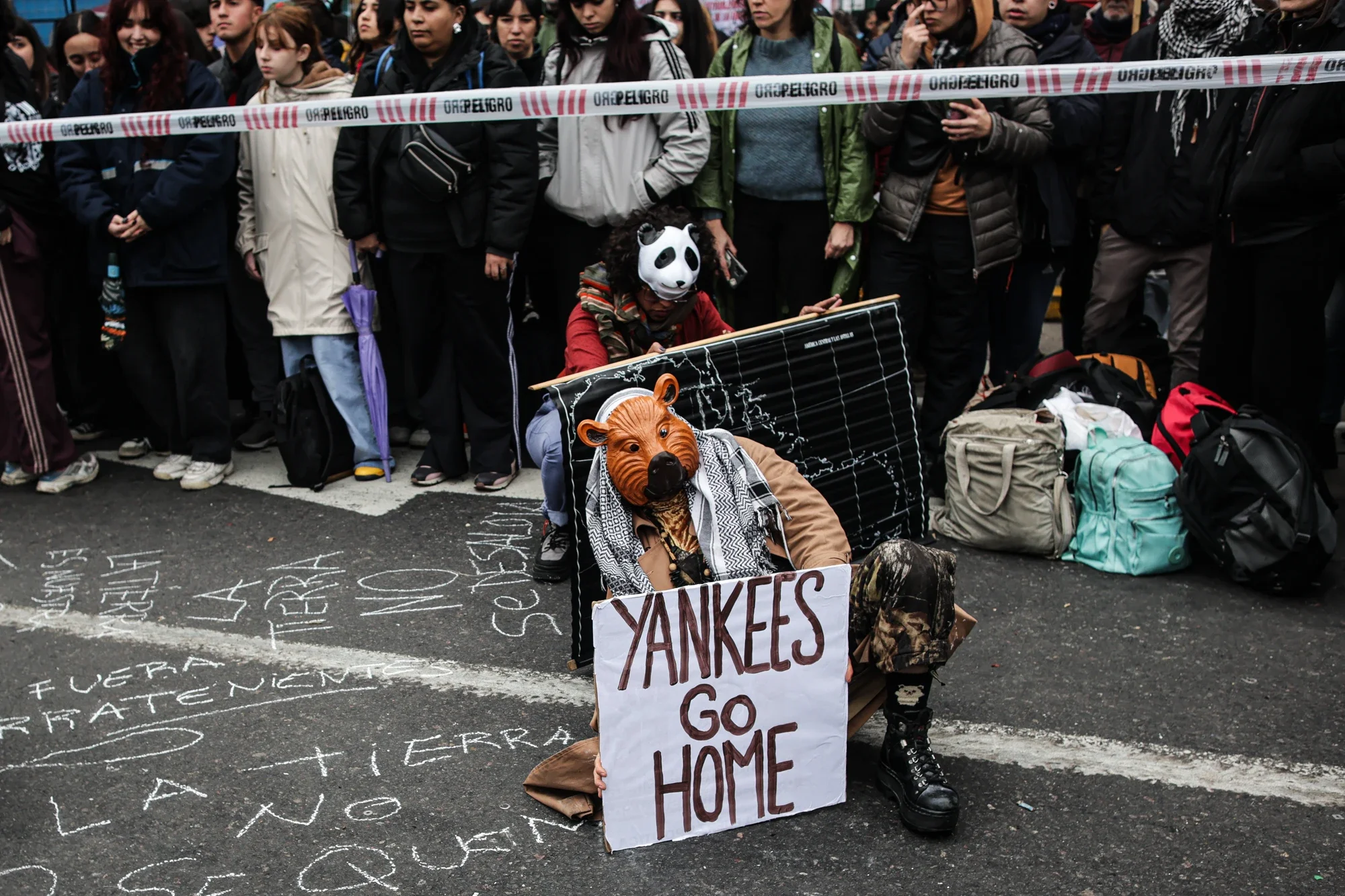
“Yankees go home,” reads a sign held by a young woman during a performance in front of the National Congress on August 6, 2026. Buenos Aires, Argentina. Photo © Susi Maresca.
There were hundreds of gathering points across the country, organized by the same assemblies and communities that had previously come together to defend glaciers against similar legislative advances from the government.
The demand was clear: “The land is not for sale, it will not be burned, and it will not be removed.”
Key losses
The day before the protest, Patricia Bullrich, the former minister of security and current LLA senator spearheading this takeover, announced that Chapter III had been struck from the Law on the Inviolability of Private Property bill before it reached the Senate floor. Chapter III sought to amend the Land Law.
Despite the announcement, a victory, the protest outside went ahead as planned.
It was scheduled for noon, although the bulk of the crowd arrived around two. No one could have predicted so many people would show up, or foreseen the brutal repression and police hunt that unfolded until the early hours of the next morning. Over 1,500 were injured and 28 arrested in Buenos Aires.
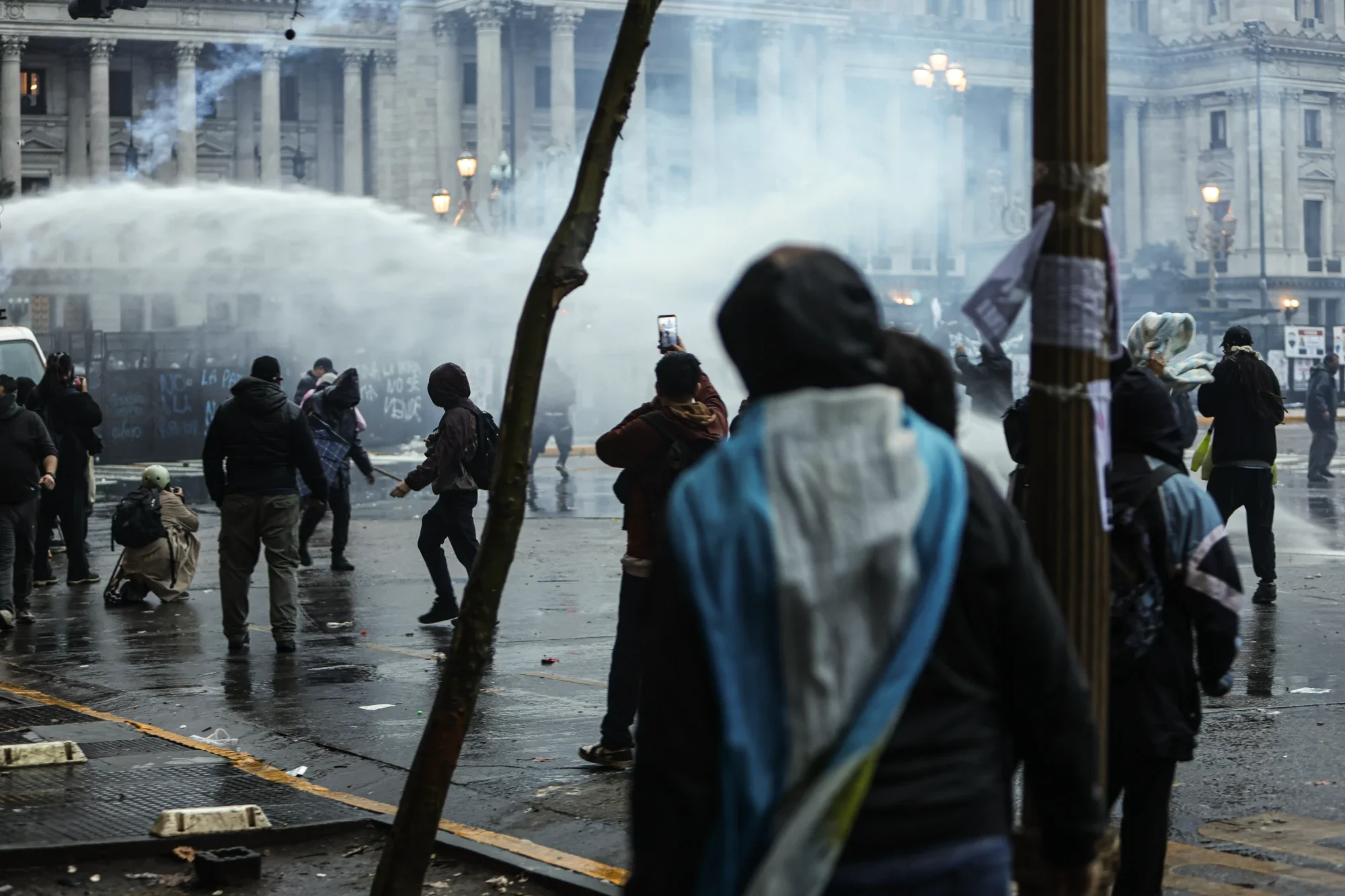
Repression at the National Congress during the march in defense of the Land Law. August 6, 2026—Buenos Aires, Argentina. Photo © Susi Maresca.
For Guillermo Folguera—a biologist, philosopher, and researcher at the National Scientific and Technical Research Council (CONICET)—the bill’s attempt to open up land to foreign ownership is not isolated.
“It is essential to view this effort in relation to the approval of the Incentive Regime for Large Investments (RIGI), as well as the current attempt to pass the ‘Super RIGI,’ the gutting of the Glacier Law, and the Labor Flexibility Law, among others,” said Folguera in an interview with Ojalá.
The RIGI was created in 2024 through the Ley Bases, which granted Milei extraordinary legislative powers. The RIGI established a series of special tax, customs, and exchange-rate exemptions for foreign corporations for 30 years, benefiting large capital groups active in mining and oil exploitation.
The Law on the Inviolability of Private Property, according to Folguera, is complemented by other pieces of the same puzzle, including the government’s slashing of the environmental protections enshrined in the Glacier Law.
“They have guaranteed the handover of territories to international corporations and financial groups linked to agriculture, real estate, and hydrocarbon extraction,” he said in an interview with Ojalá.
As the bill made its way to the Senate, it gradually lost more key provisions intended to encourage real estate speculation. For example, Chapter IV, which would have amended the Fire Management Law, was removed. This law protects land damaged by fire for 30 to 60 years, a regulation designed to deter arson for commercial purposes. The proposal to undo the protections came on the heels of a summer of record-breaking fires in key areas like the Patagonia region.
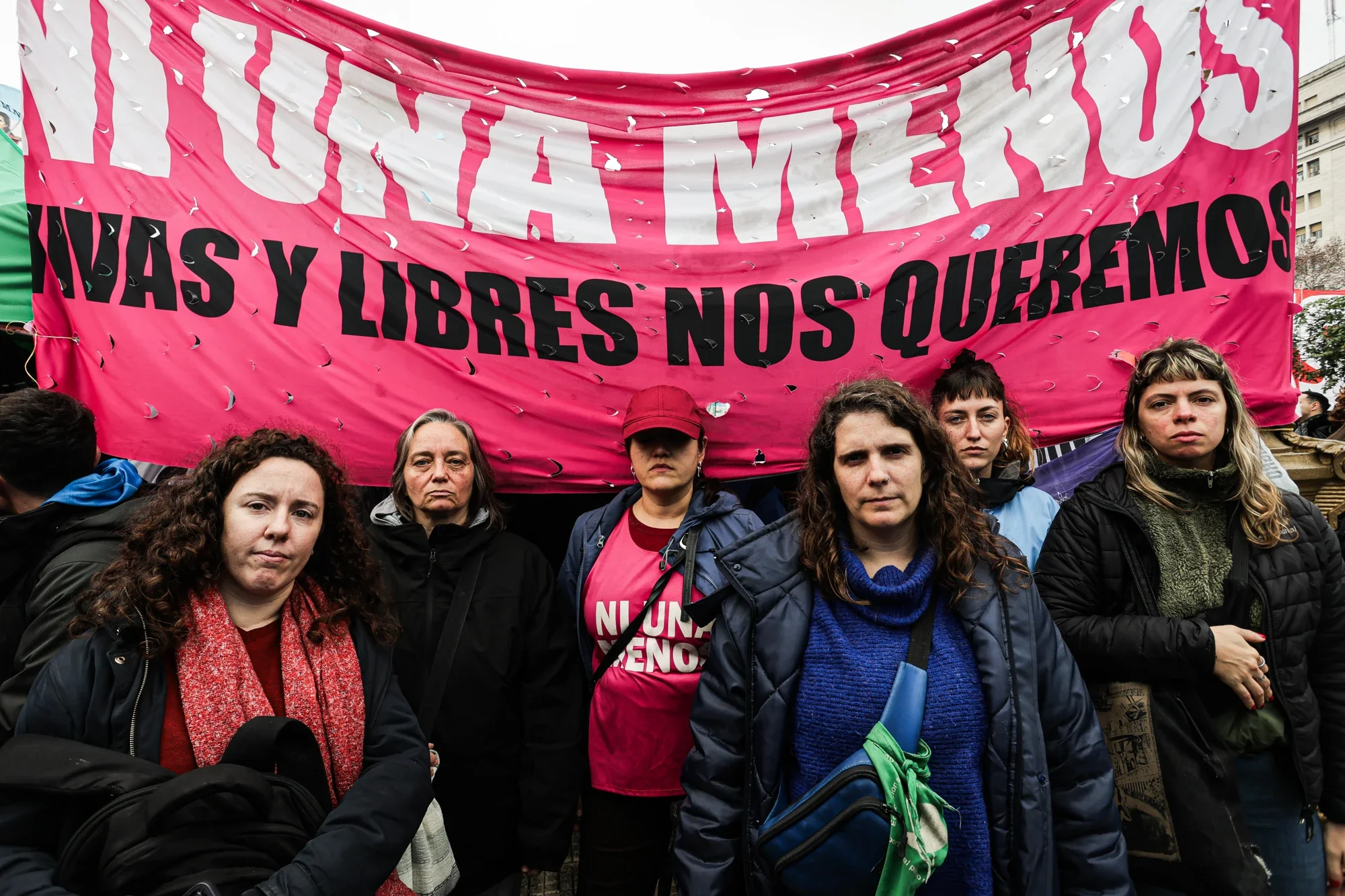
The NI UNA MENOS collective with a banner reading “We want to be alive and free” at the march outside Congress defending the Land Law on August 6, 2026. Buenos Aires, Argentina. Photo © Susi Maresca.
“We unraveled the very heart of the project,” said an elated Jessi Gentile, coordinator of the Ecosocialist Network and a member of the Basta de Falsas Soluciones (Enough Fake Solutions) collective, which organizes the defense of natural resources at the federal level.
“That didn’t happen because a parliamentary majority suddenly appeared that was willing to defend our territory,” said Gentile. “It happened because a diverse, plurinational mobilization grew, turning what seemed like a technical issue into a deeply popular discussion.”
For Gentile and others, land defense struck a chord in a way that hasn’t happened in a long time. That had to do with the revival of historical memory made possible, in part, by the men’s national soccer team unfurling a homemade banner proclaiming “The Malvinas [Islands] are Argentine” as they celebrated their victory over England in the World Cup semifinals.
Eviction and expropriation
Despite walking back parts of the bill, on August 7, 2026, the Senate passed two key chapters of the Foreign Ownership Law: Expropriations and Eviction Procedures.
This is particularly damaging for tenants, as well as for Indigenous communities.
Since the repeal of the Indigenous Territorial Emergency Act in 2024, which suspended evictions until property surveys were completed, evictions have grown steadily.
If the Foreign Ownership Law were enacted, it would legalize the dispossession of those who today represent the last line of struggle and resistance against extractivism and in defense of nature.
“I want to ask everyone here if they’ve ever stopped to think that this land belongs to us, not to whoever has the most,” sang Víctor Jara in Desalambrar.
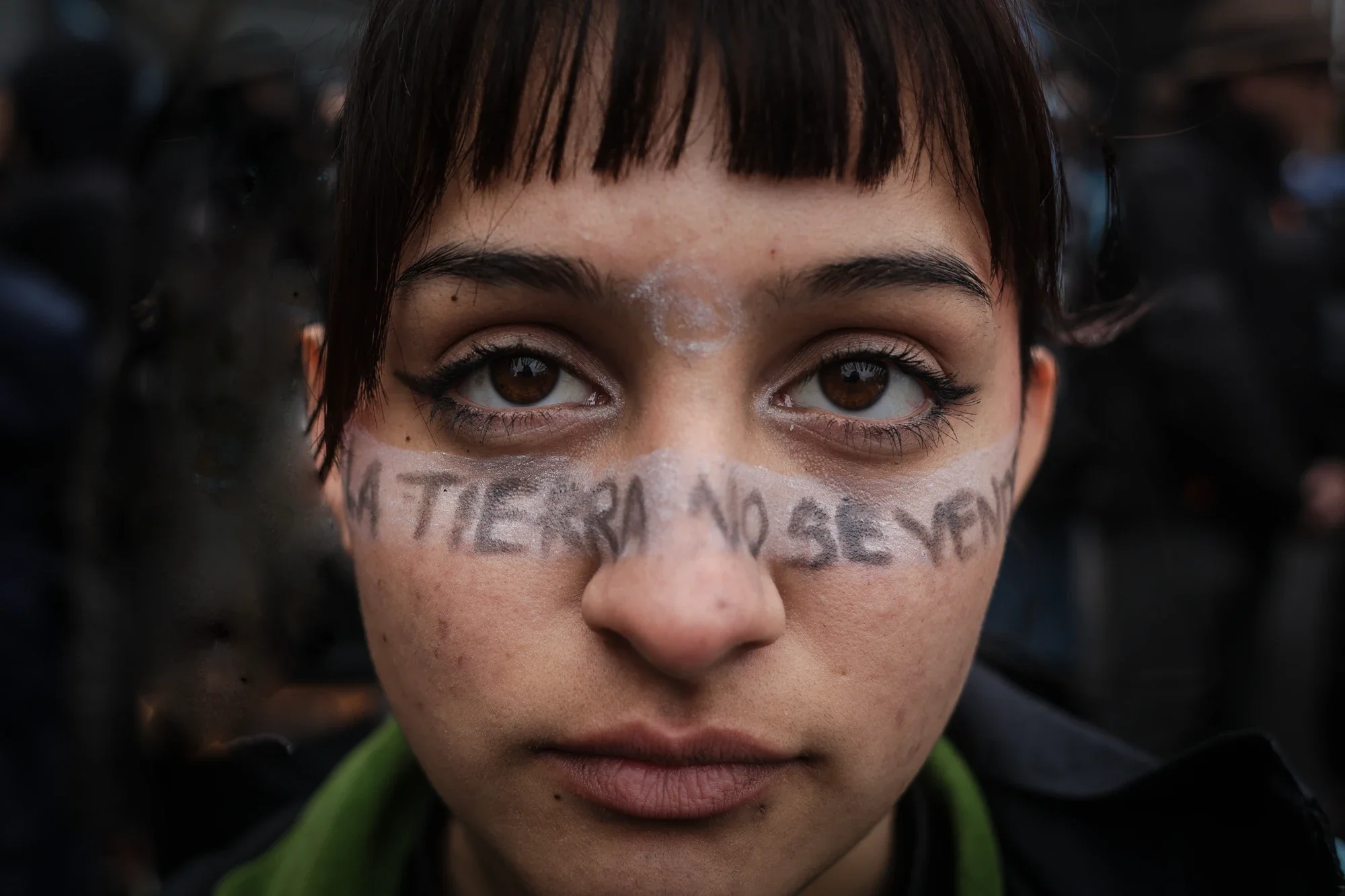
A woman has “La tierra no se vende” (The land is not for sale) written on her face on August 6, 2026. Buenos Aires, Argentina. Photo © Susi Maresca.
The struggle over land in Argentina is intrinsic to the nation-state and its founding paradox. Argentina is a country built upon the genocide of Indigenous peoples, the massacres of workers, and land grabs.
Over the course of 200 years, disputes over land among the wealthy have played out violently. Many of those who govern today, such as Bullrich, inherited lands violently expropriated from Indigenous communities in the 19th and 20th centuries.
More recently, in 1982, at the height of the civil-ecclesiastical-military dictatorship, an illegitimate war laid bare that same logic of land grabbing in a strategic territory known as the Malvinas Islands.
It was not until 2011, with the enactment of the Land Law, that a check was placed on the modern advance of foreign ownership. The restriction is broad, allowing only 15 percent of national, provincial, and municipal territory to remain in foreign hands.
According to the country’s Land Observatory, 13 million hectares in Argentina, equivalent to 5 percent of the country’s territory, belong to foreign investors. This raises serious concerns about the proposed increase to 25 percent sought through the Foreign Ownership Law.
The Observatory created a map showing areas where the foreign ownership limit exceeds the 15 percent established by law, and this, they emphasize, is the most concerning issue. They point out that there are 36 districts that already go over the legal limit—like Lácar in Neuquén, General Lamadrid in La Rioja, and Molinos and San Carlos in Salta—where foreign ownership exceeds 50 percent.
All of these areas are home to strategic resources such as fresh water and minerals. In addition, Iguazú in the province of Misiones, Ituzaingó and Berón de Astrada in Corrientes, and Campana in Buenos Aires—all located along the country’s main navigable waterway, the Paraná River—far exceed the 30 percent threshold.
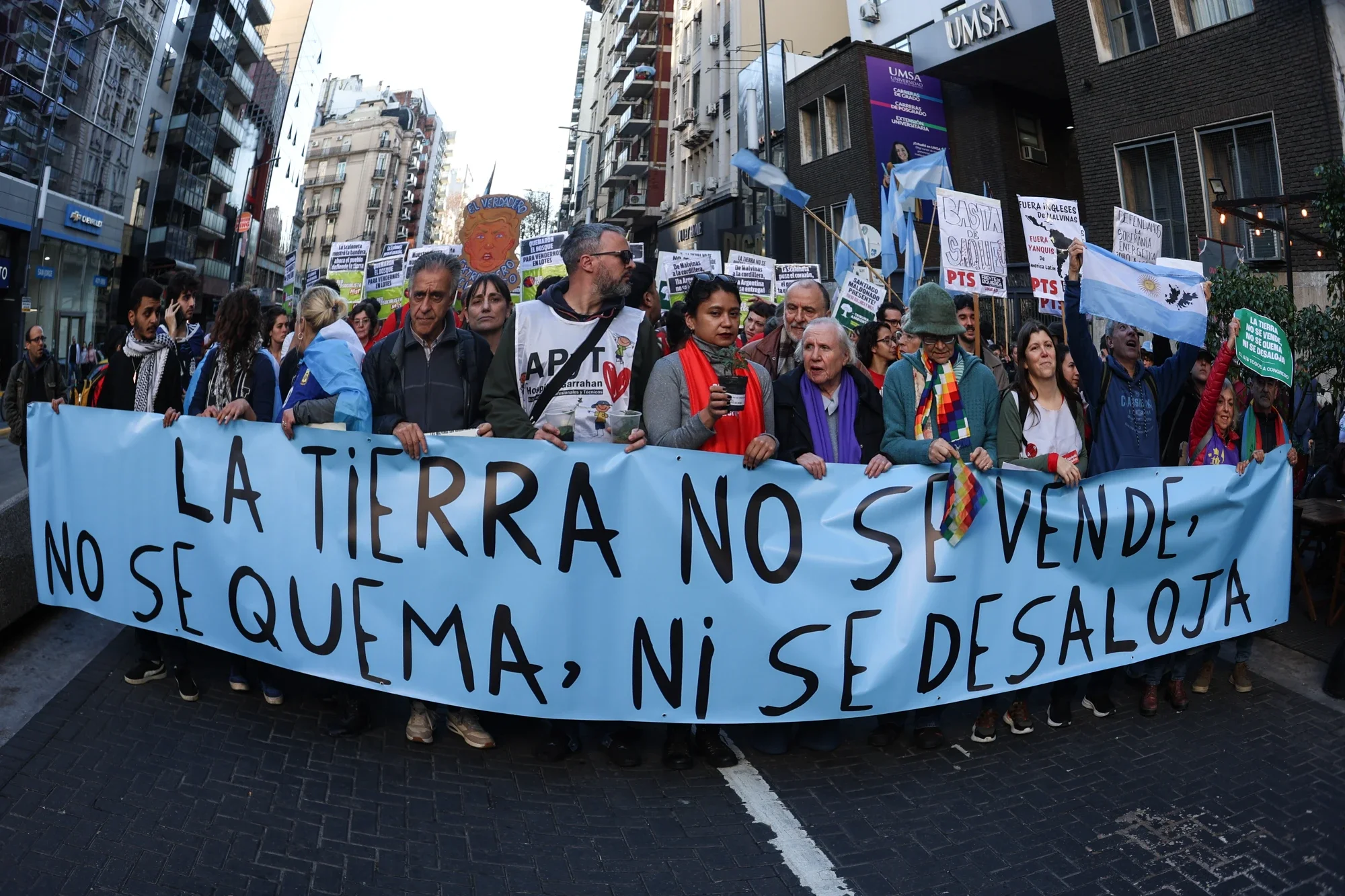
“Land must not be sold, burned, or removed,” reads the banner at the head of the march on Corrientes Avenue on August 1, 2026 in Buenos Aires, Argentina. Photo © Susi Maresca.
Who is the land for?
According to Gentile, it would be a mistake to think that blocking key provisions of this law has ended threats to Argentine land. “We must look at what is happening in the realm of artificial intelligence and data centers used for surveillance and social control,” she said.
Gentile is referring to Peter Thiel, founder of PayPal and CEO of Palantir, who has been in the country for more than four months meeting with Milei and his officials. He represents the new global tech elite seeking territories and regulatory frameworks tailored to their needs.
“This isn’t science fiction or technological modernization, as the government would have us believe,” Gentile said in an interview. “We’re talking about who’s going to control the infrastructure, energy, data, and territories necessary for a new economy.”
Although tech magnates speak of “the cloud” as if it were floating in the sky, the cloud needs land: AI and data centers require land, enormous amounts of energy, and water.
That is where, according to the experts interviewed, changes to laws protecting national territory—such as the Land Law—intersect with this new offensive by the Silicon Valley barons.
The fundamental question is: for whom and for what purpose is the land being developed?
If the Law on the Inviolability of Private Property is passed, international powers will gain a major opportunity to encroach upon everything that is alive in Argentina.
That’s why a wide range of environmental, transfeminist, and labor organizations, along with Indigenous communities, are calling for a nationwide “march of rage” on September 19.
The name references “La marcha de la bronca”—the iconic Argentine rock protest anthem, which includes the lyrics: “I cannot bear to see so many organized lies without answering, in a hoarse voice, with my rage.”
