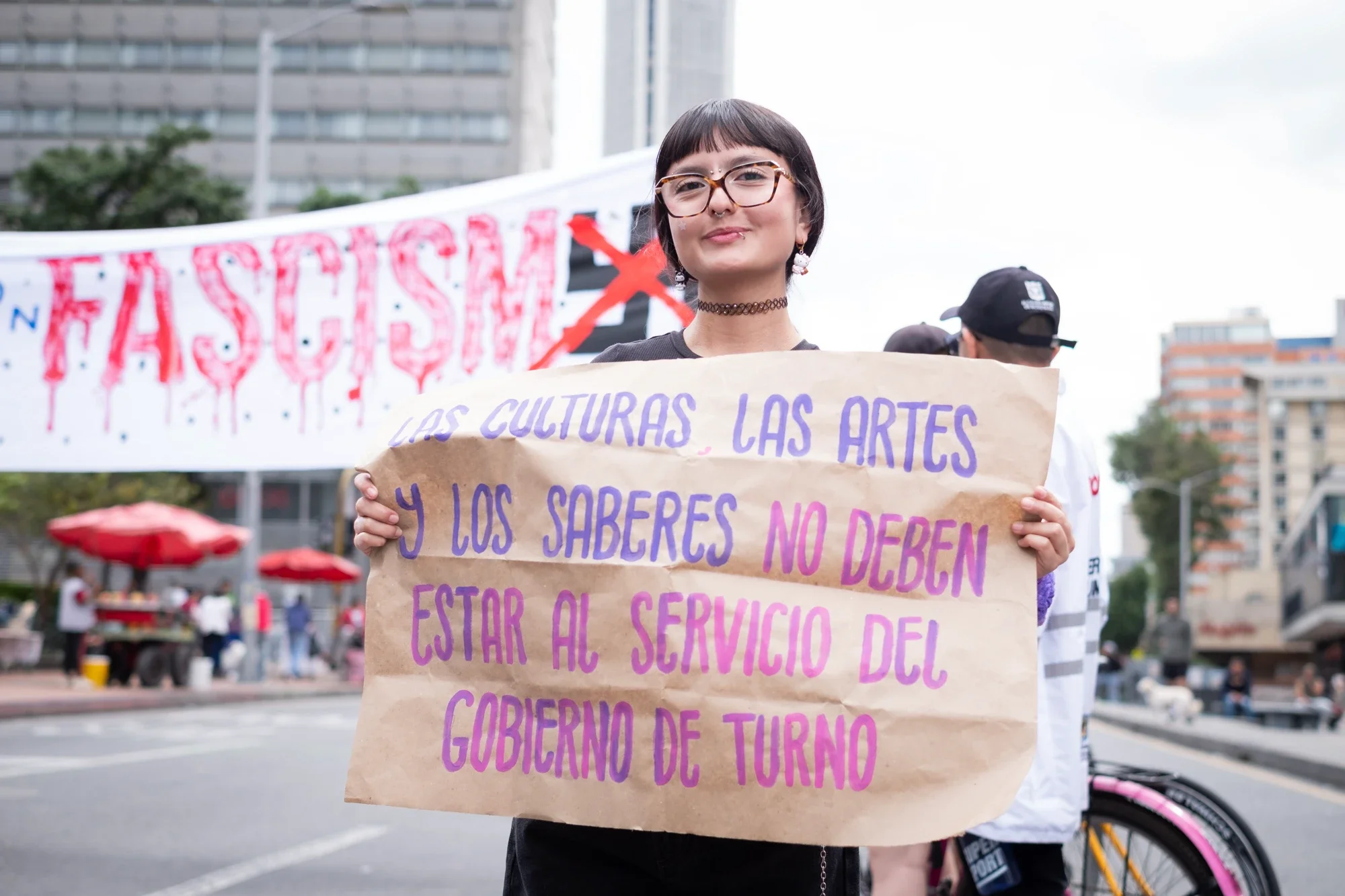
A protester holds a sign reading “Culture, the arts, and knowledge shouldn’t be in the service of whoever is governing” during a demonstration against censorship at the National Museum in Bogotá, Colombia, on October 25, 2026. Photo © Mariana Mora.
Reportage • Mariana Mora • October 29, 2026 • Leer en castellano
“Every dictatorship starts with censorship!” was one of the slogans shouted on the streets of downtown Bogotá on October 25.
Around 200 people marched from the National Museum to Plaza de Bolívar, protesting the removal of more than 30 pieces showcasing the LGBTIQ+ and feminist movements, the victims of the Patriotic Union, and the Peace Accords from exhibition on orders of Colombian President Abelardo de la Espriella.
For many, this censorship is a warning sign of escalating fascism on the part of de la Espriella's government, which took power on August 7. In his inaugural address, de la Espriella pledged to wage a “culture war to restore the values of family, merit, discipline, respect for the law, love of country, belief in God, and individual responsibility.”
“The right wing, which in many parts of the world is already a consolidated fascist force, is talking about imposing its worldview on people, about winning over people’s hearts and minds,” said Mariana Ramírez, a supporter of the group Revolutionary Communists of Colombia.
For Ramírez and her comrades, it’s important to understand what fascism is and how it operates through what is called a “culture war.” During Sunday’s protest, the third of its kind since the pieces were removed, her group distributed fanzines and posters explaining these ideas.
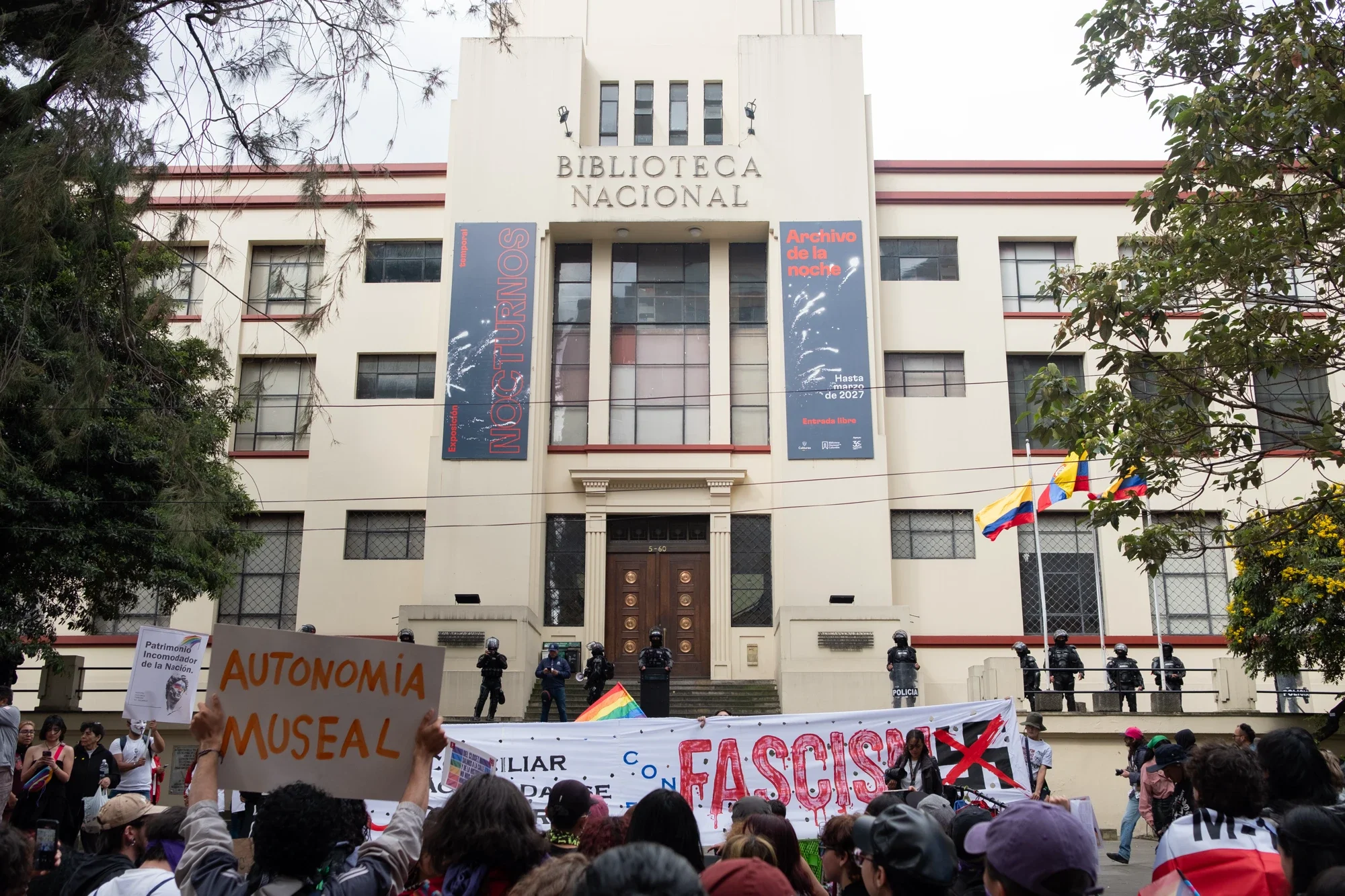
Protesters stop in front of the National Library during the march against censorship in Bogotá, Colombia, on October 25, 2026. Photo © Mariana Mora.
On October 15, during his first visit to the Ministry of Culture, de la Espriella announced the start of a “cultural counterrevolution,” which he said is “aimed at restoring traditional values and principles to Colombian society and strengthening national identity.” He instructed Paola Holguín, the Minister of Culture, to remove from public spaces any depictions he described as “glorifying terrorism.”
Hours later, museum officials removed more than 30 items from a permanent exhibition tracing the country’s history and diversity. Among them were banners related to the LGBTIQ+ movement; photos, magazine covers and historic posters from feminist struggles; the pen used to sign the 2016 Peace Accords; a ballot for the Seventh Referendum, the citizens’ initiative that led to the 1991 Constitution; and other items associated with the assassinations of leftist presidential candidates Carlos Pizarro and Bernardo Jaramillo
Protests under threat
“We have to return to a critical and scientific way of thinking in order to objectively analyze history,” said Ramírez, referring to the efforts to censor Colombian history. “We won’t be able to understand all historical processes to the letter, but we can get as close as possible and confront what has made us uncomfortable, because it’s part of our history.”
A day after the pieces were removed, Minister Holguín defended the move, arguing that the National Museum cannot “serve as an instrument of political indoctrination” nor “be a space that condones crime.”
The public response was immediate. Multiple petitions demanded that the museum return the items to display. That weekend, hundreds of people protested outside the National Museum, and over the following week, professors from the National, Externado, Javeriana, and Andes universities held open classes on the museum’s outdoor steps as a form of protest.
During the first two days of the protest—October 17 and 18—protesters experienced a crackdown that included the use of armored vehicles, water cannons, and stun guns, according to Temblores, a human rights organization in Colombia. Police from the National Anti-Riot Unit stood guard at the museum during the open classes, though they did not crack down on the participants.
”In Colombia today, we feel threatened by the national government. This is a government that has declared all-out war on our fundamental rights,” said Camila Farfán, an LGBTIQ+ feminist activist who, along with her fellow activists, reprinted some of the removed pieces to distribute them among the protesters. “We took to the streets because we see our very existence threatened by this government.”
Censorship has not been the only way De la Espriella's government has violated the rights of the LGBTIQ+ population. In September, the Minister of Education, Ilva Myriam Hoyos, submitted a request to suspend Joint Resolution 1350 of 2026, issued by the Ministries of Health, Labor, Education, and Culture, that adopts the National Intersectoral Policy on Sexuality, Sexual Rights, and Reproductive Rights. This document, which was to be in place from 2026 to 2035, establishes a framework to guarantee access to health services, prevent gender-based violence, end pregnancy among girls under 15, and to incorporate comprehensive sex-ed into institutional educational programs and teacher training. The Minister requested a Presidential Directive to suspend its implementation while the resolution for its repeal is under review.

A protester holds a sign that reads “Every dictatorship begins with censorship” during a demonstration against censorship at the National Museum in Bogotá, Colombia, on October 25, 2026. Photo © Mariana Mora.
In a press release dated October 16, Caribe Afirmativo, a sexual and gender diversity rights group said Hoyos’s request “poses a threat to the progress made in recognizing sexual and reproductive rights, comprehensive sex education, and the creation of learning environments free from discrimination.”
The request came days after the Foreign Ministry announced Colombia’s withdrawal from the Equal Rights Coalition, an international organization that brings together governments and civil society from 42 countries to promote and protect the rights of LGBTIQ+ people.
In response, Colombia’s Office of the Ombudsperson expressed concern in a context in which discrimination, stigmatization and violence related to prejudice continue. According to data from the Attorney General's Office compiled by the Ombudsperson, 74 people of non-hegemonic sexual orientations and gender identities were murdered in Colombia last year. As of August 19, 2026, 31 such murders had been recorded.
Collective reflection and action in the face of the far right
“It’s all connected and cuts across the board,” said Lety Muñoz, a member of the Feministas Antifascistas de Colombia collective. “The war that has been declared on us is not only legislative, but also symbolic.”
Over the past 10 years, the anti-fascist feminist group has done grassroots organizing, educational work, and raised awareness about fascism. They believe popular education is one of the most important areas in resisting the current reactionary offensive.
Ramírez shares a similar view. “The most important tool is critical thinking,” she told Ojalá when asked what to do in the face of the “culture war,” adding that the truth must be defended. “We must be brave at a time when everything is under attack.”