

Fujimori consolidates power in Peru
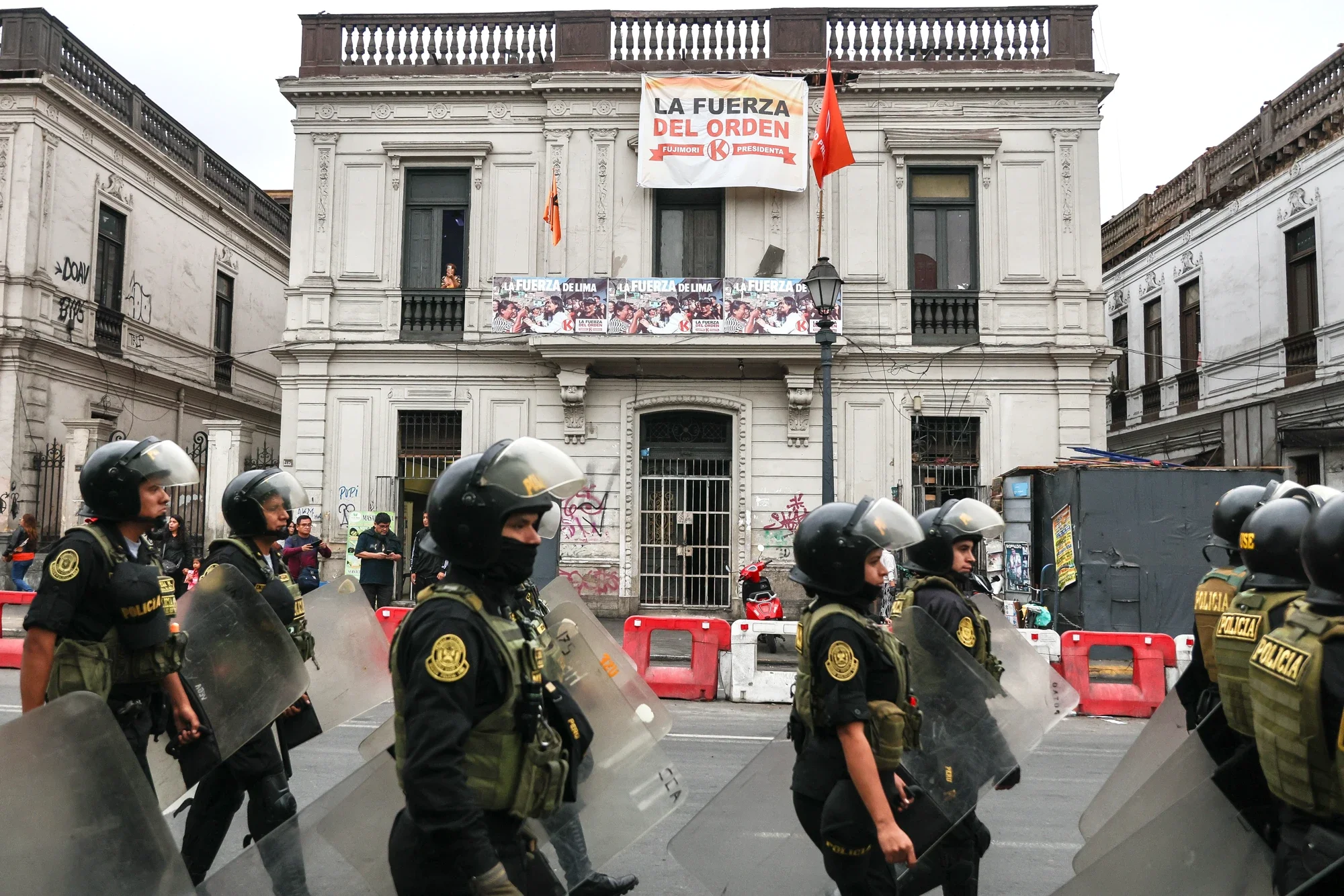
A group of police officers guards outside one of Keiko Fujimori’s campaign offices, where a sign reading “The Force of Order” is displayed, in downtown Lima on June 19, 2026. Meanwhile, supporters of Roberto Sánchez gather across the street, preparing to march in defense of their vote. Photo © Connie France
Opinion • Víctor Miguel Castillo • July 2, 2026 • Leer en castellano
When Keiko Fujimori takes office as president on July 28, which is Peru's Independence Day, we will not be facing a new government. We will be facing the continuation of one that is already in power.
The outgoing Congress is dominated by a Fujimori-led majority and its allies, labeled the “mafia coalition” by the opposition. They have removed presidents from office, shielded their legislators from investigations, subjugated the National Board of Justice (which appoints and removes judges and prosecutors), and undermined the prosecution of crimes linked to illegalized economies (mining, logging, and drug trafficking) while presenting itself as the guarantor of order.
Keiko Fujimori’s coalition is not coming to power in July. It has been in power via Congress for quite some time. What will change, if nothing prevents it, is that it will now also don the presidential sash.
Calling this “continuity” rather than simply a “regime change” isn’t just a subtle rhetorical distinction. It is the difference between warning about what’s coming and being caught off guard again—as if Peru had no memory of how Fujimorism operates when it enjoys a concentration of power.
A close election
With all ballots counted by the National Office of Electoral Processes (ONPE), 23 days after the runoff election, Fujimori tallied 50.1 percent of the valid votes with her right-wing party Popular Force (Fuerza Popular). Meanwhile, her left-wing opponent, Roberto Sánchez, gained 49.9 percent of the vote for Together for Peru (Juntos por el Perú). That’s a margin of nearly 50,000 votes out of almost 20 million cast.
The daughter of the late dictator Alberto Fujimori—who was convicted of the Barrios Altos and La Cantuta massacres and of rampant corruption—is counting down the days until she steps into the role he held from 1990 to 2000.
Sánchez has claimed that “fraud is underway,” and said he will take the matter to international bodies. Sánchez stated that he will not recognize an “illegitimate government” and is calling for a “patriotic and people’s resistance coalition” and protests across the country.
But Sánchez did not present concrete evidence of fraud. His reasoning was that without the votes of Peruvians abroad—where Fujimori received more than 63 per cent of the vote—he would have won.
In the first-round of legislative elections, Popular Force won 22 of 60 Senate seats and 41 of 130 House seats in the new Congress. Together for Peru came in second with just 14 senators and 32 representatives.
The gap speaks volumes: half the country that rejected Fujimorismo in the second round is left without representation proportional to its actual size in either chamber. It will have a minority caucus facing a coalition that already knows—from experience—how to change the rules, shield its own security forces, and remain in power regardless of any adverse results. The results will allow Fujimorismo to govern with minimal institutional checks and balances and the greatest possible impunity.
Today, the key question is what it means—in a country with Peru’s history—for Fujimori to once again concentrate all power in its hands.
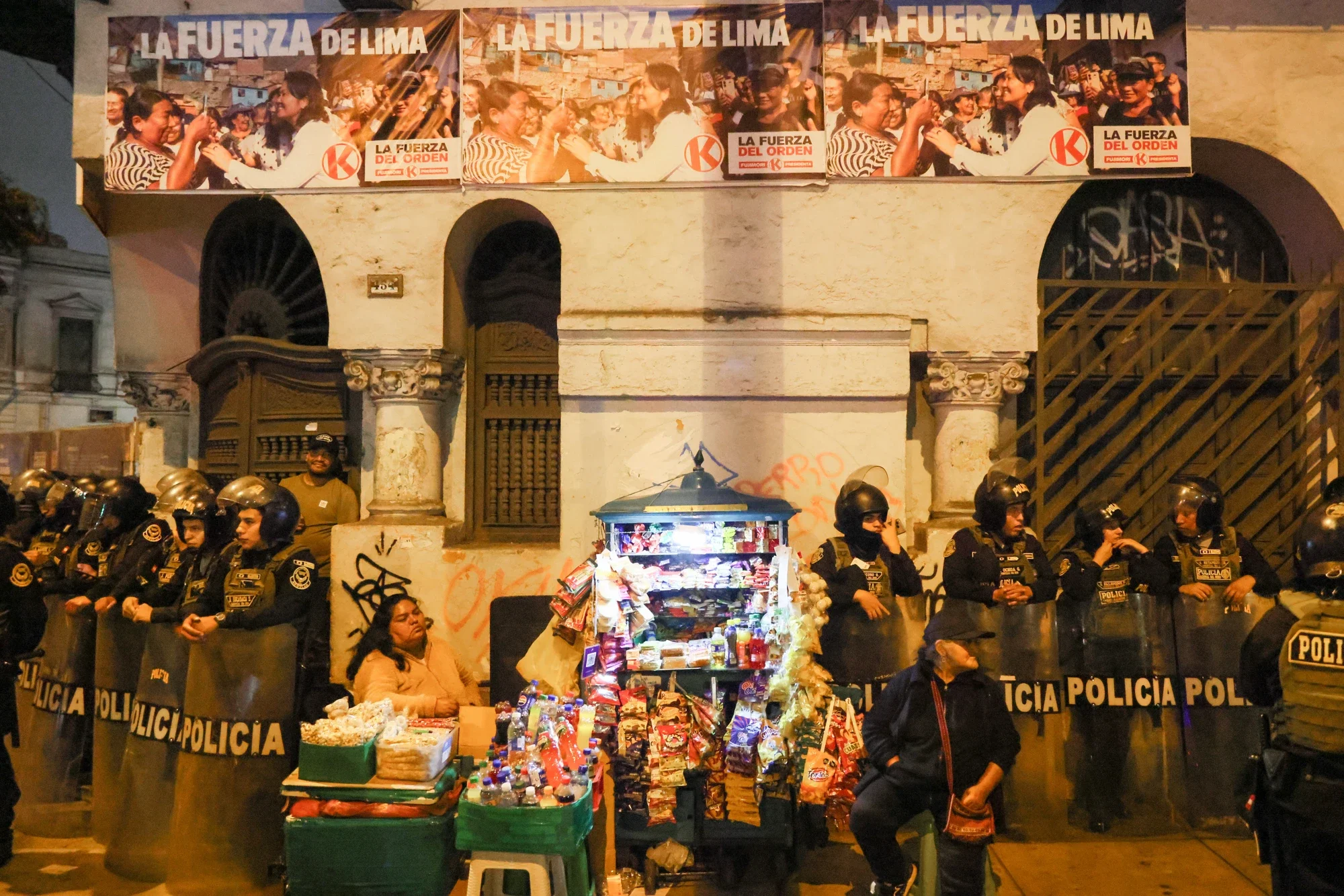
A group of police officers stands near the gathering point for Roberto Sánchez’s supporters on Paseo Colón in Cercado de Lima, Peru, on June 19, 2026. Meanwhile, two women sell their goods at a small stall beneath posters hung on an old mansion that read “The Strength of Lima,” alongside a photograph of Keiko Fujimori with supporters. Photo © Connie France.
Ghosts and sitting ducks
Following the first round of the election, I wrote about the persistence of Fujimorismo and the voters who consistently voted for president-elect Fujimori election after election. That column also suggested anti-Fujimorism—the memory of crimes against humanity, forced sterilizations, and systemic corruption—is the most solid political identity in Peru.
That memory, sustained over three elections, was the only thing that prevented Fujimorismo from returning to power in previous elections. This time, it wasn’t enough. For the first time in four attempts (against Ollanta Humala in 2011, Pedro Pablo Kuczynski in 2016, and Pedro Castillo in 2021), Fujimori prevailed.
That said, as many analysts have pointed out, this is a Pyrrhic victory. Half the country continues to view Fujimorismo as the main entity responsible for the institutional, political, and social decline of recent decades. The fact that she managed to advance to the runoff with just 17 percent of valid votes speaks volumes.
Within Peru’s borders, excluding the diaspora, Sánchez won the election. But votes cast by more than one million eligible Peruvians abroad swayed the national outcome. The fact that Peru’s presidency was ultimately decided by those who will not face the immediate consequences of that government cannot be overlooked.
The outgoing Congress itself, whose term ends on July 27, is using its final weeks to pass legislation that Fujimori’s supporters have been trying to enact for years.
On June 23, amid heightened tension over the outcome of the runoff election, Congress passed a law, after a second vote, stipulating that police and military personnel can only be prosecuted in military-police courts for crimes committed in the line of duty, prohibiting the civilian justice system from investigating the same offenses.
This is the same system of military impunity that prevailed in the 1990s under Fujimori Sr. The law was passed with 52 votes in favor, against the express recommendation of the United Nations High Commissioner for Human Rights.
On the same day, Congress approved another change which was less high-profile but just as serious. It revised the definition of crimes against humanity, requiring proof that a crime is part of a “widespread or systematic attack” against the civilian population. Otherwise, it must be tried as a common crime, subject to the corresponding statutes of limitations.
It is not difficult to imagine who this redefinition protects, or which pending cases might resurface in the coming years. The Constitutional Court had previously ruled that crimes like murder cannot be tried in military courts due to the magnitude of the harm they cause.
This is precisely what the Fujimori faction, governing through Congress and other institutions since 2016, decided to secure before the end of the current, compliant administration of José María Balcazar, taking advantage of an opposition that remains fragmented and the fact that public attention remained focused on the presidential election.
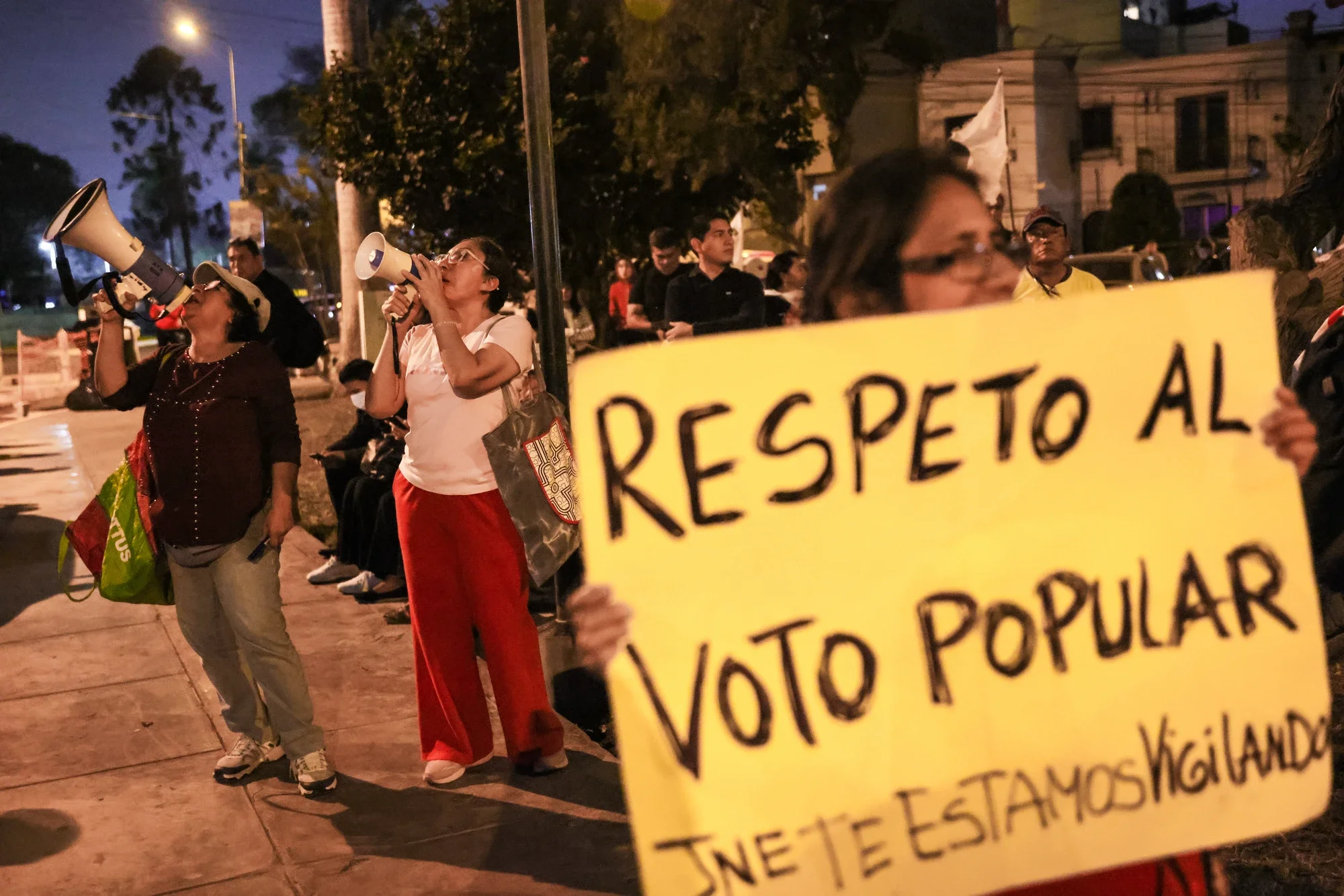
A group of Roberto Sánchez supporters arrives outside the National Elections Board in the Jesús María district of Lima, Peru, on June 9, 2026, to defend their votes and call on the electoral body to ensure transparency in the process. This comes in the wake of statements by the head of the polling firm Ipsos Peru, who indicated that his initial projections were shifting in favor of Keiko Fujimori. Photo © Connie France.
Memory as resistance
If Sánchez continues to call on his supporters to mobilize, especially in the country's Andean regions, July 28 will not be a peaceful transfer of power but rather another round of defiant responses to an unpopular regime. One of his first reactions was to announce that he would appeal to the Inter-American human rights system.
The protests will likely fail to reverse the outcome that authorities already show to be final. But it is in the streets that Peruvians have previously succeeded in thwarting what the ballot box failed to stop. And the streets will remain the arena where memory—one that the new Congress is unlikely to represent—will be upheld.
The aim will not be reconciliation with those who return to power. Rather, it will be to ensure that Fujimori’s legacy of crimes against humanity is not erased, treated as mere anecdote, or allowed to fester once more as a wound that heals only superficially while the coalition that inflicted it formally reestablishes itself in the Presidential Palace.
The question that truly matters today is whether Peruvians will accept being forced to choose—once again—between memory and political stability.
The specter of Fujimorism was so difficult to dispel because it came from within, from an open wound. The task before us is not to wait for time to heal it. It is, rather, to ensure that Fujimorism is never again presented as something other than what it was.