

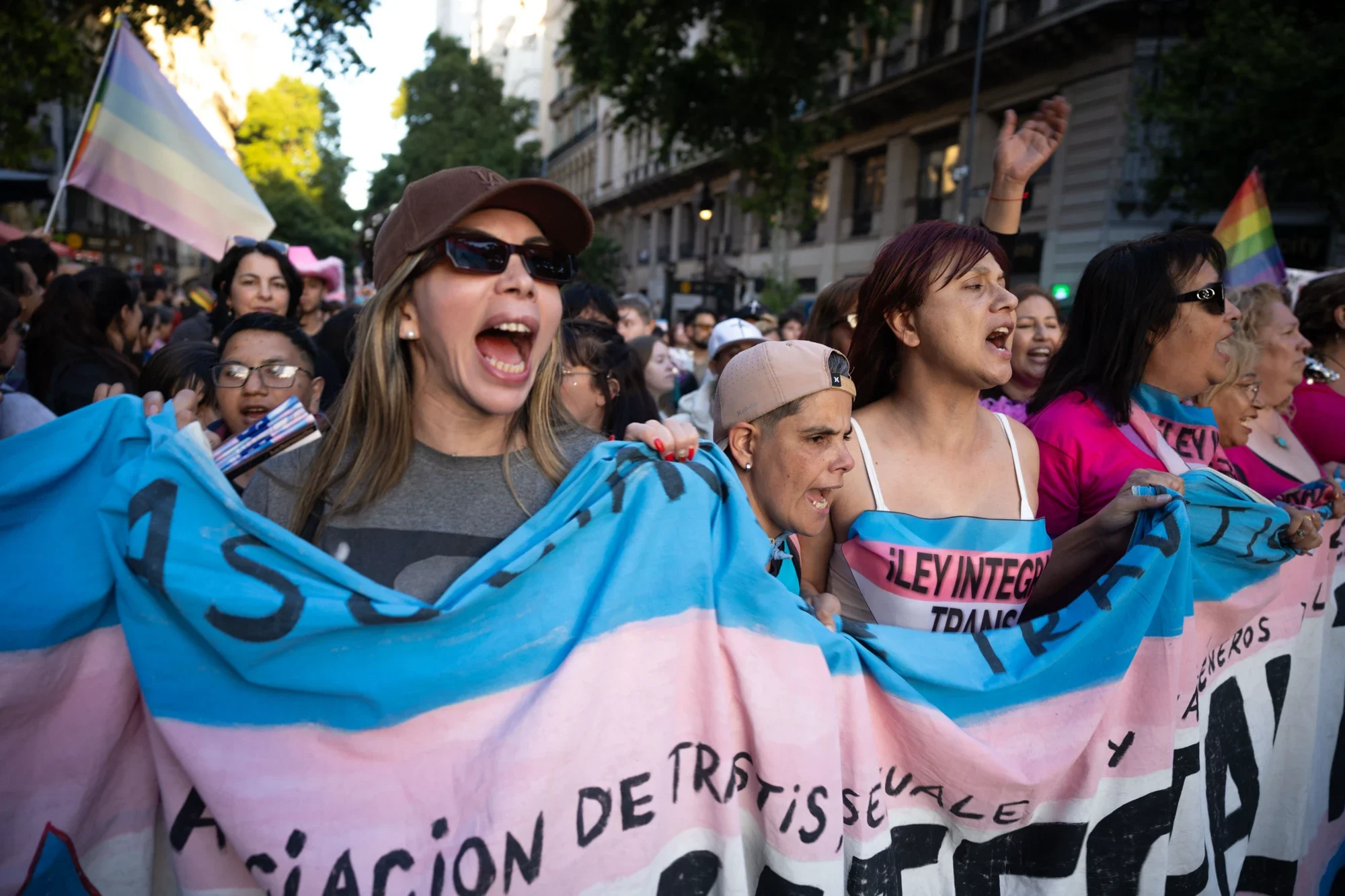
The procession of the Association of Travestis, Transsexuals, and Transgender People of Argentina (ATTTA) reached the vicinity of the National Congress. Their demand for justice was one of the day's main demands at the 35th Pride Parade in Buenos Aires on November 7, 2026. Photo © Camila Godoy.
Reportage • Agustina Ramos • November 12, 2026 • Leer en castellano
A week before the Pride March and the arrival of Pope Leo XIV in Argentina, a brutal, coordinated attack against travesti and transgender women in Buenos Aires—carried out by more than 100 young people on bicycles—sparked outrage and a desire to take action.
The 35th annual march celebrating and fighting for sexual diversity was a resounding response. On Saturday, November 7, according to organizers’ estimates, three million people turned out in the City of Buenos Aires—about a third more than in previous years—demanding an end to hatred and cruelty.
“Just because democracy is tainted by this violence we’ve been witnessing doesn’t mean we’re going to stop resisting. We’ve already tasted freedom, and we’re not going back,” said Virginia Silveira, a trans activist and president of the trans-inclusive education institute Mocha Celis Civil Association, in an interview with Ojalá. “We understand that we are citizens and that we have rights. We’re not asking society for tolerance: we have to live together.”
Fighting to educate perpetrators
This year, certain crimes and attacks against the LGBTQIA+ community received significant attention, mainly on social media. The most recent was an attack on travesti and trans sex workers in the early hours of Sunday, November 1, when a group of about 150 young cyclists assaulted them with sticks, traffic cones, and other blunt objects while they were working in the Palermo neighborhood of Buenos Aires City.
The videos—which the attackers themselves uploaded to their social media, boasting about the violence—went viral and sparked an outpouring of shock and solidarity. The massive turnout at the march reflected those sentiments. The crowd was not limited to the LGBTQIA+ community, as many came out to show their support and defend the lives threatened by hate.
“This case is not an isolated incident, it’s a high-profile one,” said María Belén Correa, founder and director of the Archivo de la Memoria Trans, who led the march. “I hope there will be a real push for awareness, like there was for femicides in the past. We want these cases to have the same visibility and, above all, the same treatment.”
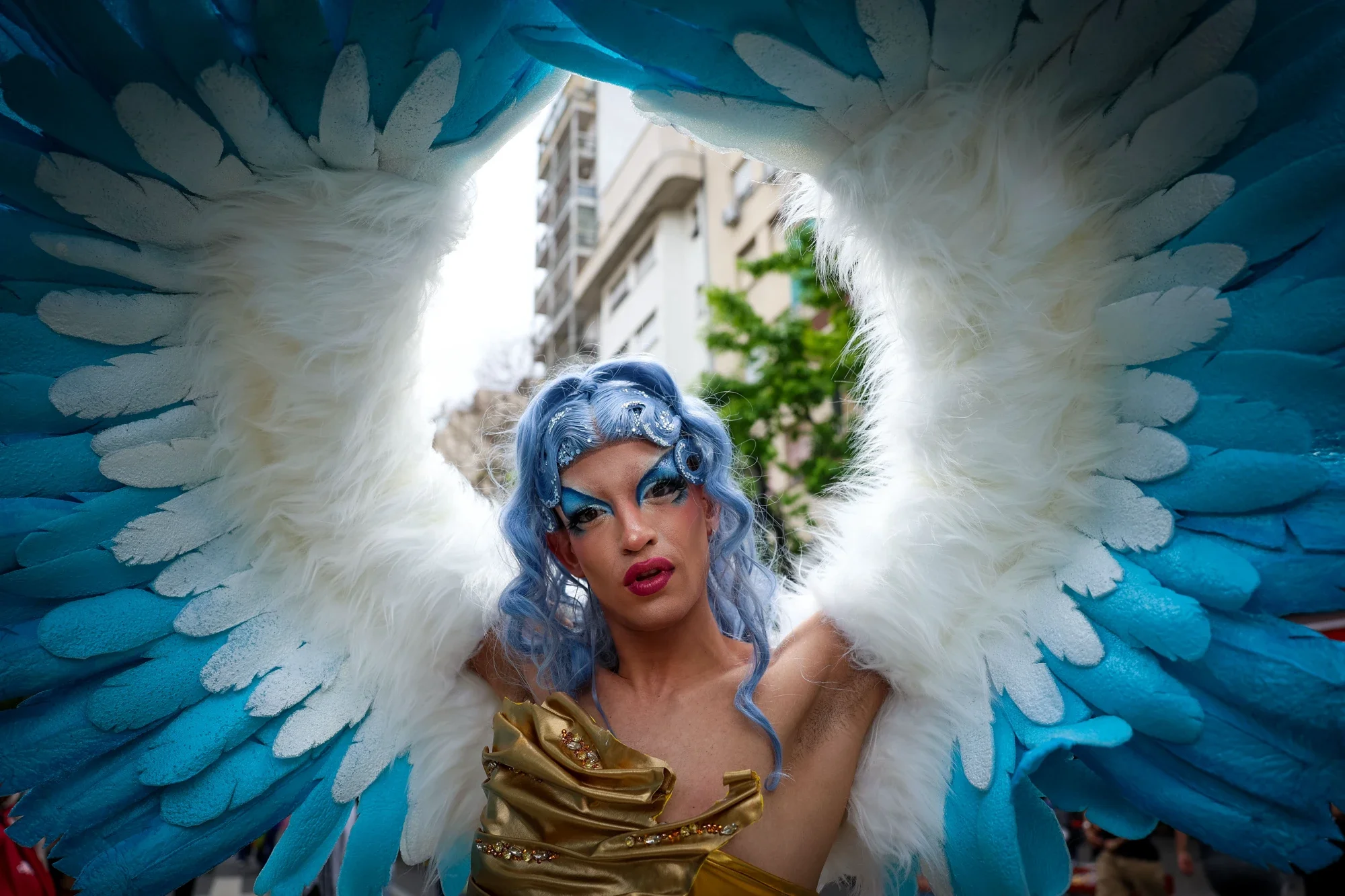
Drag artist “La Juampiii” poses in a costume paying tribute to the Argentine Republic at the 35th Pride Parade in Buenos Aires on November 7, 2026. Photo © Camila Godoy.
Despite the disturbing nature of the November 1 attack, activists are not calling for imprisonment. This sets them apart from the punitive policies that the national and Buenos Aires City governments are seeking to implement—such as the law lowering the age of criminal responsibility to 14.
“What happened the other day was an attack on our identities. We demand education: we don’t want those people locked up,” said Silveira. “We want young people committed to the growth of society. We’re convinced of that.”
Many of those attacked in Palermo frequent the Casa Roja, a self-managed space run by the Argentine Sex Workers’ Union (AMMAR), which holds workshops, community meals, and provides contraception, among other things. The union has reported intensified police persecution and social violence, and at least four sex workers were murdered in October.
“We sex workers always resist. But we’re sick and tired of resisting. We don’t want this life anymore,” said Georgina Orellano, president of AMMAR, speaking with Ojalá from the Casa Roja float in the march, with cumbia music playing in the background. “We are workers; we are not disposable. Our lives matter.”
Different paths against hate
This year's march was also unusual. Despite a local law protecting social organizations holding the Pride March in November, the Buenos Aires City government under Jorge Macri initially sought to postpone it, citing the Pope's arrival in the country the following day. After lengthy negotiations with the Pride March Organizing Committee (COMO), the date remained, but the traditional route was changed.
As a result, the march did not start from Plaza de Mayo, outside the national government headquarters, but from 9 de Julio Avenue. From there, it proceeded along Avenida de Mayo toward the National Congress as usual. In total, the march covered seven blocks—approximately half the usual distance.
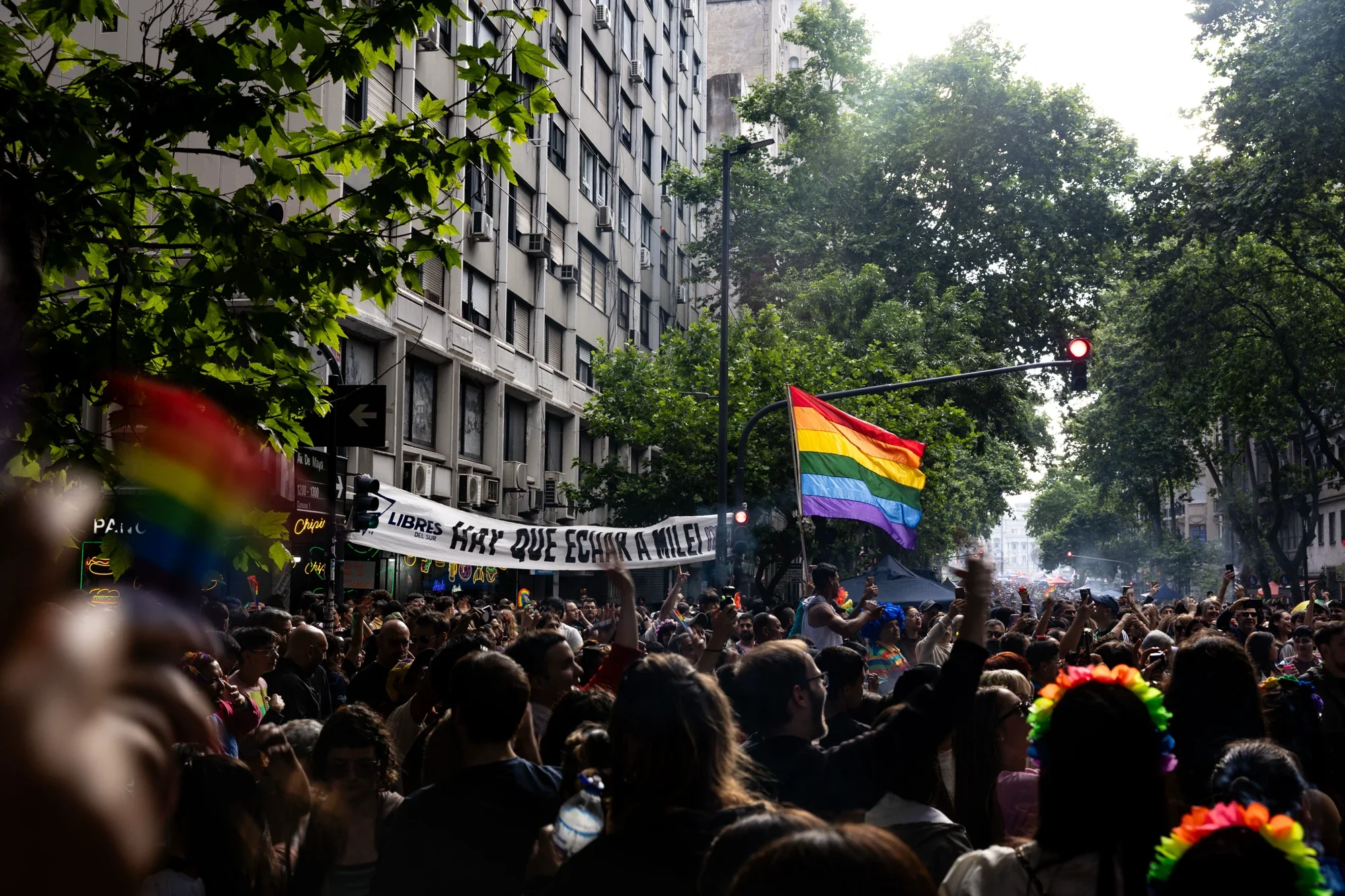
A crowd marches and chants against President Javier Milei at the 35th Pride March in Buenos Aires on November 7, 2026. Photo © Camila Godoy.
This decision caused tensions within groups advocating for sexual and gender diversity. For several years, a parallel protest called Pride March-Historical Line has been organized primarily by the Pride and Struggle Front. Their criticism of the COMO stems from the belief that it has become depoliticized and engages in pinkwashing. This year, they also condemned the recent negotiations with the Buenos Aires City government.
Thus, two marches converged at the same location. Both, however, acknowledged that their primary goal is to combat hate. The rallying cries were: “When hate advances, Pride in the streets is resistance” and “Pride to power, to hell with hate!”
Starting at noon, the carrozas—decorated trucks from various organizations, unions, brands, or political parties that people climb onto to dance—parked along 9 de Julio Avenue as protesters arrived.
Several artists performed on the Nadia Echazú stage set up at the intersection with Avenida de Mayo. They paid tribute to the Mothers and Grandmothers of Plaza de Mayo, and the event concluded with a performance by La Joaqui, a leading figure in the Argentine RKT music scene. Later, María Becerra brought the day’s events to a close on the Congress stage. Both are well-known artists in the country and abroad, and they delivered messages of support for the community.
Meanwhile, a soup kitchen kicked off at 1:00 p.m. The Columna Mostri collective—part of the Antifascist Assembly—organized the initiative in response to Argentina's critical socioeconomic situation. They decided to set it up on Lima Avenue, at the very back of the march. “At the ass of the march,” in their words. Their slogans reflected this reality: “There’s no pride when you’re hungry” and “There’s no pride with evictions.”
A march on one side, the papal visit on the other
The arrival of Pope Leo XIV in Argentina also set this march apart from others. Among the protesters there were signs that read “Inclusive Christians,” and some traveled from other provinces to attend both the march and the Pope’s address. Near the stage were members of Centu Community, an organization that seeks to build bridges between religion and sexual diversity.
“We want to foster dialogue and reconciliation between religion and the LGBT community. The challenge is not to become polarized. Not to think it’s one thing or the other,” said Teby Mentruyt, a 34-year-old member of Centu. “As [former Pope] Francis said: ‘Go out to meet others.’ Let’s not shut ourselves off. We have to go out and seek out those who think differently. Not to inflict violence, but to listen to them, to understand what frightens them. That is the only way we will be able to build peace among everyone and for everyone.”
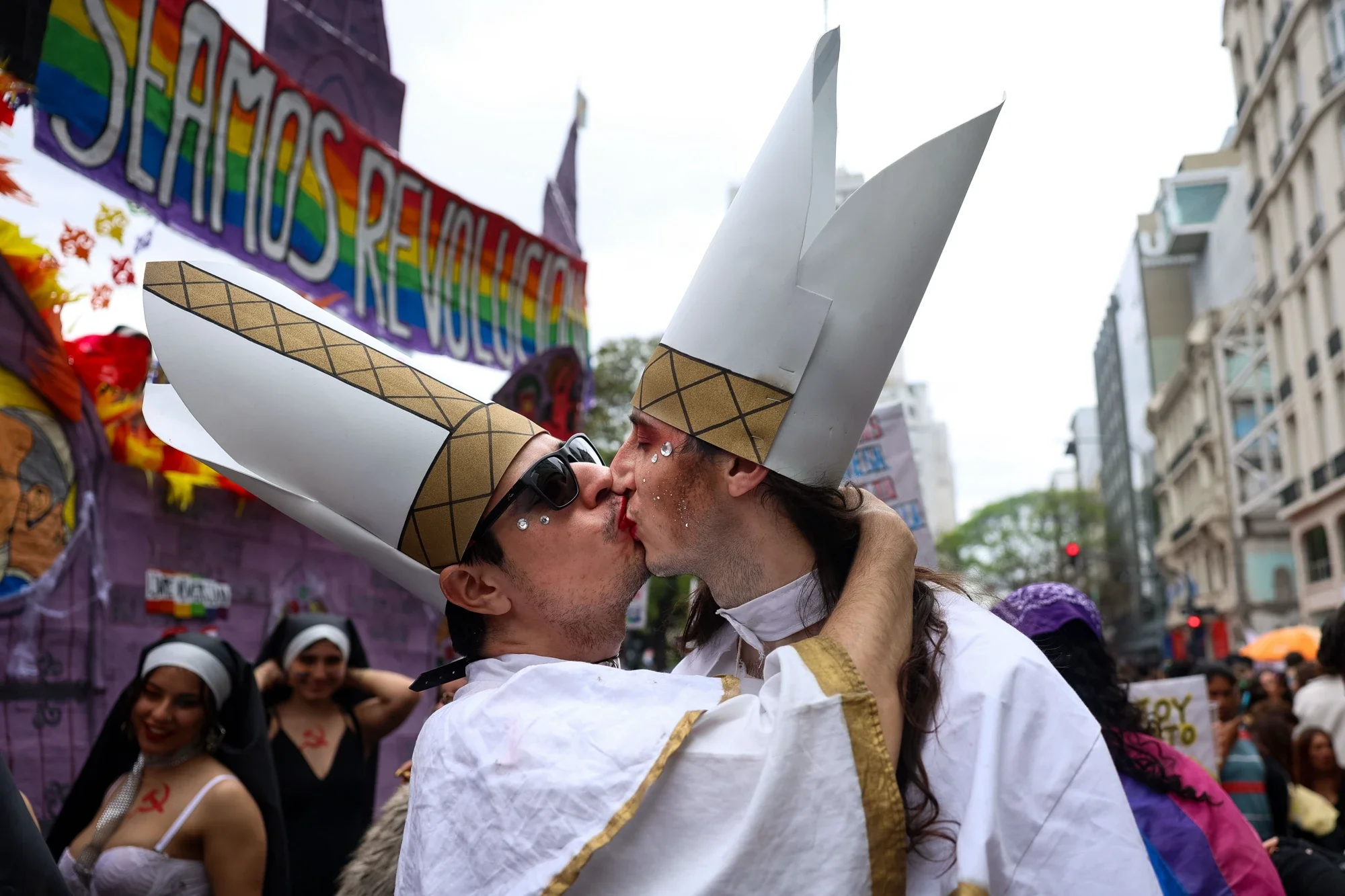
On a float bearing the slogan “No cap, no cassock—let’s be the revolution,” two men dressed as the Pope kiss, referencing Pope Leo XIV’s visit to Argentina, during the 35th Pride March in Buenos Aires on November 7, 2026. Photo © Camila Godoy.
During his visit to Argentina, Pope Leo delivered various messages regarding the state of the country. He stressed the importance of the economy being “at the service of the person, and not the person at the service of the economy,” clearly referencing the socioeconomic policies of the current government led by Javier Milei. He spoke about the need to seek agreements and help the most vulnerable, highlighting that authorities must recognize “the limits of the power entrusted to them.”
The Pope also spoke against the right to legal, safe, and free abortion—a right won through street protests in 2020. In his first speech, he urged those present to “work together to defend life from conception.”
He did not directly refer to LGBTQIA+ people or meet with anyone from the community to hear their story. However, during a meeting with young people on the evening of Tuesday, November 10, in the City of Buenos Aires, he echoed former Pope Francis’s statement that “todos, todos, todos” (“everyone,” using the default masculine plural) is welcome in the Church.
Unlike any other Pride march, this one featured scores of protesters dressed as nuns, priests, and other religious figures. At the head of the march was José María Di Bello, an activist for the rights of LGBTQIA+ people and those living with HIV, dressed as the Pope and holding a sign that read: “Todos, todas, todes” (“everyone,” using the masculine, feminine, and gender neutral plural).
A carroza bearing the colors of the trans flag—pink, white, and light blue—and matching balloons kicked off the march toward the National Congress at 4:00 p.m. Its signs read “No trans child should have to grow up in fear” and called for a “Comprehensive Trans Law—now!” as well as “historical reparations for trans elders.” Thus, the travesti-trans community once again led the fight for diversity but also, and above all, for a society free from violence.
