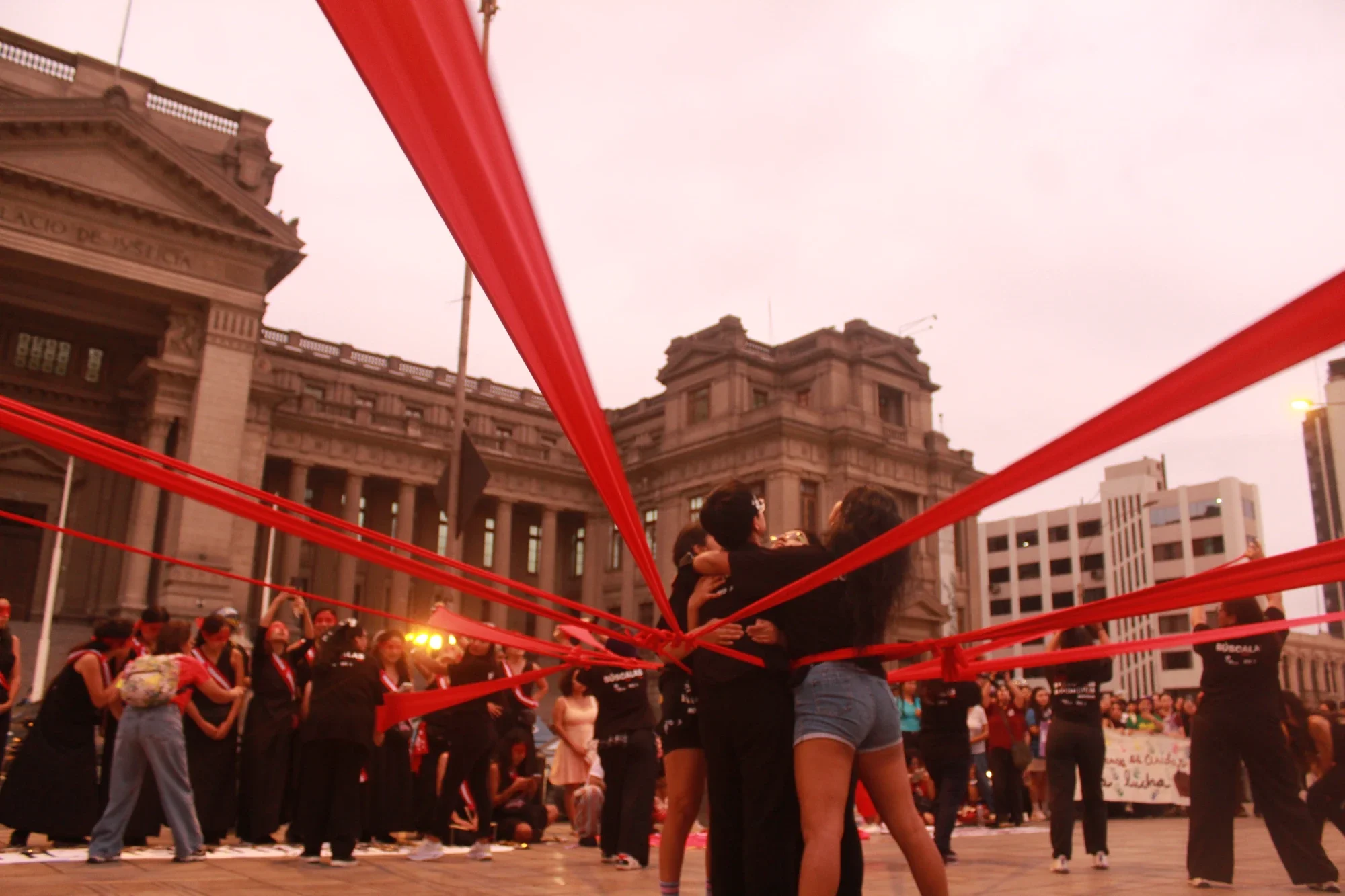
Women trapped in a net from which they cannot escape as part of a performance called “Search for them”, a performance as part of a campaign on disappeared women in Lima, Peru on November 21, 2026 as part of #25N mobilizations. Photo © Amanda Meza.
Reportage • Amanda Meza • November 27, 2026 • Leer en castellano
Rocío Fuentes has been involved in feminist activism through artistic performances in Peru for more than 10 years. She uses her voice and her body to call attention to gender-based violence in public spaces. But this year has been unlike any she can remember.
Just six days before the #25N march in Lima to mark the International Day for the Elimination of Violence against Women—which was commemorated on November 21 this year—her collective suffered an act of police intimidation that she considers state-sanctioned retaliation.
On November 15, Collera Red, the feminist collective led by Fuentes, was meeting in a private space to rehearse a performance called “Justice Against All Forms of Violence,” which the group was set to present at the march. A police patrol arrived and knocked on the door looking for the organizers of an alleged “demonstration.”
Fuentes and other activists approached the police to ask why they were there. The officers refused to answer, saying only “It’s an order from headquarters, an order from the Ministry of the Interior.”
After much insistence, the officers presented a warrant issued by telephone from the National Directorate of Criminal Investigation, which deployed the Directorate Against Terrorism (DIRCOTE), the Criminal Investigation Directorate, and the Criminal Investigation Division. According to the warrant, the justification for the raid was “the promotion of feminist organization and participation in defense of women’s rights.”
The police didn’t enter the building, but they did repeatedly ask for the names of the organizers, and remained outside the premises for two hours. At one point, police began filming activists from their van as they demanded to speak with the warrant officer. The cops left only after activists took out their phones and began to film.
“This appears to be part of a crackdown on women’s rights, and on defenders and feminist activists who have been exercising their right to free speech and protest for years,” said Fuentes, pointing out that their activities have always been public on social media. “Instead of the state and Keiko Fujimori’s government promoting justice, actions and policies to eradicate violence against women, they are persecuting activists and those who engage in critical thinking and collective action.”
A widening net of criminalization
The November 15 police raid was not an isolated incident. Days later, two artists from the “Saturnino Huilca” cultural association—named in honor of the Indigenous leader who founded Peru’s first rural union—were detained by DIRCOTE.
One of them is rapper Brenda Jah. During the arrest, which was recorded on video and went viral on social media, the officer could not explain why she was being detained.
Jah, rapper Pedro Mo, and eight others were ordered to serve 15 days of pretrial detention, which sparked protests and a warning from Andrea Bolaños Vargas, the United Nations Special Rapporteur on human rights defenders. Brenda Jah was released a week later by the Court of Appeals, which found no grounds to keep her in custody during the investigation. Mo remains in pretrial detention.
Lawyers and politicians are calling out legal inconsistencies in the arrests. DIRCOTE alleges the artists are affiliated with a group linked to the Túpac Amaru Revolutionary Movement, a guerilla organization listed as a terrorist group by the Peruvian government. It was dismantled in 1997 in the wake of a military operation that killed its leaders.
Among the accusations, the government is pointing to the use of terms including “people’s power” and “self-defense.”
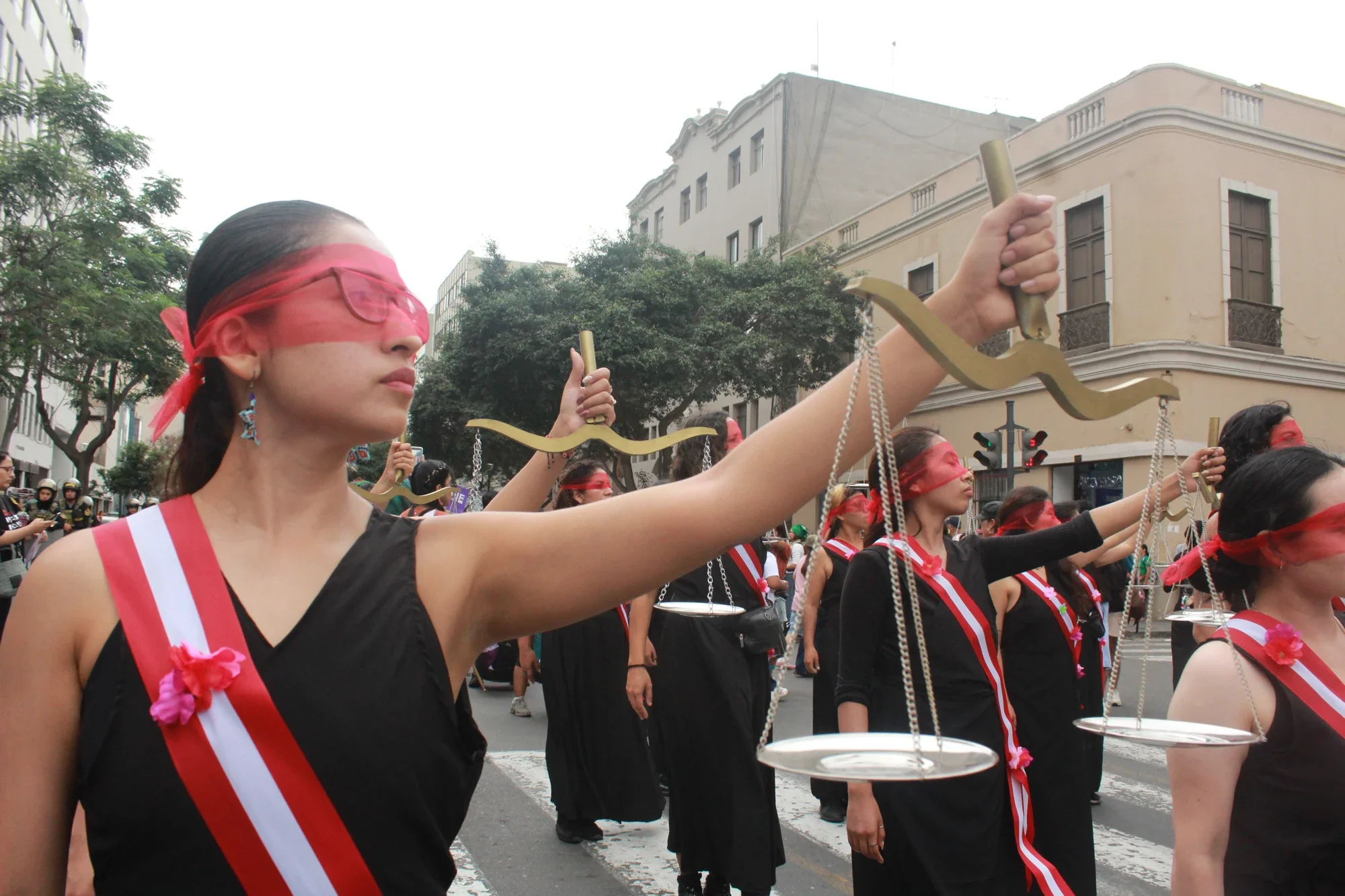
A woman holding a scale questions the impartiality of the justice system as part of the performance titled “Justice Against All Forms of Violence,” carried out by feminist collective Collera Red in Lima, Peru on November 21, 2026, as part of #N25 demonstrations. Photo © Amanda Meza.
In Peru, these marches began in 1981, were organized by the November 25 Collective in the 1990s, and by the 25N Assembly since 2019. This year, #25N extended beyond condemning gender-based violence, becoming a protest against the use of the state apparatus to silence human rights activists, feminists, and LGBTIQ+ folks.
“There is open criminalization, and the state uses insecurity as an excuse, not to pursue criminals, but to sow fear and stifle dissent,” said senator Ruth Luque of the center-left party Ahora Nación.
Luque notes that the current political climate began to take shape in December 2022, when Dina Boluarte’s regime launched a military-police offensive that killed over 50 people in the south of the country.
This is compounded by the recent approval of a legislative package consisting of eight laws that weaken criminal prosecution, favor criminal networks, and foster impunity in cases of corruption and organized crime. New legislation that prevents NGOs from taking on legal cases against the state has also been introduced. And, on the very same day as the #25N march, the government announced the creation of a secret Registry of Terrorist Organizations.
“There is a trend toward the criminalization of a social sector that Fujimorism has always sought to marginalize: human rights organizations and women’s organizations that work around gender,” Luque said in an interview with Ojalá. “Authoritarianism targets vulnerable populations and critical voices that challenge power.”
Even as Peru’s public sphere becomes more dangerous, feminist activists, LGBTIQ+ activists, human rights activists, artists, and engaged residents continue to assert their right to protest.
Demanding to be heard
This year’s #25N march wound its way through downtown Lima, starting at Parque Universitario and heading toward the historic Plaza San Martín, before continuing to the Supreme Court about two kilometers away.
Some 2,000 women gathered at 3 p.m., fine-tuning their drumming, rehearsing their chants, and running through their performances one last time. Everyone is present, every name, in the voices of those who are alive and can demand justice.
Behind the protest’s main banner marched a group of no more than 10 women. Their case has sparked widespread national outrage. Two years ago, it was reported that more than 800 girls from Awajún and Wampis communities in the Peruvian Amazon were sexually assaulted by teachers and public officials.
The assaults took place between 2010 and 2024 in schools and dormitories in the province of Condorcanqui. Many girls became pregnant by their attackers, and some contracted HIV as a result of the abuse.
Three administrations have come and gone since the allegations were made public, all three avoided taking concrete action and remained silent on the issue. Under Keiko Fujimori, the Bicameral Budget Committee warned that the 2027 general budget omitted specific funds for protection and justice for these Amazonian communities.
“The number of cases is increasing every day. There are cases that have been shelved and remain unpunished,” said Daniela, a member of the Awajún Wampis Umukai Yawi Women’s Council (COMUAWUY), a collective that brought the issue to light. She asked that her last name be withheld for fear of retaliation. “We had to come to Lima to be heard.”
Marching in Lima represents a small victory for the Awajún and Wampis women. The journey from their communities takes up to 40 hours of navigating rivers, crossing highways, and taking flights, but they say the cost is worth it. COMUAWUY warns that reports of abuse have increased over the past year, reaching nearly 1,100 cases.
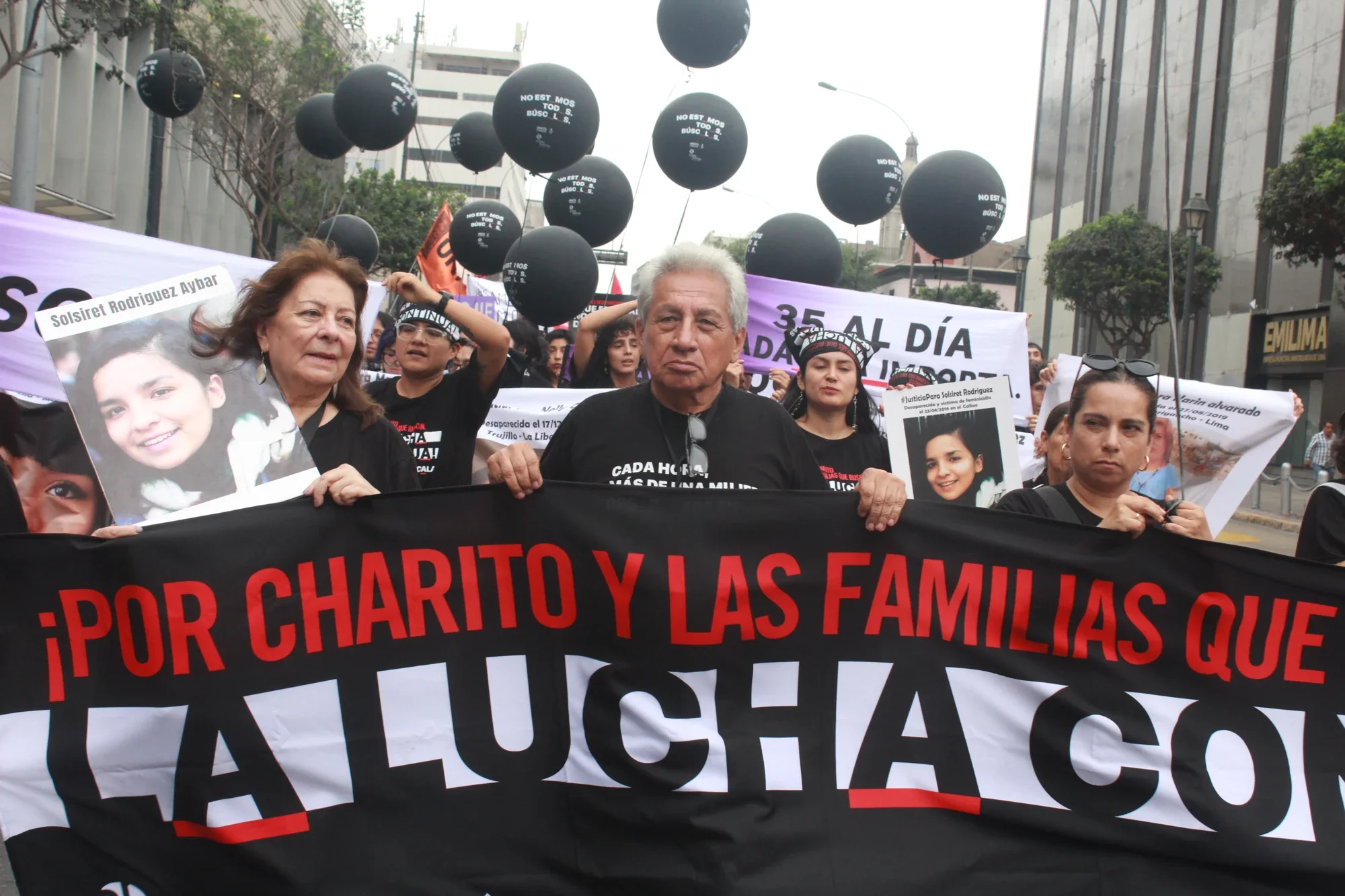
Carlos Rodríguez, father of Solsiret Rodríguez, a feminist activist who was a victim of femicide, stands with a banner commemorating the struggle of his wife Rosario, or “Charito,” and of thousands of families of disappeared and murdered women during the #25N march in Lima, Peru, on November 21, 2026. Photo © Amanda Meza.
For the Disappeared
The protest continued, and the slogan “Find Them” stood out on a banner held by Carlos Rodríguez, the father of Solsiret Rodríguez, a feminist activist who disappeared in 2016 at the age of 23.
Her remains were found three years later by the Fifth Provincial Corporate Criminal Prosecutor’s Office of Callao. Of six individuals implicated, two were arrested. One defendant was sentenced to 28 years in prison and her brother-in-law, initially sentenced to 30 years in prison, had his sentence reduced to six years after being acquitted of femicide.
Rodríguez pursued justice alongside his wife, Rosario Aybar, who, after their daughter’s disappearance, became a tireless advocate supporting cases involving disappeared women, migrants, the LGBTIQ+ community, victims of forced sterilizations under Alberto Fujimori’s regime, and victims of state repression.
Solsiret’s name has been present at vigils and the cause taken up by her parents has the support of the feminist movement. Between January and August of this year, Perú’s National Registry of Disappeared People (RENIPED) recorded 8,432 reports of disappeared women, adolescents, and girls.
After a decade of struggle, Aybar passed away on October 5 of this year due to an illness. Rodríguez has taken up the torch to fulfill their shared promise.
“It’s a promise my wife and I made to each other. It began with my daughter’s disappearance, continued with my wife, and now it’s my turn,” said Rodríguez. “I’d like many other men, fathers and grandfathers, to join this fight as well, because this isn’t just ‘something that happens to others’; it affects everyone until justice prevails.”
Authoritarianism on the rise
The march in Lima proceeds flanked by two columns of police. This march for the International Day for the Elimination of Violence against Women is taking place amid severe political setbacks.
On November 18, the Executive Branch issued a decree ordering the reorganization and modernization of the Ministry of Women and Vulnerable Populations. The ministry is a bastion that the ultra-conservative political and religious sectors aligned with the “Hands off my kids” movement have long sought to control.
Far-right factions including the ruling party Fuerza Popular have rolled back laws won by women’s and LGBTIQ+ collectives, eliminating the term “gender” from public policies, blocking comprehensive sex education, and suppressing the use of inclusive language. They have attempted to criminalize sexual dissidence through legal reforms and have denied the existence of gender-based violence, despite the fact that so far this year, the ministry itself reported that Emergency Centers for Women have handled more than 130,000 cases of violence.
“The systematic attack on rights—following the removal of a gender lens from public policy—is now once again targeting the ministry,” said María Ysabel Cedano, a lawyer with the feminist NGO DEMUS. ‘There is no doubt that the reorganization is not aimed at strengthening the mechanisms to achieve gender equality. Quite the opposite.’
This year’s #25N march in Peru was a call for collective self-care and highlighted the urgency of grassroots organizing. It was a form of active resistance in the face of uncertainty, in which authoritarianism is casting a long shadow over social rights won more than half a century ago.