
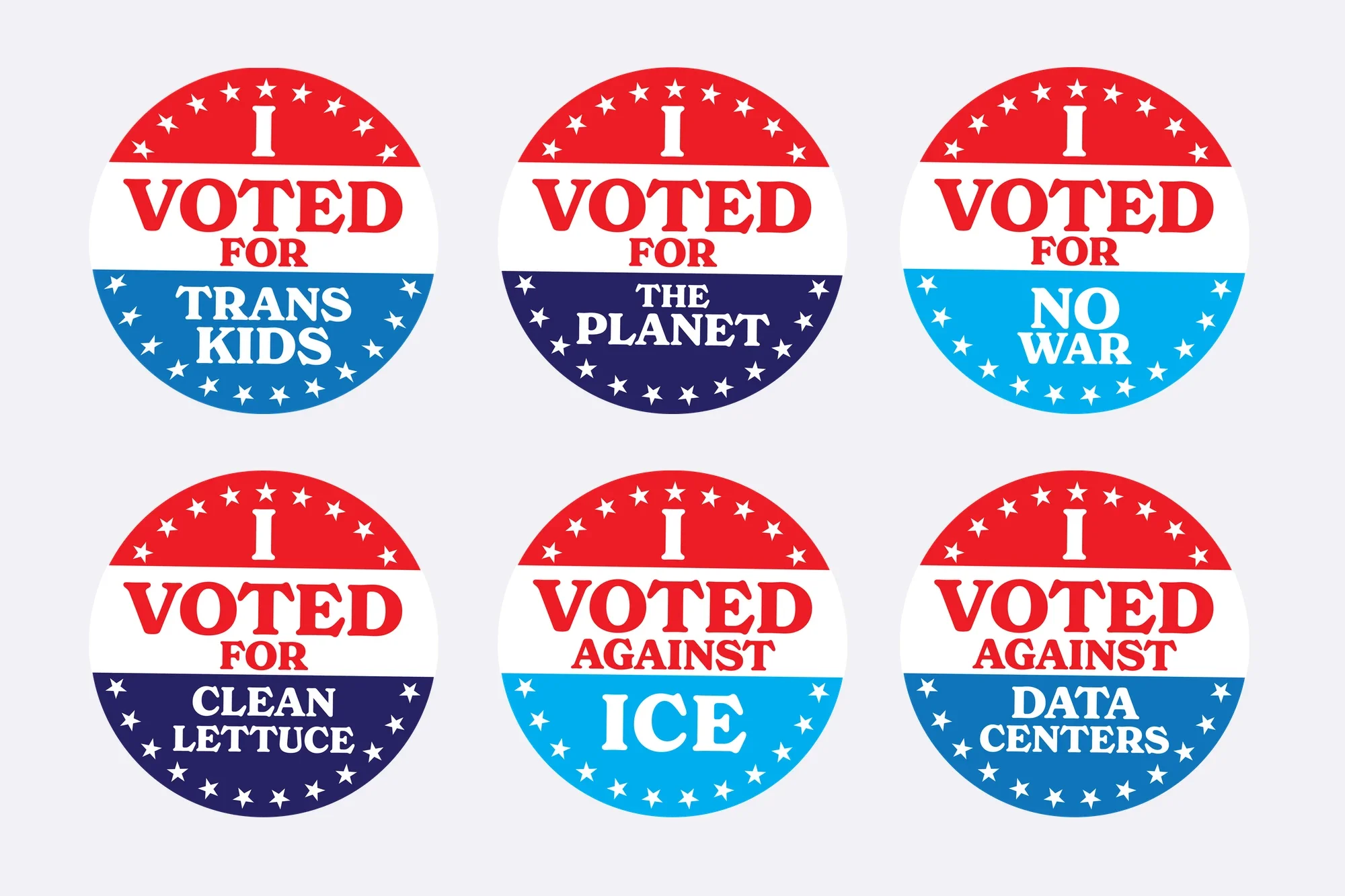
I Voted Stickers by Kendall Mackey & Nicole Manganelli for Justseeds.
Opinion • Susana Draper • November 27, 2026 • Leer en castellano
The midterm elections in the US were a pivotal moment in responding to a period of fierce policies that kill, undermine livelihoods, and destroy the planet. A multifaceted electorate voiced its desire to curb the onslaught of destructive policies carried out without pretense or disguise.
After two years in which constitutions, civil liberties, and international sovereignty have been increasingly and aggressively disregarded, many of us living in the US feared what would happen during the midterms, which were held on November 3.
From the outset of Donald Trump’s second term, the Republican party began redistricting following a racist, supremacist logic, in an attempt to block votes from neighborhoods with large African American and Latinx communities.
On the economic front, we witnessed a massive investment by financial interests that the Trump administration has rewarded with record profits. One exorbitant example is that of Elon Musk, who poured $445 million into electoral campaigns to ensure the continuation of his interests. This was particularly true in Texas, where he has expanded the operations of SpaceX and increased the number of data centers to boost the AI industry.
There was also the use of violence and harassment, including a raid on the home of Ilhan Omar, a representative from Minneapolis, Minnesota, by federal agents in the middle of the campaign. Omar, who is a US citizen, was also threatened with deportation. There were also the attacks against Abdul El-Sayed in Michigan, who, despite the harassment, became the first Muslim senator in history.
Republicans deployed these campaigns and investments to influence the results, showing they thought this was a crucial election. Their efforts failed spectacularly, in a way very few anticipated.
Mobilizing beyond party lines
A key feature of this electoral process—which saw massive grassroots mobilization, especially in complex races in Texas and Southern states—was that it was not a choice between “parties.”
This strikes me as a central point. This election represented not only a choice between Republicans and Democrats, but a choice between the advance of a form of techno-financial capitalism that operates through war—domestically and abroad—to expand, expropriate and profit, and demands based around the satisfaction of the material conditions necessary for the possibility of living and sustaining life.
The speeches given by the more innovative progressive candidates—who broke with the Democratic establishment—made it clear that theirs was a rejection of a wealthy class that has long profited from the expropriation and theft of the very possibility of life for the majority of people.
Within the organizational structure of the political arena, a more movement-oriented strategy gained traction—one that had previously been framed as the opposition between the 1 percent and the 99 percent, and which is now centered on making sustainability a reality at various levels.
A multifaceted and complex opposition prevailed, which we can understand as a popular stance against the policies of terror and the destruction of life and the environment. By “multifaceted,” I refer to a heterogeneity that encompasses positions that are different and even antagonistic toward one another.
Within this context, there was also opposition from within the Democratic Party itself, which, despite being different in style from Trumpism, shares many of the current regime’s economic and political interests.
Many candidates explicitly took a stand against the genocide of the Palestinian people (even though this position remains a target of media attacks), the expansion of ICE and the so-called war on immigration as a strategy of everyday militarization. They rejected the difficulty of making ends meet amid inflation and budget cuts, and the ongoing imposition of data centers. Votes were cast to protect abortion rights in three states (Missouri, Nevada, Virginia), as well as queer and trans rights (Virginia and Missouri respectively).
What came through was a prevailing desire to foster intersectionality instead of isolated silos.
Appropriation to the max
Unlike the rhetoric of the Democratic establishment, Trump's second administration speaks its unvarnished truth. His “Big Beautiful Bill” budget proposal sealed the core political plan: historic funding for various pillars of military expansion and a near-total defunding of public services.
Sustaining militarization required dismantling a large part of the healthcare system (Medicaid) and food assistance programs, among others.
Two government shutdowns over two years laid bare the forces driving the current system. The first, in 2024, which was a total shutdown, was an attempt to halt cuts to the healthcare system. The second, in 2025, was a partial shutdown, sought to curb the exorbitant budget for expanding ICE and border militarization.
Cutting a healthcare system that was far from ideal left millions of people without health coverage overnight, bringing to the forefront what, a decade and a half ago, the group Strike Debt rallied around with the slogan: “debt or death”.
During the partial government shutdown last year, it was revealed that one in eight people in the US rely on federal subsidies to put food on the table. This is a crisis of the very possibility of sustaining life at the most basic level of physical survival.
Today, militarization and digitization are the means through which different types of war, the war industry, and the imposition of ever-greater dependence on these systems in our daily lives have been deployed and reimagined.
Fighting border surveillance
The expansion of the migrant detention system and the proliferation of data centers are two parallel processes unfolding within a framework of profiteering and multiple forms of expropriation.
The “war on migration” has been a key arena for integrating various branches of the digital industry, as forms of surveillance and tracking via cell phones have expanded and become widespread.
Various new surveillance technologies increase the capitalization of detention and intensify the financial transactions generated by a person simply by “being” in a situation of incarceration or while awaiting the resolution of their asylum case.
Hunger and work strikes carried out by migrants detained in ICE detention centers managed by the GEO Group in May revealed that, in addition to being stripped of their lives, time, and health, they were forced to do most of the prison maintenance work for a dollar or less a day, generating multimillion-dollar profits for the companies.
It later came to light that, as part of the expansion of the ICE budget, it bought industrial warehouses at exorbitant prices, without any local consultation or legal process, to convert into detention centers. ICE is now led by David Venturella, who had previously worked for the GEO Group.
The same logic is at work here, combining current systems of data storage and human detention to expropriate life on both a human and environmental level, as these processes deteriorate in both the short and long term. In both cases, forced displacement via rendering the environment unlivable is also central.
On November 3, voters overwhelmingly rejected the advance of data centers on 46 of 47 related ballot initiatives. Together, these struggles point to new possibilities and the potential for new forms of internationalism.
This is a moment in which we need to take risks, expand our horizons, and insist on a political imagination that multiplies practices of care and neighborhood defense that have intensified and multiplied in recent years. We must have conversations in which strategies are shared across different regions, and questions are raised about how we adapt forms of struggle—both those that have worked and those that have not—to different contexts.
In a way, the grassroots organizing that’s taking place is an expression of resistance to the techno-fascist advance that stems from a multifaceted demand for the need to rethink what kind of life we want, and to the right to dignified lives in all their diversity.
Certain threads of this opposition to the system rather than to a specific party hold significant importance. However, could also be considered a weakness without an organizational process that continues to develop political strategies rooted in the everyday reality of each community.
The lessons learned from grassroots community struggles in Chicago and Minneapolis over the past year have served as an example of organizational strategies and sharing.
A great deal of creativity is needed to organize at the local and international levels—not only to assert these “NOs” in the face of the logic of inevitability that capital imposes on us through discourses of development, but also to imagine and create other livable and desirable worlds that give substance to these acts of resistance in diverse regions united by a common challenge.