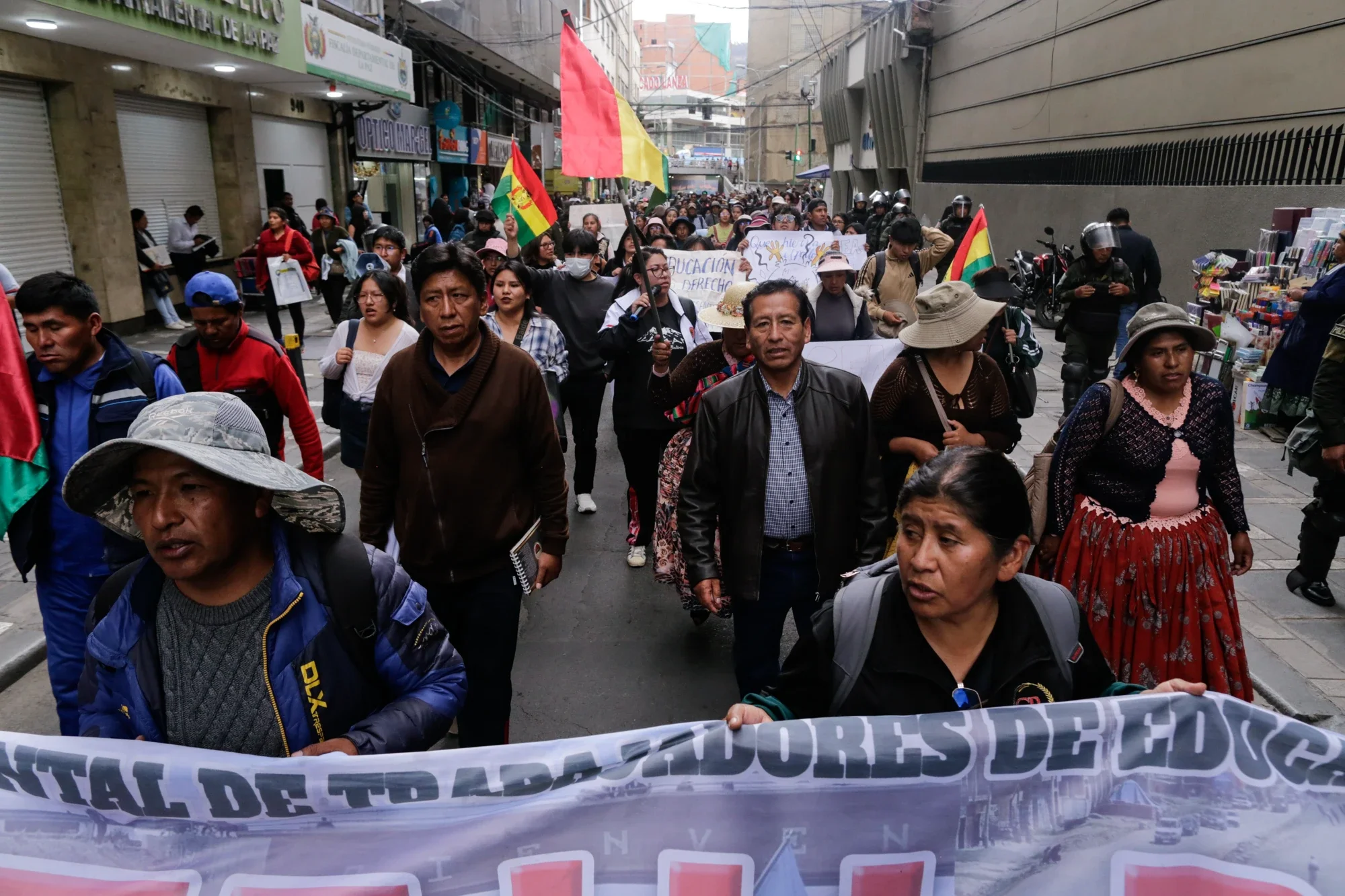
March in defense of public education in La Paz, Bolivia, on November 20, 2026 in La Paz, Bolivia. Photo © Josué Cortez.
Interview • Claudia López Pardo • November 20, 2026 • Leer en castellano
For several weeks now, Bolivian streets have been filled with protesting teachers, as the Rodrigo Paz administration makes moves to decentralize public education. According to teacher representatives, decentralization is the first step toward privatization.
On October 19, the Director of Autonomies Alfonso Lema (who reports to the Ministry of the Presidency) announced the government’s 50/50 agenda, which includes a draft bill to decentralize the administration of technical, technological, artistic, and language-focused higher education institutions. If passed, departmental governments would oversee the hiring, payment, and appointment of teachers instead of the central government (this in addition to their current role of paying infrastructure costs).
This directly contradicts promises that decentralization was off the table, which Paz’s government made in May. Today, it contends that schools must “manage themselves.”
Since October, the education sector has been mobilizing across the country. The dispute centers on defending public education as a financial, administrative, and political responsibility of the state. Various picket lines and hunger strikes have been set up. State violence in response has been rampant. Thirty people were arrested during a police crackdown on teachers and students protesting against decentralization on November 10 in La Paz.
The protests continue even though the government suspended discussion of the draft bill. The suspension was decided during a meeting between the government and the National Confederation of Rural Teachers of Bolivia (CONMERB), mediated by the Ombudsman’s Office. However, urban teachers, their national union, and the rank-and-file members of the rural teachers’ union disagree with the decision to negotiate with the government to suspend the measure rather than eliminate it entirely. Protests continue despite the nationwide state of emergency.
The conflict has erupted amid multiple crises: the economic crisis, the elimination of the gasoline subsidy to take place next year, and the energy crisis that is exacerbating extractivism. Cuts to public spending are a condition of a recent $1.9 million IMF loan. Families are organizing to cope with the austerity measures and rising prices.
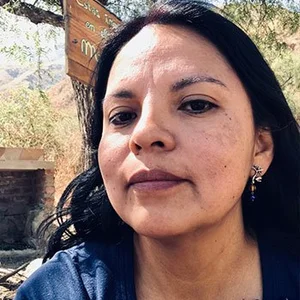
The situation in Bolivia is critical, and the conflict with the teachers’ union is another front in the debate about public services and government responsibilities. In this context, I met with Eliana Quiñones Guzmán, whom I have known for a long time through her work and activism in feminism and education.
Quiñones Guzmán is a graduate of the “Sede Sapientae” Catholic Teacher Training College; she earned her bachelor’s degree from the PROFOCOM teacher training program and holds a master’s degree in research and knowledge production from the Pedagogical University.
Today she works as a second-grade teacher in the town of Orcoma, in the Capinota province of Cochabamba. Her school is located at the foot of a gypsum and limestone deposit. We sat down for some tea on last week and discussed the latest developments in the teachers’ struggle. This interview has been translated and edited for clarity and length.
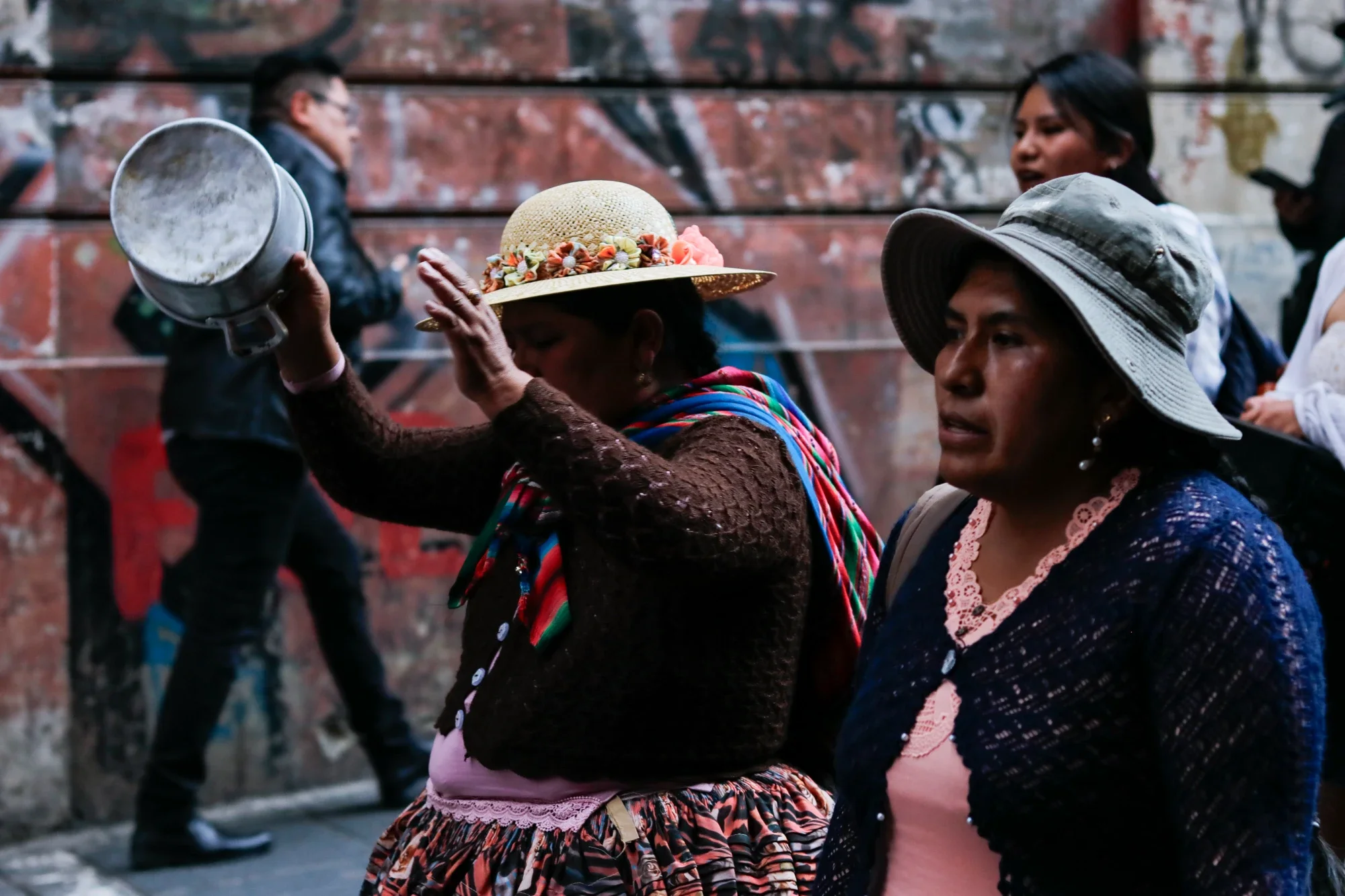
March in defense of public education in La Paz, Bolivia, on November 20, 2026 in La Paz, Bolivia. Photo © Josué Cortez.
Claudia López Pardo: Why did you choose to work in a rural area instead of in the city?
Eliana Quiñones Guzmán: At first, I worked in urban areas, but then I left teaching to pursue other jobs. I’ve been living in the countryside for 8 years now. I’ve already “gone rural,” because in teaching, after five years, you either become “urbanized” or “ruralized.” For me, working in the countryside is a political choice. It means living in harmony with the land, the farm, and the children. It’s a different way of life.
CLP: What is the current situation of Bolivian teachers?
EQG: In the past, the teaching profession enjoyed general stability both in terms of labor issues and its role in society, specifically in ensuring a universal, free public education system.
Right now we’re experiencing a deep crisis in our unions at the national level, this is happening across all sectors? We’ve arrived at a different juncture where we need to rethink and reflect on everything related to the labor movement in Bolivia and how we can regain our strength, our dialogues, our debates, and our analysis. We’re facing an openly right-wing, neoliberal, privatization-oriented government.
It’s clear that Rodrigo Paz doesn’t understand Bolivia; he doesn’t understand who Bolivians are. He doesn’t know the history or the different lineages of the sectors that exist in the country. So now we’re experiencing a government attack across all spheres and in all sectors. We’re stunned by the constant scandals of corruption, impunity, and the abuse of power.
I believe this is a time for us to rethink our relationship with the state and with governments. We need to start with autonomy, which is one of the basic values of a union, and union independence, which for a long time has been co-opted and instrumentalized. Now, since everything is in a state of flux, the Paz administration wants to make us foot the bill for the agreement with the IMF, to cut public spending and the annual payroll—which means slashing the education budget.
CLP: Can you explain the teachers’ arguments for opposing decentralization? How are they approaching the current conflict with the government?
EQG: The draft bill is unconstitutional because it goes against the state’s primary function, which is to guarantee education for all Bolivians. That is non-negotiable.
Decentralization is privatization. Its purpose is for the state to rid itself of the economic burden that education represents, because it views it as “a burden”—not as an investment in Bolivian society. This is extremely concerning because state investment in education was 10 per cent last year, seven percent this year, and they want it to be five percent next year.
Cutting the budget, on the one hand, means privatizing education and denying children, young people, and society at large the right to a free, publicly funded education. On the other hand, it creates precarious conditions for teachers, pushing us toward job instability. They’re starting with the decentralization of technical institutes to create a sort of domino effect and a gradual adjustment at every level.
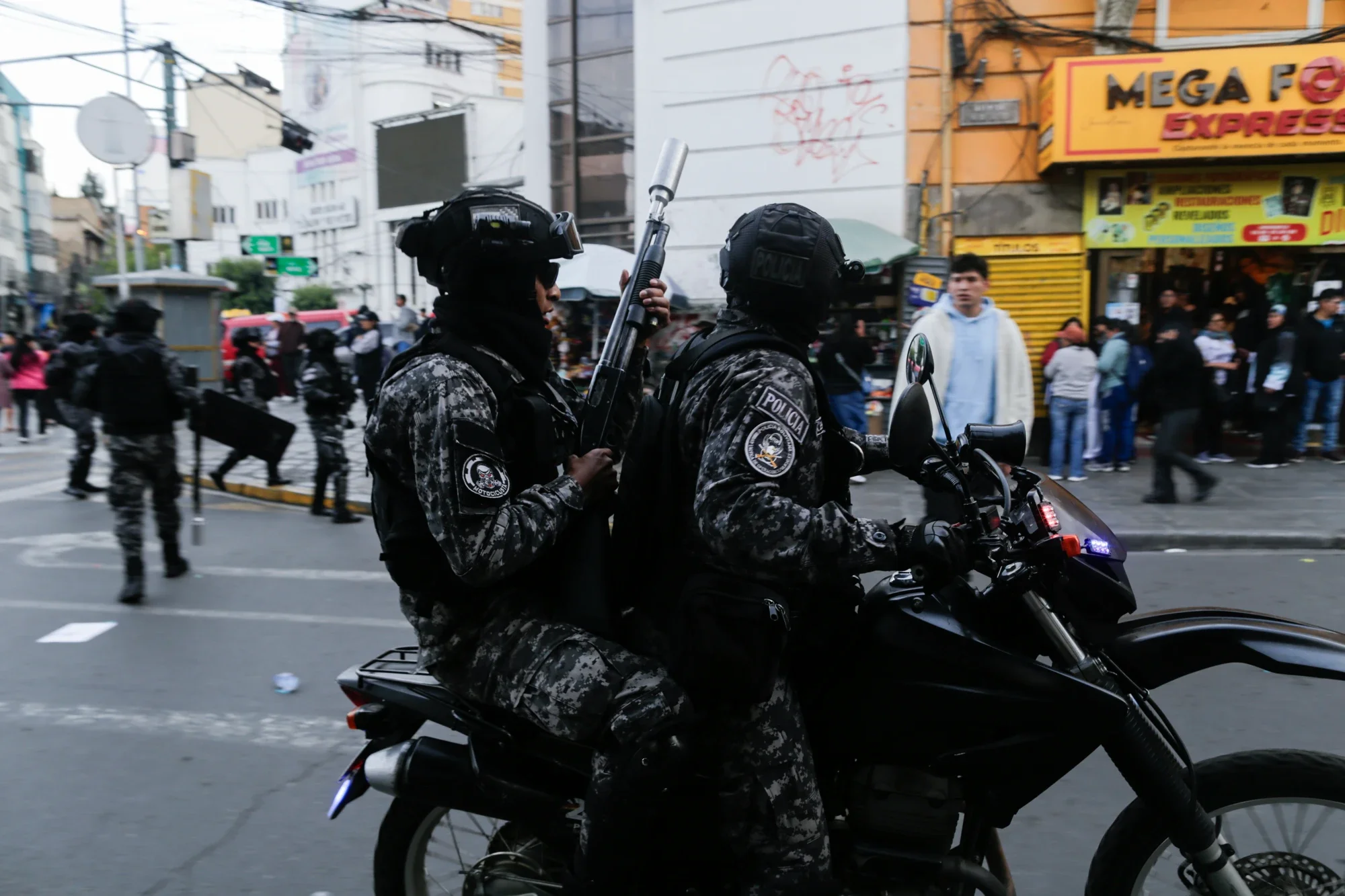
March in defense of public education in La Paz, Bolivia, on November 20, 2026 in La Paz, Bolivia. Photo © Josué Cortez.
With the 50-50 plan, the government wants to privatize education. That's why it's important to resist, because vulnerable populations—especially students in rural areas—will bear the brunt of the burden. They are the ones who attend technical institutes, since they generally cannot afford to go to universities.
If the system is decentralized, where will the burden fall? On the shoulders of the people. For all these years, while local government has been responsible for educational infrastructure costs, we haven’t received a single pencil.
The state doesn’t pay for electricity, water, or anything else. If the new measure is approved, the cost of tuition, registration fees, supplies, staff wages, and all other expenses will fall on the shoulders of parents, who will have to foot the bill for their children’s education. This means that many will have to give up their education and career training and will be forced to seek out very precarious jobs.
It also means that teachers will join the ranks of precarious workers in Bolivia. By shifting responsibility to departmental governments, there will be political quotas and job distribution based on political affiliation. Teachers will not be selected based on our abilities but on our party affiliation. That’s how city and departmental governments have operated, and the same thing will happen with education.
The type of contract teachers have prevents job insecurity and the kind of discretionary decision-making the government now wants to implement. In addition this measure aims to dismantle the organizations that defend our labor rights. It’s about undermining—completely weakening—the very fabric of labor unions.
CLP: Do you think the government is opposed to the political agency of the teaching profession?
EQG: The government’s attack on education is not a recent development. There have been gradual measures to first fragment unions, then discredit teachers' work, and finally implement decentralization.
I believe that being a teacher requires a strong commitment to self-education. It is a social commitment to children. You must have pedagogical skills and teaching tools. The teaching profession now requires us to meet postgraduate standards.
Now the government wants to return to mechanistic methodologies and pedagogies—to a traditional classroom model where students are confined within four walls.
A student learns from life, outside the classroom—from experiments, field trips, art, music, and physical education. Learning is entirely holistic and is complemented by extracurricular activities and experiences outside the classroom. Now those experiences are completely prohibited.
I believe the government’s measures aren’t isolated—they’ve been building up and are being implemented across all areas and sectors. Today, decentralization is reaching the teachers’ union.
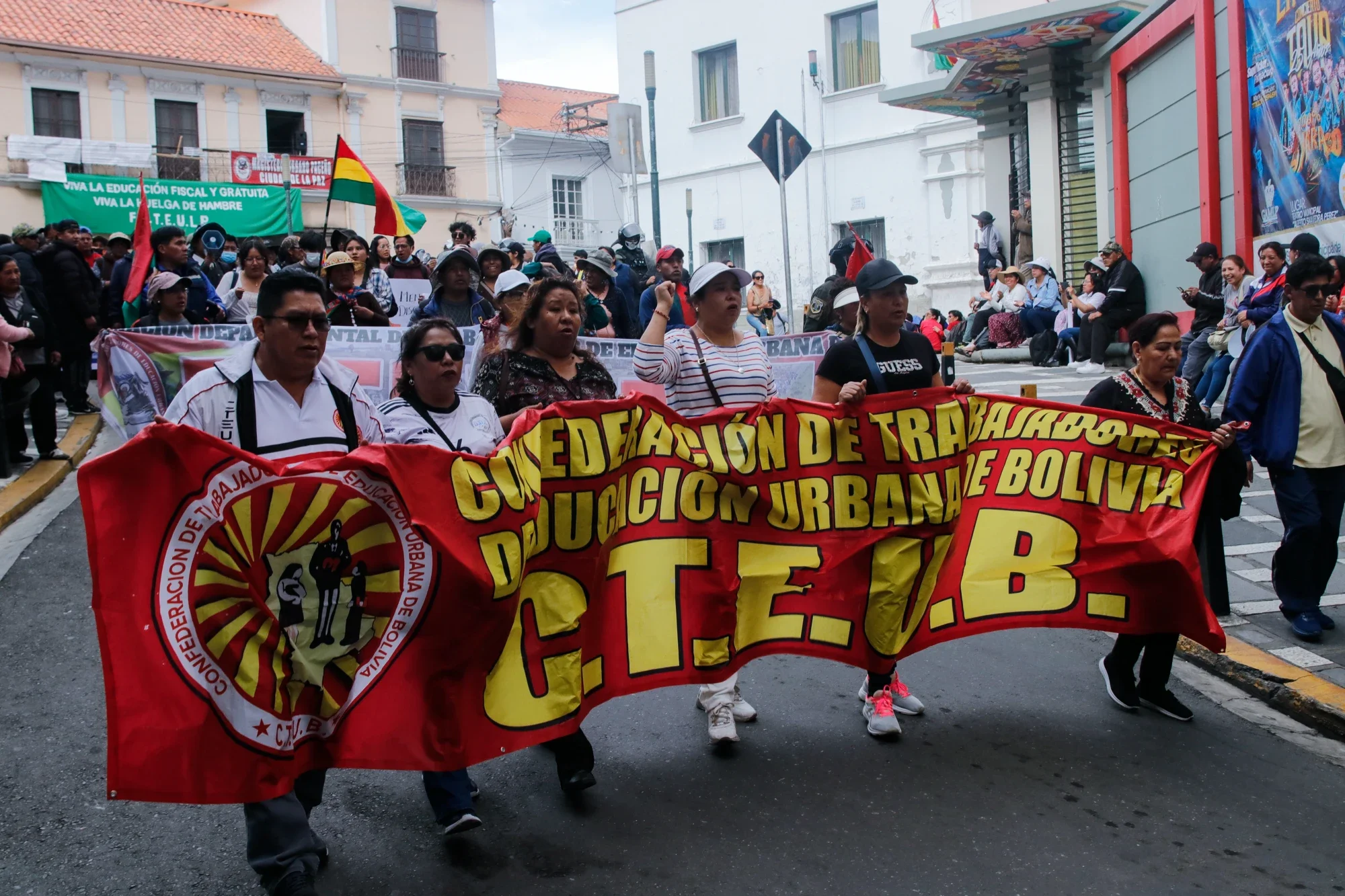
March in defense of public education in La Paz, Bolivia, on November 20, 2026 in La Paz, Bolivia. Photo © Josué Cortez.
CLP: What does this conflict open up on the horizon? What is being discussed?
EQG: I truly believe that crises also force us to rethink ourselves, reflect, and make new proposals. The teachers’ union is one of the largest labor organizations, and I think our duty as educators is to start to reconsider our role, not only as a sector but as a fundamental part of Bolivia’s transformation.
It’s important that we focus on how to rebuild a union in the current context, acknowledging our historical memory, but with the new realities we now live in, that we work to restore our organizational structure, horizontal governance, debate, assembly-based decision-making, and diversity. It’s a huge challenge, as is figuring out how to build alternatives to these attacks. For the right, the crisis is socialized while wealth is privatized.
These conversations are happening in schools right now. There’s also criticism of how unions have been run, corruption has been very destructive. That grassroots criticism is important for identifying new pathways to reorganization and for understanding what we’re going through. We must realize that it’s not just a matter of fighting for wages, much less a sector-specific struggle; rather, it’s also a struggle to defend education.
We must stop neoliberal policies that are anti-people and anti-working class. The main actors in education are teachers, children and young people. That is why we are fighting and will continue to mobilize until the government eliminates the measure—not just suspends it.
On Friday, November 20, 2026, urban teachers in La Paz held a national demonstration to protest the Rodrigo Paz administration’s educational decentralization plan. These powerful images are by photographer Josué Cortez.