

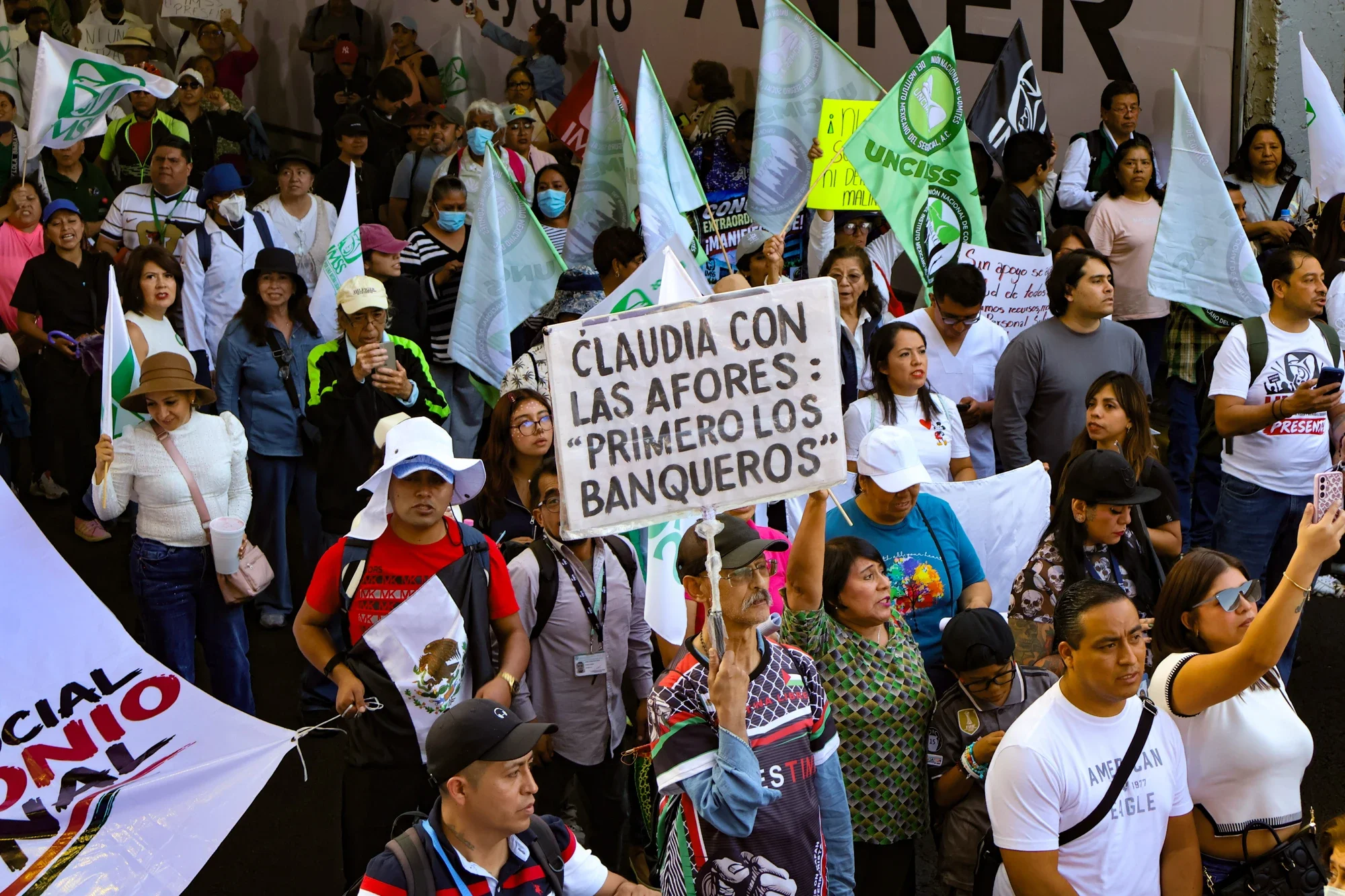
Workers condemn Claudia Sheinbaum’s alliance with the bankers who own the Afores during a march on October 30, 2026 in Mexico City. Photo © Norberto Soto Sánchez.
Opinion • Norberto Soto • November 19, 2026 • Leer en castellano
At 3 in the afternoon on October 13, around 30,000 workers from the Mexican Social Security Institute (IMSS in Spanish) joined their comrades from other sectors to march from the XXI Century National Medical Center to the IMSS headquarters on Reforma Avenue in central Mexico City.
I left work at the Public Education Ministry that afternoon, a little before 5 o’clock, and rushed to join the march. When I arrived, I was surprised by what I saw: thousands of people in different columns marching together, turning the streets into a river of protesters.
A diverse showing from working-class who are affiliated to the IMSS as workers and beneficiaries, was on the streets seeking dignified conditions in the public healthcare system. We are calling for a budget increase for the entire healthcare sector to 7 percent of GDP, labor justice, and a 10 percent increase in wages across the board at the IMSS.
We are also calling for the removal of Rafael Olivos Hernández as head of the National Union of Social Security Workers (SNTSS) due to his anti-democratic and pro-employer leadership, which is referred to in Mexico as charra or charril. We also want to democratize the union and end the current private pension regime that is managed at the behest of transnational capital.
Fighting for public services
The IMSS is one of Mexico’s federal public institutions tasked with guaranteeing the right to health, medical care, and social services for workers who are formally employed and their families. The majority of the IMSS workforce is employed in medical services.
IMSS workers have been subjected to many injustices by the federal government and by the leadership of the SNTSS, the union that represents them. The bureaucratic leadership of the SNTSS has failed to fight for better working conditions and resources that would allow IMSS workers to provide decent service to users.
Olivos Hernández—who is also a federal deputy for the ruling National Regeneration Movement (Morena) party—reportedly reached an agreement, behind the workers’ backs, with President Claudia Sheinbaum’s administration. Specifically, he struck a deal with IMSS Director Zoé Robledo for an overall wage increase of 6.8 percent, of which 2.9 percent applied to the base salary and 3.9 percent was distributed among various benefits.
The base salary is a core cash payment, while benefits are forms of support that management breaks down into various categories but which do not count toward retirement. This undemocratically negotiated pay increase is entirely insufficient.
There are also strong demands to change the pension system, currently controlled by the Retirement Fund Administrators (Afores). The Afores manage individual retirement savings accounts, which are reinvested in various types of projects by private national and transnational banking institutions.
Changing the pension system and the Afores has been a recurring theme in struggles that have been waged at different times under both administrations of the so-called Fourth Transformation—that is, those of Andrés Manuel López Obrador (AMLO) and Sheinbaum.
That is why state workers—both in education (through the National Coordination of Education Workers - CNTE) and in the energy sector (through the Mexican Electricians’ Union - SME)—as well as others organized in groups such as Queremos Trabajo Digno also took to the streets on October 13. We took to the streets again for another major demonstration held on October 30.
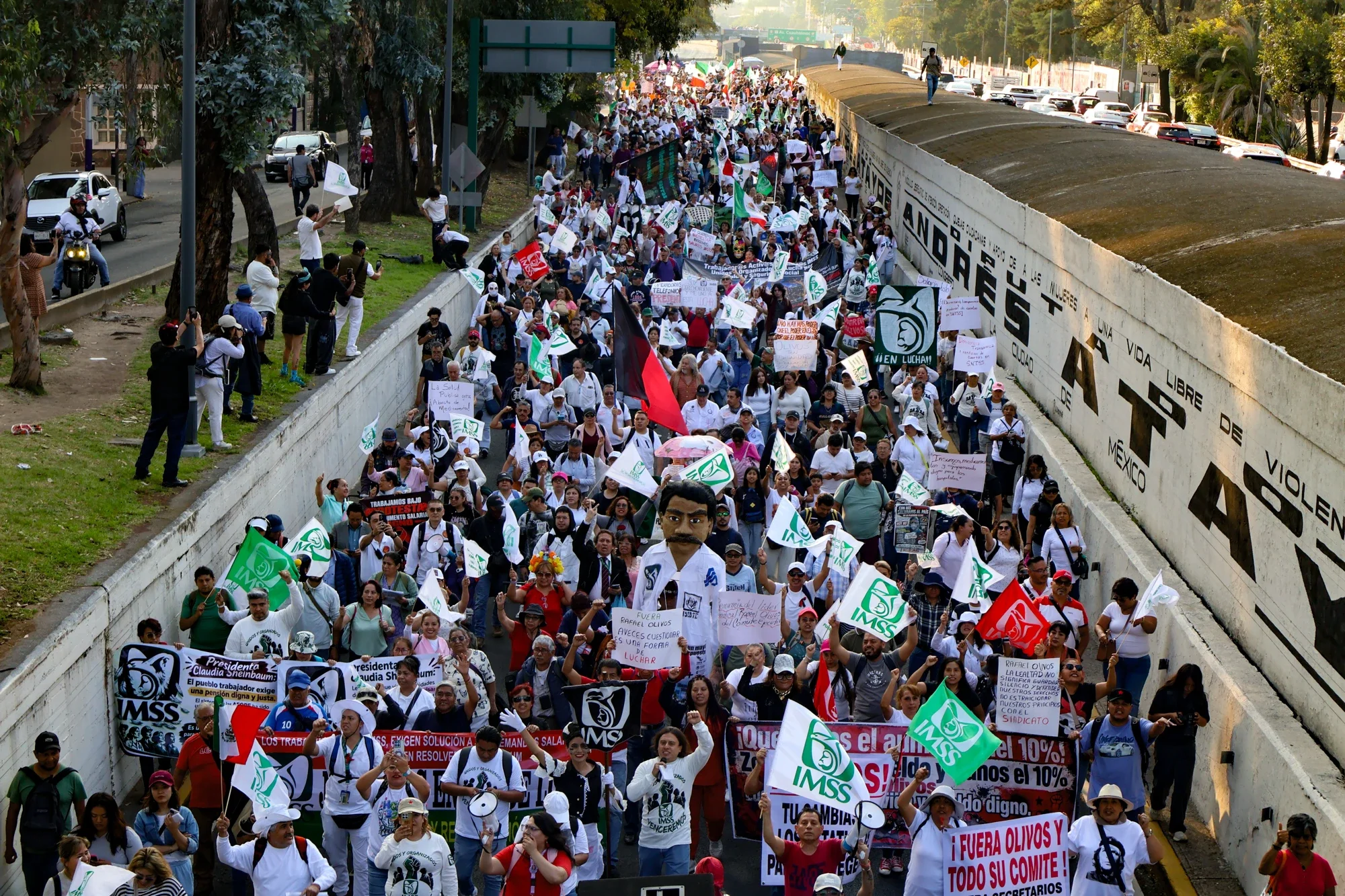
Working class dignity takes to the streets as part of a march in Mexico City on October 30, 2026. Photo © Norberto Soto Sánchez.
An intensifying protest cycle
Although we had expected a fairly positive response to the October 13 call to action, turnout exceeded all expectations. IMSS workers had been mobilizing since early October, key actions include marching on union headquarters on October 1 against corrupt leadership under Olivos.
On October 10, marchers suffered brutal repression at the hands of the Zorros Unit of the Mexico City Police on Reforma Avenue, where they were staging a blockade. To some extent, the increased turnout three days later stemmed from discontent sparked by that repression.
The current episode in the struggle of Mexican healthcare workers builds on the momentum of the protest cycle that began during the 2026 FIFA World Cup.
Attacks on the labor rights and the erosion of working conditions in Mexico’s public health system began to intensify in the 1990s, at the height of neoliberalism.
For workers affiliated with the IMSS, two moments are key: the creation of the Retirement Savings System in 1992 under Carlos Salinas, and the adoption of a new Social Security Law in 1997 under Ernesto Zedillo.
These two events marked the advance of an offensive against the working class that governments had to carry out gradually so as to mitigate resistance.
These changes put an end to a solidarity-based, intergenerational pension system that guaranteed a fair and dignified retirement, based on the worker’s full, final salary. In its place, a system of individual accounts administered by the Afores was imposed, drastically reducing workers’ monthly pensions precisely at the age when healthcare costs become most pressing.
At the outset of his six-year term, the AMLO administration promised that the 1997 pension reform and the 2007 ISSSTE reform would be reversed. That promise went unkept.
What the Fourth Transformation implemented instead was a Welfare Pension Program. It’s a supplemental but insufficient, form of social assistance from the state to people over 65. While it is a universal benefit, it provides a mere 3,200 pesos a month, equivalent to about $172.50. The government also established a separate Welfare Pension Fund, the scope of which remains unclear. It is not universal since it requires meeting complex eligibility criteria and is subject to annual budgetary allocations.
These supplementary schemes are administrative maneuvers carried out by both López Obrador and Sheinbaum to avoid confrontation with the banks that manage the Afores. In practice, they contradict the promises made during their presidential campaigns.
Decades upon decades of job insecurity, budget cuts, and repressive tactics aimed at controlling unions in various state sectors persist despite the progressive rhetoric of the Morena governments. This is what has sparked recurring protests that have intensified since 2024, with strikes and sit-ins organized by the CNTE and other organizations.
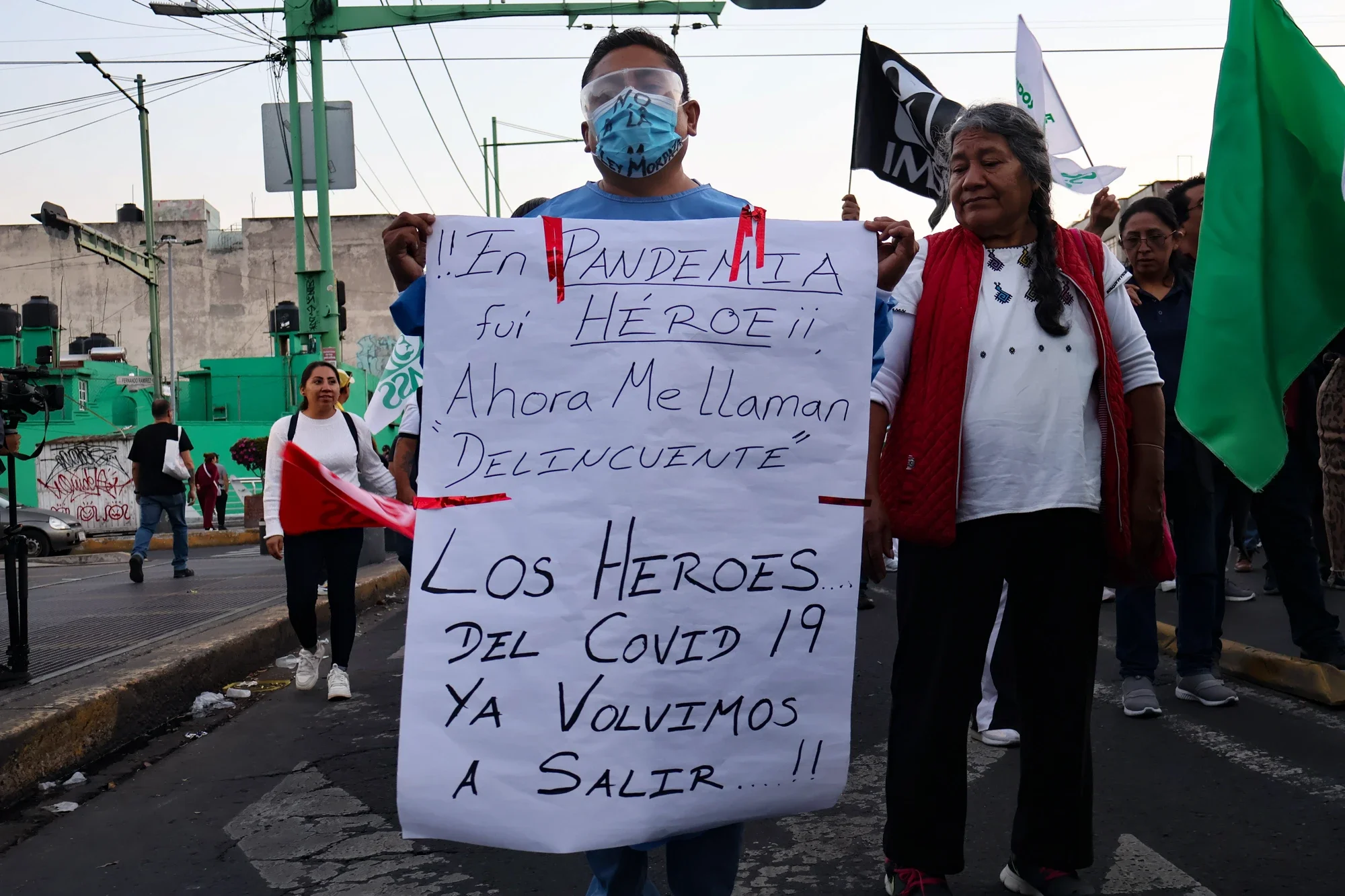
The COVID heroes are back on the streets, pictured here during a march on October 13, 2026 in Mexico City. Photo © Norberto Soto Sánchez.
Against neoliberal continuity and right-wing opportunism
On October 21, right-wing opposition figures from the National Action Party (PAN)—including its president, Jorge Romero, and federal deputy Kenia López—arrived at the IMSS sit-in seeking to opportunistically piggyback on the movement.
Both were kicked out by rank-and-file workers, who have not forgotten that former PAN presidents Vicente Fox and Felipe Calderón encouraged the adoption of the neoliberal measures in the health sector that the movement is fighting against.
The priorities of the Morena governments are evident through the numbers: from 2025 to 2026, the Ministry of National Defense budget increased by 7.9 percent, while the Ministry of Health suffered a 3.2 percent reduction.
Worker protests have taken place in the capital and in 17 other states, with collective actions in Puebla, Nuevo León, Jalisco, and the State of Mexico, to name a few.
The rivers of people in white coats that flooded the streets on October 13 and 30 indicate an outpouring of anger against the injustices imposed by capitalism, an anger that can fuel various forms of organization to defeat capital.
In Mexico City, sporadic protests outside the President’s morning press conference are ongoing, and there is a march convened in Puebla on Saturday, November 21.
No police crackdown with tear gas, baton blows and encirclement tactics like those we saw on October 10, nor any criminalization campaigns, will defeat the dignity of the working class as it strives to determine its own destiny—especially when so-called progressive governments back down in the face of financial and imperialist capital.