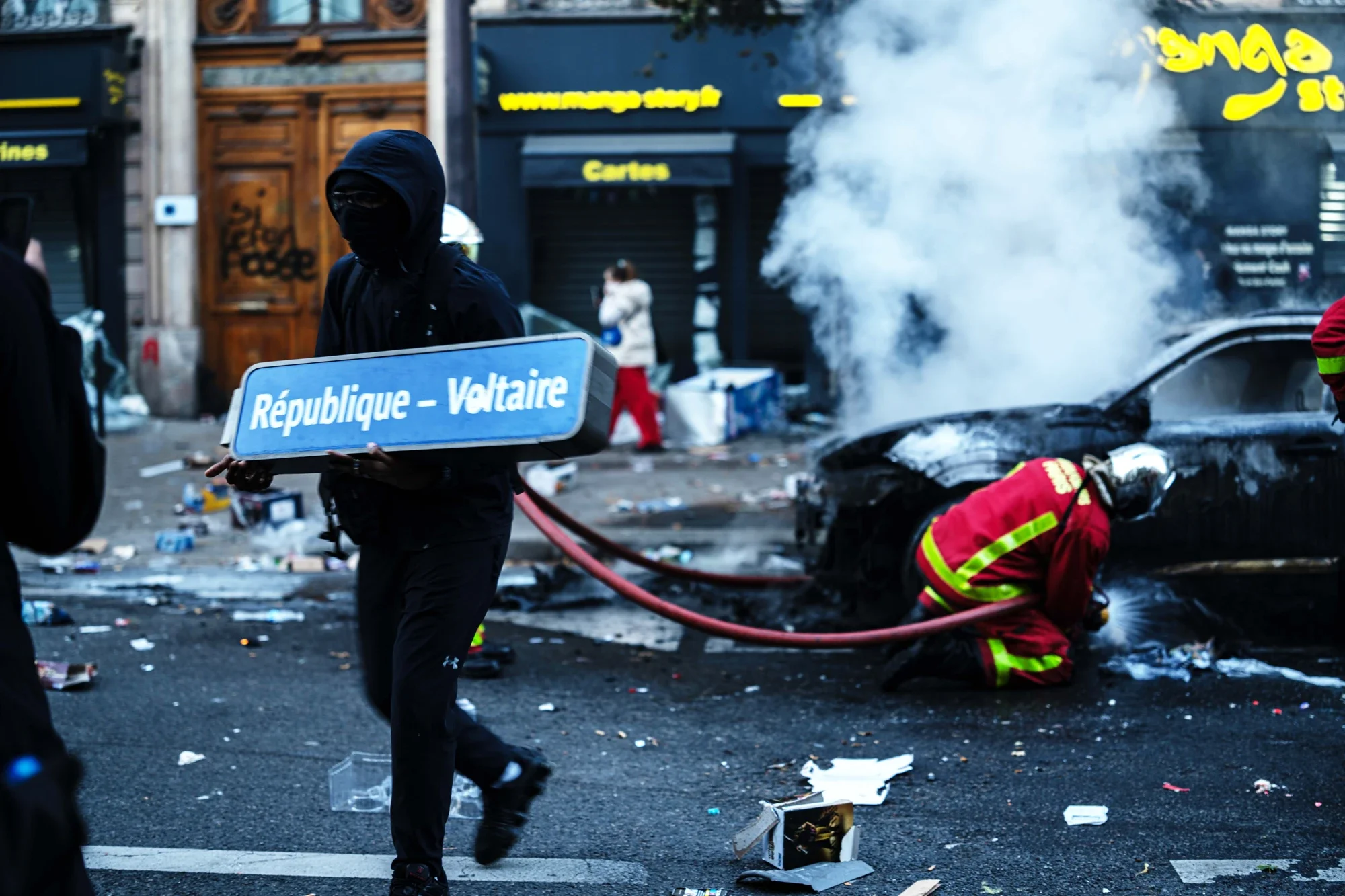
Manifestantes con un cartel de autobús de la estación République – Voltaire en París, el 17 de octubre, 2026. Foto: JJxFile, Jorge Jaramillo, CC BY 4.0, vía Wikimedia Commons.
Interview • Gavin Jacobson • November 13, 2026 • Leer en castellano
Throughout October and into the first weeks of November, French youth have mobilized time and again before the eyes of the world. Assemblies and heated debates in high schools and universities, occupy actions, and widespread demonstrations have been taking place daily in a decentralized manner for weeks now. There is a strong sense that normalcy has been shattered.
Following the intense unrest on Saturday, October 17, the slogan that gives this article its title has resonated with us: “We are the children of the Algerians you didn’t drown.” These words point to a certain dialogue with the Latin American feminist movement, echoing the well-known slogan that resonated across the region in countless protests: “We are the granddaughters of all the witches you could not burn.” At the same time, it revives and weaves together the memory of October 17, 1961, when police massacred Algerian pro-independence demonstrators in Paris.
To shed light on less visible aspects of this vast spectrum of civil disobedience and mobilization led by French youth, Ojalá is featuring an excerpt from an interview with Chowra Makaremi and Michel Feher, conducted by Gavin Jacobson for Equator magazine and translated into Spanish by the team at La Laboratoria. The original full interview can be found here, and its Spanish translation here —Editors
Gavin Jacobson: What’s the mood in Paris right now?
Chowra Makaremi: I’m speaking from EHESS, a university occupied by students and closed like most others right now. In some ways, it reminds me of the testimonies I collected during the Woman, Life, Freedom uprisings in Iran. People would describe daily life as feeling completely normal, even while vibrant demonstrations filled television screens. We’re living in a double temporality: on one side, the rhythm of demonstrations—about four in the last two weeks, peaking on 17 October; on the other, the rhythm of the everyday, saturated by a media discourse centered on police responses and moral panic over the riots.
While there are new dynamics at play in this moment of political ferment, there are also echoes of recent struggles and indignations, all now resonating together—whether it’s the global student movement against the Gaza genocide in 2024, the 2023 riots in working-class neighborhoods over the police murder of Nahel Merzouk, or the “eco-anger” in working-class districts that were hit hardest by the recent heatwaves.
Finally, the unaddressed demands of the Gilets Jaunes, stifled by Covid-19 but never resolved, are resurfacing. Although the left emerged as the largest parliamentary bloc after the 2024 legislative elections, this never translated into representation or institutional power. Now, high school students who were only eight to 10 years old at the peak of the Gilets Jaunes are chanting their slogans.
Michel Feher: I think the situation is in a temporary lull. What’s at stake right now is a radical clash of interpretations over the events of 17 October.
For the government and the mainstream media, the narrative is entirely about “senseless violence”. [President Emmanuel] Macron echoed the former Prime Minister Manuel Valls, who, after the 2015 terrorist attacks, said that “To try to understand is already to justify, and this is unjustifiable.” The implication is that while the protestors might theoretically have legitimate grievances, we can’t discuss them because the violence eclipses everything else. The only acceptable response is police force, curfews, and the threat of a state of emergency — if only to calm the anxieties of the bond market vigilantes.
Marine Le Pen has been more subtle. She separates “violent youth from racialized neighborhoods” from “good students” with legitimate grievances, while offering a platform that criminalizes the former but fails to address the latter. Her narrative blames government incompetence and demands even harsher crackdowns, especially against the racialized youth that she blames for the unrest.
The left, meanwhile, is caught in a bind. On the one hand, the high school movement, university students, and Gilets Jaunes seemed to point toward the long-sought “convergence des luttes”. More importantly, perhaps, the genius of this current movement was its joyfulness and its core demand: we want to study in order to build a desirable life.
Contrast that with the National Rally’s vision—shortening education to fast-track youth into low-skill jobs before AI replaces them— or Europe’s project to turn the continent into a fortified retirement home. When youth demand a desirable life, it offers the left an opening: to campaign on making that life possible and rallying parents against the National Rally’s bleak future.
The tactical dilemma for the left after [October 17] is stark. Either it calls the protesters peaceful and blames a violent fringe, which plays into Le Pen’s hands by dividing “good” (coded white) protesters from “barbaric” rioters. Or it justifies the violence as understandable rage, which strips the movement of its core power (joy and the demand for a desirable life) and reduces it to anger against existing conditions.
GJ: Anglophone liberals like to say these riots discredit the French left and give strength to Le Pen. Does that reading seem correct to you?
CM: There is a tendency to treat uprisings of any kind as mere gifts to the far right. This makes the protestors responsible for how others weaponize their anger. It’s a convenient trap: blame those who rise up for how political elites manipulate their anger and desire for change.
This movement is about much more than rage — it is an experience of active citizenship and political subjectivation. Its energy is driven by youth. High school and university students are coordinating across the baccalauréat divide: because high schools are currently on break, university students are maintaining the momentum until secondary students return.
Through this shared struggle, high schoolers and undergraduates recognize themselves as part of a single continuum. A major driver of this unity is Parcoursup, the platform using opaque algorithms to assign university placements to high school applicants. The system dictates students’ choices and daily lives, replacing meaningful qualifications with algorithmic conformity based on grades, subjects, and extracurriculars. This is creating generational anxiety and comes amid a severe youth mental health crisis in France, where pediatric psychiatric wards have been overwhelmed since Covid-19.
The students are confronting police repression and crumbling school infrastructure, and they are rejecting forms of algorithmic control. Media coverage heavily distorts this: 75 percent focuses on violence, ignoring their articulate demands on public defunding, the rule of law, ecological survival, antiracism and Palestine. Online, thousands of micro-confrontations on social media capture the true political stakes that corporate media erases.
One striking slogan from 17 October adapted the famous feminist line “We are the granddaughters of the witches you couldn’t burn” into: “We are the children of the Algerians you didn’t drown in the Seine in 1961”. Antifascism is central here, too—“Siamo tutti antifascisti” has become the defining soundtrack of these protests.
When students mobilized for basic needs, the government responded with patronizing “adultism”, telling them to go back to class. This mirrors grassroots movements like Cancer Colère (linking hospital defunding, oncological violence and environmental toxins), showing how bottom-up resistance is building a coherent democratic alternative against fascistization.
GJ: How does the framing of suburban populations as uncivilized enable the state to deploy methods of order originally reserved for colonial territories or external borders?
CM: The police response to legal demonstrations has been violent, utilizing military-grade weaponry. By unleashing this level of force against nearly a million peaceful marchers, the state effectively clears the streets of regular demonstrators, who are forced to flee for their safety, leaving behind only rioters engaged in violent confrontations. The human toll is immediate: protesters losing limbs, being blinded or suffering beatings.
We need to view the security response not merely as a reaction, but as a central protagonist shaping the entire situation. The state’s management of protests actively dictates how events are framed.
This represents an extraordinarily radicalized, repressive response, extending to society at large [with] forms of policing developed against colonial and postcolonial subalternised populations, especially given that today’s movement spans a broad demographic, including high schoolers, university students, trade unionists, teachers, parents and Gilets Jaunes.
While French justice claims to be colour-blind, enforcement is deeply racialized: your demographic profile dictates whether a minor infraction, like cannabis possession, lands you in a fast-track court and, once there, the probability of receiving a prison sentence.
This strategy —a legacy of 20 years of dismantling the welfare state in favor of a security state— produces a demographic profile of “rioters” tailored to fit the National Rally’s political discourse.
Finally, this security apparatus relies heavily on colonial tools and strategies: curfews, mass detentions, and military-grade crowd-control gear, including water cannons and tear gas grenades, the same types of technologies deployed in occupied territories like the West Bank.