


A group of protesters read their demands and pose with signs in front of the Pemex pyramid in Villahermosa, Tabasco, on October 9, 2026. Photo © Josue Leal.
Opinion • Josué Leal • November 5, 2026 • Leer en castellano
The afternoon was cloudy, with a cool breeze moving through the tropical heat, but instead of being refreshing, the breeze carried the stench of hydrocarbons, an odor that makes eyes water and noses run. With that awful smell hanging over them, on Friday, October 9, people organized and gathered at the iconic pyramid-shaped headquarters of Petróleos Mexicanos (Pemex), located in downtown Villahermosa, the capital of Tabasco state.
The office, with its glass walls shaped in a manner reminiscent of great Mayan architecture, serves as the company’s administrative hub in the state and coordinates the state-owned oil company’s national operations.
Pemex has played a crucial role in Tabasco’s urban and economic development since the 1970s, following the discovery of oil wells in the Gulf of Mexico. It has built an industry centered on oil, which is Tabasco’s main source of economic revenue.
To put the oil company’s role into perspective: this year Pemex allocated over seven billion dollars to extraction projects in Tabasco—more than double the federal funding the state will receive for public welfare programs.
Tabasco produces wealth that is extracted and monetized outside the state. The local production chain is stifled by extractive investment and debt that Pemex never pays to its private contractors and partners, who employ local workers.
Now, this problem is also reflected in the environmental issues caused by Pemex’s gas flares, known locally as mecheros, which are used to burn off excess gas and have become a constant source of health and environmental concern for the residents of Villahermosa the surrounding area.
Environmental advocacy groups, and especially the Villahermosa Urban Observatory, called on the people of Tabasco to demand answers and take action to improve the quality of life and the air they breathe.
A city of flares
The heavy, pungent, sulfur-like smell comes from the gas and oil burned in the gas flares, towers of fire resembling the Eye of Sauron, which are located on the outskirts of Villahermosa. At night, they turn the sky red, causing severe light and air pollution.
The flares release pollutants such as benzene, soot, sulfur oxides, and methane, all of which affect air quality. A study conducted by the Mexican Center for Environmental Law and CartoCrítica found that high exposure to gas flaring is associated with serious increases in the risk of chromosomal abnormalities, congenital malformations, and premature births.
The Agave flares are the most notorious in Villahermosa. They are part of a complex consisting of three industrial flares that’s very near to the city and that generates the most direct controversy locally.
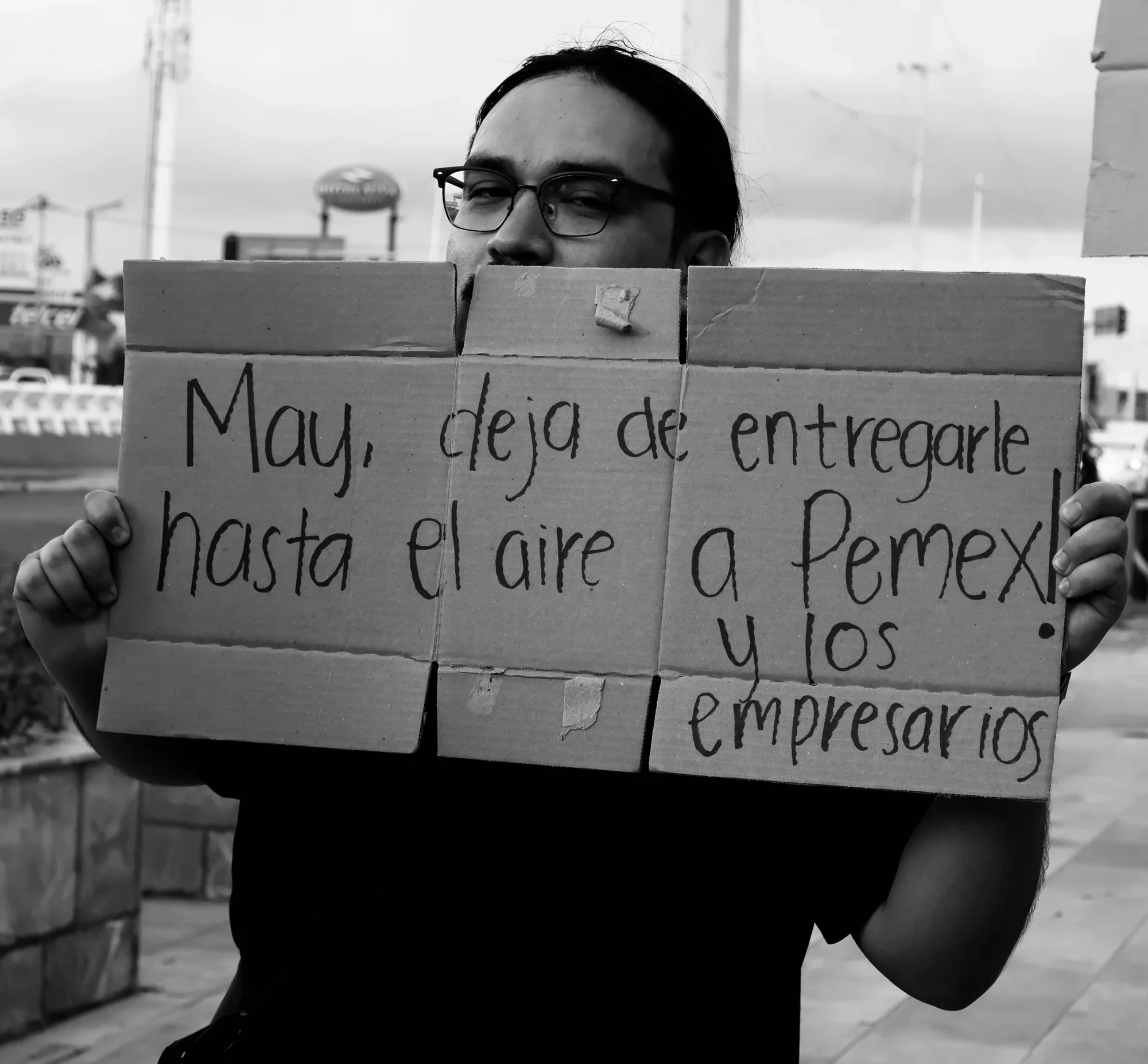
A protester holds up a sign reading “May, stop giving away even the air to Pemex and the business owners,” alluding to the governor prioritizing economic interests over the well-being of people and the environment in Villahermosa, Tabasco, on October 9, 2026. Photo © Josue Leal.
There are other flares in the Teapa-Centro corridor, located just a few meters from residential areas in the southern part of the municipality of Centro. These four flares directly impact more than 5,000 people in communities adjacent to the capital.
In Villahermosa, the stench became so strong and persistent that some elementary schools were forced to cancel classes. Roadblocks were set up to pressure the authorities to act, actions which were a precursor to further organized efforts and protests by those affected.
Fire from above and below
Governor Javier May Rodríguez, of the ruling National Regeneration Movement Party (Morena), claimed emissions from Pemex’s flares do not pose a health risk to people living nearby.
In response to complaints and protests from citizens, May said conditions are being continuously monitored in coordination with the state-owned company to detect any situation that could endanger the communities.
The ruling party’s version of events is the classic “nothing bad is happening, and we’re keeping an eye on everything.” Regardless, environmental groups and residents from many different walks of life organized via social media to demand answers and meaningful action. That is why, on the afternoon of Friday, October 9, they gathered and read their demands.
“Tabasco is a land blessed with fertility and wealth everywhere. But the people of Tabasco have been victims of unfair, violent, and cynical treatment by Petróleos Mexicanos for several decades,” said Clio Canudas, a member of Villahermosa’s Urban Observatory. “We want signed commitments, not verbal agreements. We won’t wait until next year. These gas flares must be shut down immediately and permanently.”
After reading the demands, collective members and others who took the time to fight for their quality of life hung a banner with various demands.
Protesters set up a charcoal barbecue at the building’s main entrance, where they roasted chili peppers so officials could physically feel what people have been experiencing, intending to teach disinterested public servants a lesson.
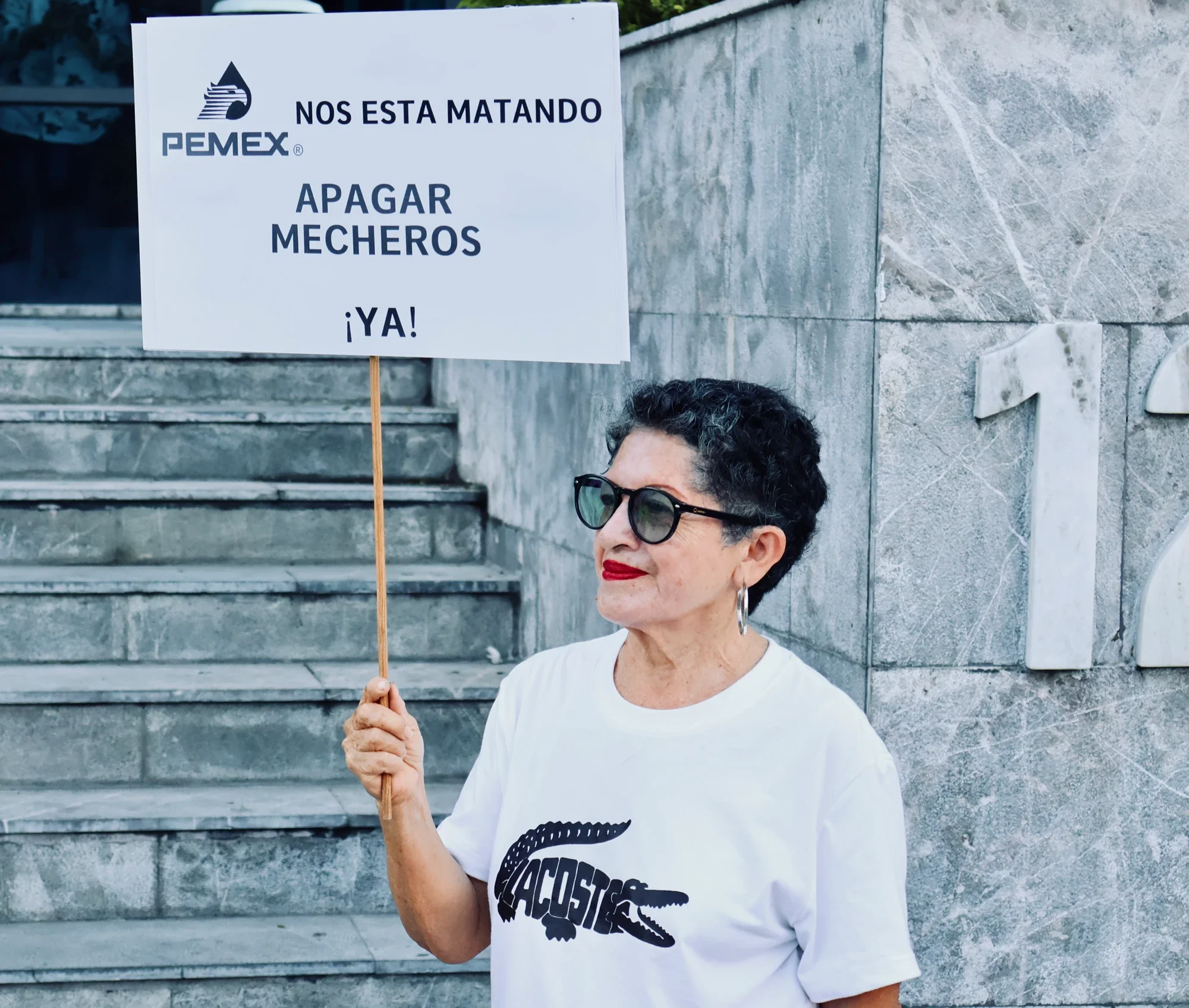
A protester holds up a sign demanding the immediate shutdown of flares, reflecting the concern shared by all sectors of the Tabasco population in Villahermosa, Tabasco, on October 9, 2026. Photo © Josue Leal.
People in this region are forced to endure so-called progress, in which proceeds end up in the pockets of a select few while the poor and the marginalized suffer and endure the stench of death.
This small act of protest, which brought together about three dozen people, was met with harassment from state forces, very much in keeping with how power is organized. Soldiers blocked the entrance to Pemex HQ and filmed the folks at the protest, while unidentified government workers snapped photos left and right of those in attendance.
Pemex offered no response following the protest at the pyramid.
Fighting for air
The small group in attendance that day was a testament to the power of organization, something sorely needed in a state that has not been known for organizing grassroots movements. Given the current situation in Mexico and around the world, their actions are a much-needed sign of defiance against environmental destruction and institutional silence.
It is our future, the future of people from below, that we must defend.
Using progress as an excuse, elites seek to destroy our most basic and vital resources: land, water, and now air, poisoning the people in order to uphold the system. But the people have said “basta,” and are now organizing. This must continue until the dream of a better world becomes a reality for everyone—not just a select few.
We want to breathe clean air. Progress that cannot be achieved without “sacrifice zones" or collateral damage is nothing to boast about. Necropolitics must be eradicated; the benefits should belong to everyone.
In these times, when the debate over the climate crisis and the transition to renewable energy seems to have died, we must work to rekindle the spark of critical thinking and land defense. Transnational corporations and fossil fuel companies do not want their profits touched, which is all the more reason for the people to say no. It is not worth sacrificing our world for their world of money.
I hope the memory of the smell of the burning chili peppers brings tears to our eyes and calls us to action.
